
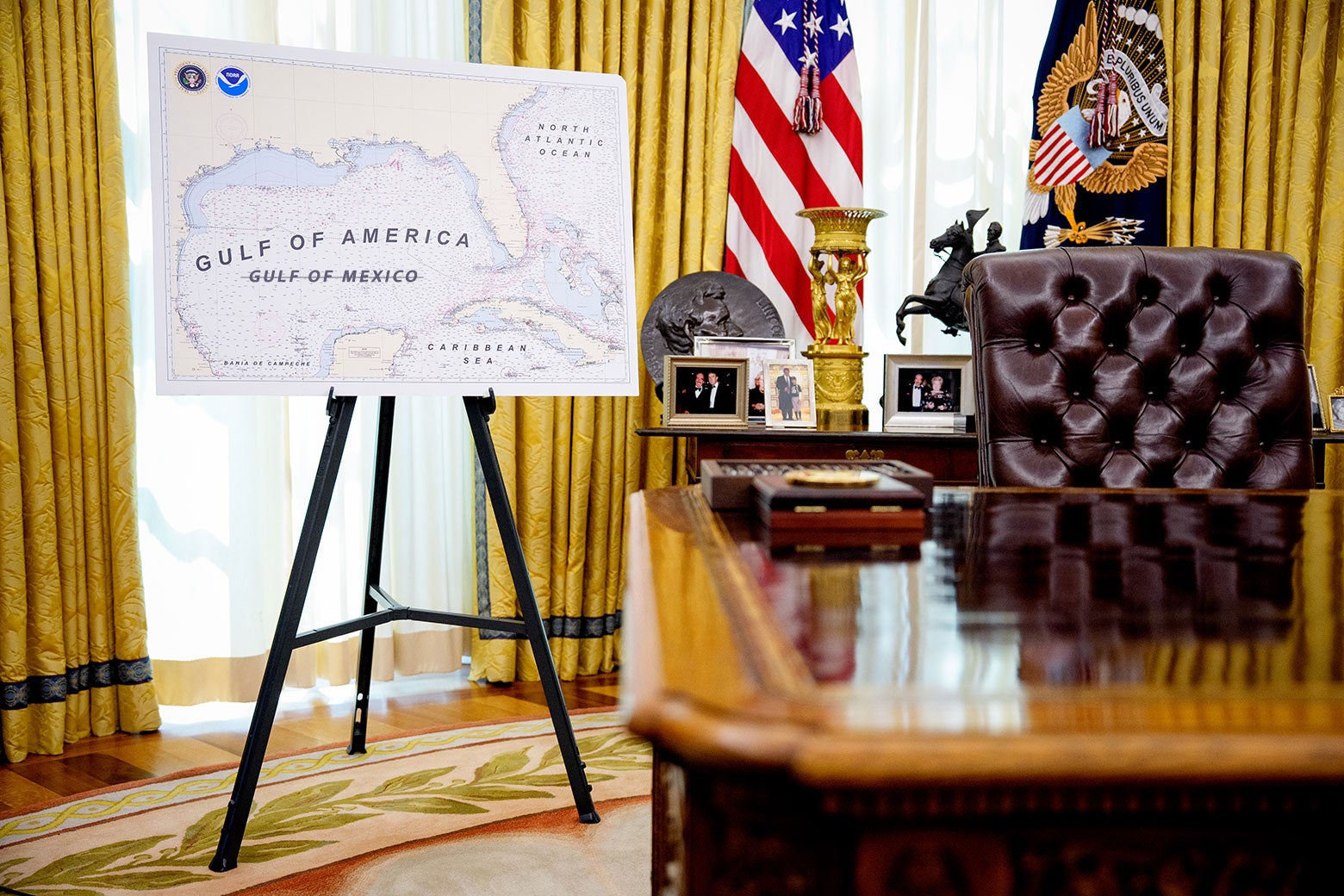
Jurisprudence Photo illustration by Slate. Photo by Andrew Harnik/Getty Images. Sign up for Executive Dysfunction, a weekly newsletter that highlights one under-the-radar story about how Trump is changing the law—or how the law is pushing back—and keeps you posted on the latest from Slate’s Jurisprudence team. In academic discourse, use of the correct name is an important means of establishing professional credibility. For example, if within the fields of computer science and information science, a specific term of art, such as artificial intelligence, has gained widespread acceptance, the use of an alternative term—a term, like superintelligence, not widely accepted within the discipline—would seriously undermine the credibility of academic work (and the author’s more general standing within the field). President Donald Trump has notoriously attempted to rechristen the Gulf of Mexico as the “Gulf of America.” So too has he attempted to rename Lake Ontario to “Lake America,” and he is threatening to fashion new MAGA names for an ocean, a major river, and the state of New Mexico. Trump also recently signed an executive order requiring all federal government programs and communications to use the terms superintelligence and S.I. rather than the broadly accepted nomenclature artificial intelligence and A.I. One might shrug all of this off and say, “Well, so what? It’s a free country, and all of us can still use the generally accepted names of places (Gulf of Mexico) and things (A.I.).” Unfortunately, after Oct. 1, 2026, this is no longer the case for academics at state-sponsored colleges and universities in Alabama. H.B. 2 officially bans the use of the phrase Gulf of Mexico by any and all state employees. As a professor at the University of Alabama School of Law, I find this appalling. This bizarre law provides that “all state and local entities and their employees shall be required to … [r]efer to the body of water that borders the coast of Alabama as the ‘Gulf of America,’ ” including “in all newly created maps, documents, educational materials, websites, official communications, and other resources.” Section 3 contains a limited exception to this general rule: “Nothing in this section shall prohibit a public K–12 school or public institution of higher education from using the term ‘Gulf of Mexico’ within a larger course of academic instruction when reasonable for historical purposes.” Imagine, for a moment, a marine biologist at Auburn University preparing to present research at a major global academic conference on the marine mammals of the “Gulf of America”? Or a geologist at the University of Alabama writing about oil deposits in the “Gulf of America” in a scholarly research paper? H.B. 2 plainly renders unlawful the use of the term Gulf of Mexico in any and all professional endeavors, including teaching and scholarship, save for using the generally accepted name within national and international academic discourse solely for “historical purposes.” This is bad enough, of course, but future legislation could compel Alabama’s public college and university professors to abjure using Lake Ontario or artificial intelligence in both their classrooms and academic publications. Moreover, Trump’s “superintelligence” executive order significantly raises the stakes for compelled academic speech and does so on a nationwide basis. The federal government sponsors billions of dollars of academic research annually. Now government-funded research into A.I. will presumably require grant applicants to use the term superintelligence in both their grant applications and subsequent published research. (It bears noting that the leadership of Facebook and X, Mark Zuckerberg and Elon Musk, dumped artificial intelligence in favor of superintelligence in recent quarterly earnings calls with investors.) Efforts to control speech in Alabama’s educational institutions constitute just one part of a larger national effort to standardize speech and, by necessity, thought. Happily, however, the First Amendment not only protects the use of particular words but also extends to a person’s choice of language. Government efforts to compel speech are facially inconsistent with the First Amendment. Cohen v. California, which blocked California’s effort to criminalize the use of the word fuck in public, clearly establishes this rule. Writing for the Cohen majority, Justice John Marshall Harlan explained, “We cannot indulge the facile assumption that one can forbid particular words without also running a substantial risk of suppressing ideas in the process.” The power to control words involves the power to control thought, and “governments might soon seize upon the censorship of particular words as a convenient guise for banning the expression of unpopular views.” Cohen squarely forecloses government efforts to ban the use of particular words—presumably including Gulf of Mexico, Lake Ontario, and artificial intelligence. Under the First Amendment, neither the federal nor state government possesses the constitutional authority to put words in the mouths of citizens. Instead, the First Amendment “is designed and intended to remove governmental restraints from the arena of public discussion, putting the decision as to what views shall be voiced largely into the hands of each of us,” and this holds true “because governmental officials cannot make principled distinctions in this area.” What is true generally for all Americans has special force in the context of education. As Justice Felix Frankfurter explained, in his concurring opinion in Wieman v. Updegraff, “to regard teachers—in our entire educational system, from the primary grades to the university—as the priests of our democracy is therefore not to indulge in hyperbole.” But teachers, at all levels of our educational system, “cannot carry out their noble task if the conditions for the practice of a responsible and critical mind are denied to them.” Accordingly, “they must have the freedom of responsible inquiry, by thought and action, into the meaning of social and economic ideas, into the checkered history of social and economic dogma … to assure which the freedoms of thought, of speech, of inquiry, of worship are guaranteed by the Constitution of the United States against infraction by National or State government.” Forcing computer scientists to use the term superintelligence in federally sponsored research or environmental scientists to use Gulf of America in their teaching and scholarship squarely violates both general free speech principles and the more specific First Amendment protection afforded to academic freedom. The federal courts should move swiftly and decisively to end Orwellian experiments in government-compelled academic Newspeak. As Justice Anthony Kennedy noted in U.S. v. Alvarez, “our constitutional tradition stands against the idea that we need Oceania’s Ministry of Truth.” College Donald Trump Education Jurisprudence Supreme Court Judiciary
I’m a Professor in Alabama. We’ve Been Banned from Saying “Gulf of Mexico.” No, Seriously!
Full Article
Original Source
Read the full article at Slate →KhanList aggregates and links to publicly available news content. We do not host full articles from third-party sources. Always verify important information with original sources.