
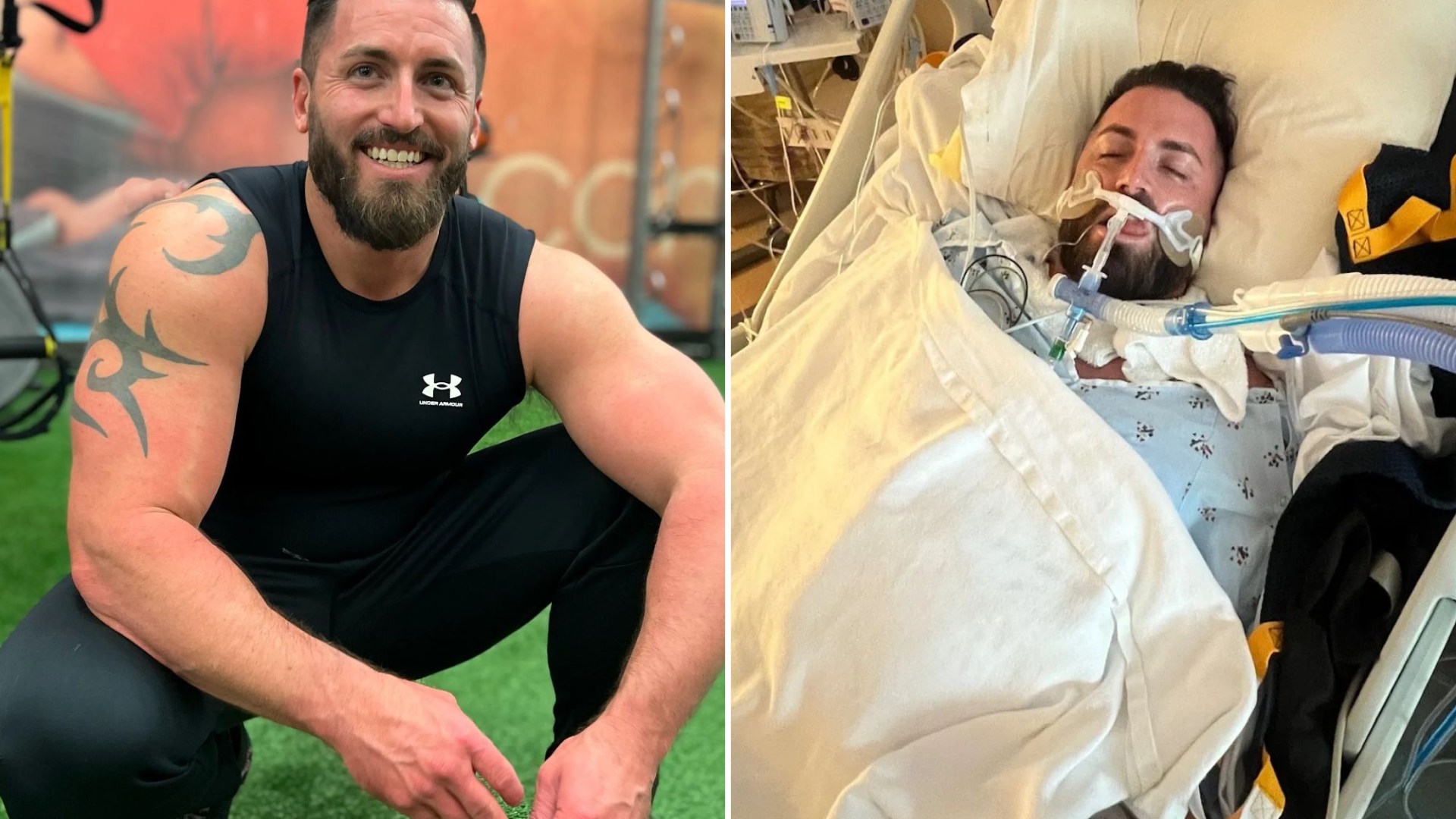
A DAD has shared the terrifying story of how his neck-cracking habit was linked to a health scare that left him fighting for his life. Donald McAvoy, known as Frue, regularly cracked his neck to relieve stiffness, but he had never considered it to be a dangerous habit. Donald McAvoy, known as Frue, used to regularly crack his neck, not knowing there was anything wrong with the habit Credit: Jam Press/@fruefitness Pictured with his wife Rachel, Frue has shared how the habit was linked to a health incident that changed his life forever Credit: Jam Press/@fruefitness The gym boss, 38, was fit and healthy until he began suffering from persistent neck and back pain, so he decided to visit a chiropractor. In one session, his neck was adjusted and Frue said it became “extremely sore” afterwards, so he kept cracking it himself to try and ease the discomfort. Sign up for the Health newsletter Thank you! Then one day in December 2023, the dad-of-one was eating at home when he began choking and started losing his vision. He was rushed to hospital where doctors told him he had suffered multiple strokes following a tear in one of the arteries supplying blood to the brain – which they believe was associated with neck cracking. Speaking about the habit that changed his life, Frue said: “I would occasionally crack my own neck whenever it felt stiff or sore. “It wasn’t something I thought was dangerous. I’d been doing it for years. “If someone had told me that neck manipulation or forceful neck cracking could, in rare cases, contribute to a vertebral artery dissection, I would have been much more cautious. “I simply didn’t know. It was the most frightening experience of my life.” Most read in Health Neck cracking, or manipulation, is generally considered safe if it is performed by a trained and licensed professional. But in rare cases, the movement can lead to a tear in the vertebral artery dissection – an artery in the neck – which can cause a stroke if a blood clot forms and blocks blood flow to the brain. Doctors say Frue’s neck cracking was linked to a tear in an artery in his neck, which caused him to have multiple strokes Credit: Jam Press/@fruefitness Frue had to spend 24 days in intensive care after he was rushed into hospital Credit: Jam Press/@fruefitness The early symptoms of this tear may include neck pain and a headache, although the signs can be subtle. Stroke due to vertebral artery dissection can cause paralysis in some instances. Describing what happened, Frue, from Jacksonville Beach, Florida, said: “In the weeks leading up to my stroke, I had been seeing a chiropractor for back pain, and during those visits I was also having my neck adjusted. “After one particular adjustment, I went home and just didn’t feel right. “My neck became extremely sore and stayed that way for weeks. “I continued cracking my own neck because I was trying to relieve the pain and stiffness.” But everything changed when the dad was eating while watching football one day and he started choking. He said: “Once the food cleared, my eyes rolled back, my vision disappeared, and I immediately knew something was terribly wrong. “My first symptoms were choking, my eyes rolling back, losing my vision, severe dizziness, loss of balance, nausea, and an inability to control my body normally.” After being rushed to hospital, Frue was told he had suffered multiple strokes following a vertebral artery dissection – a tear in one of the arteries supplying blood to the brain. Frue knew something was wrong when he started choking on his food one day and then started to lose his vision Credit: Jam Press/@fruefitness After his strokes, he had to relearn to stand, walk, speak clearly and swallow safely Credit: Jam Press/@fruefitness Doctors administered clot-busting drug TNK before carrying out an emergency thrombectomy to remove the clot and restore blood flow to his brain. Frue also needed a tracheostomy – where a hole is made at the front of the neck and a tube is inserted – to help him breathe and have a feeding tube installed as he wasn’t able to swallow safely. The dad spent 24 days in intensive care before being transferred to rehab for another 24 days. When he finally left hospital, he had to undergo months of physical, occupational and speech therapy to rebuild his life. Frue said: “Recovery has been the hardest challenge of my life. I had to relearn many basic skills that most people take for granted. “I had to learn to stand again, walk again, speak more clearly, swallow safely again after my feeding tube was removed, and rebuild my strength one day at a time. “Every milestone felt like starting life over.” He continued: “The hardest part has been losing my independence. Going from helping others improve their health to suddenly needing help myself was incredibly humbling. “Not being able to drive, work, or do simple everyday things the way I once could has been one of the biggest challenges. “Recovery has tested me physically, mentally, emotionally, and spiritually. I thought I might never recover. Don't delay... if you spot signs of a stroke dial 999 immediately A STROKE is a medical emergency, that’s why knowing the signs and symptoms is vital. It happens when the blood supply to the brain is cut off, killing off cells. The damage caused can affect how the body works, and the effects depend on where in the brain a stroke strikes. There are three different types of stroke: Ischaemic stroke – where a blockage, like a blood clot, cuts off the blood supply to the brain Haemorrhagic stroke – caused by a bleed in or around the brain Transient ischaemic attack – also known as a ‘mini stroke’, this is a big warning sign of a full-blown stroke. It’s similar to a stroke but symptoms are shorter lived. Every stroke is different but they can affect a patient’s ability to speak, move, think and feel. They can cause behavioural changes as well as emotional challenges. They can happen to any of us, regardless of our age. That’s why it’s important to educate yourself on the warning signs. The faster you get medical help and treatment, the more likely it is that the damage caused can be reversed and stopped in its tracks. There’s a handy acronym that helps identify the symptoms of a stroke. If you spot these yourself, or in a loved one, do not delay – dial 999 immediately, and tell the call handler you suspect a stroke. ACT Fast: Face weakness – can the person smile? Has their mouth or eye drooped? Arm weakness – can the person raise both arms? Speech problems – can the person speak clearly and understand what you’re saying? Time to call 999 – if you see any of these signs, get help. This test helps spot three key signs, but there are other symptoms to be aware of too. They include sudden weakness or numbness on one side of the body, difficulty speaking, sudden blurred vision or loss of sight, sudden confusion or memory loss, dizziness or a sudden fall and a sudden, severe headache. When it comes to a stroke, the bottom line is take these symptoms seriously. It may well be something more minor, but it pays to be alert and act fast. Not only could it save your life, but it could save you, or a loved one, from long-term, devastating side effects. For more information about stroke, visit the Stroke Association or the NHS website “There were many moments when I wondered if I’d ever walk again or regain my independence. Frue still suffers from double vision, balance problems, fatigue, problems with depth perception and numbness on his right side. But he decided to share his experience to encourage others to take persistent symptoms seriously. The dad said: “There were moments when I didn’t know if I would survive. It completely changed my perspective. “I treasure every moment with my family and try to use my experience to encourage others. “My goal isn’t to scare people or tell them what decisions to make. “It’s to educate people about the importance of listening to their bodies and recognising that stroke can happen to anyone, even someone who appears healthy and active. “If my story helps save even one life, then every difficult part of this journey has been worth sharing.” Comment now
I’ll never crack my neck again after I was rushed to hospital fighting for my life – no-one warned me of the dangers
Full Article
Original Source
Read the full article at Thesun →KhanList aggregates and links to publicly available news content. We do not host full articles from third-party sources. Always verify important information with original sources.