
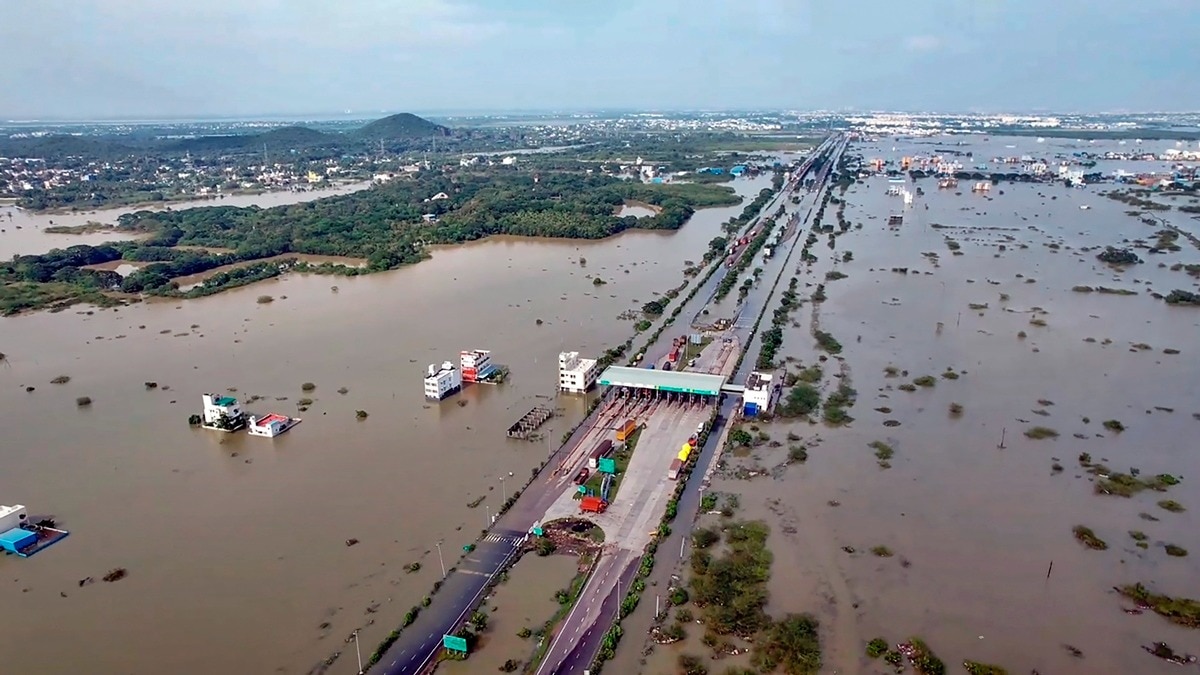
An IIT Madras-led team found that aerosols improved simulations of Chennai's 2015 rainfall and flooding. The finding could help refine urban forecasts, though the approach is not yet operational.A drone visual shows an area that is flooded after the landfall of Cyclone Michaung, in Chennai. (Photo: PTI)New Delhi,Oct 15, 2026 18:54 ISTA study of Chennai's devastating 2015 floods suggests that accounting for tiny particles in polluted air could help scientists better predict where extreme rain will fall and which areas could be inundated.When torrential rain turns city roads into rivers, the difference between a timely warning and a dangerous surprise can come down to how accurately scientists predict where the rain will fall and how much water will accumulate.Now, an international research team led by the Indian Institute of Technology Madras (IIT Madras) has identified a factor that could improve these forecasts: air pollution. IIT-Madras team used a weather model to estimate rainfall and then fed the results into two other models. (Photo: PTI) The study found that accounting for tiny particles suspended in the atmosphere could substantially improve computer simulations of extreme rainfall and the flooding that follows. Using Chennai's devastating December 2015 floods as a case study, researchers found that including these particles improved simulated rainfall by around 22% and the accuracy of flood-inundation simulations by approximately 50%, compared with a model that did not account for them.The findings were published in the peer-reviewed journal Natural Hazards and Earth System Sciences.HOW POLLUTED AIR INFLUENCES RAINFALL Air pollution is usually associated with respiratory illnesses and poor visibility. But tiny airborne particles, known as aerosols, can also influence how clouds form and develop.Some of these particles act as surfaces on which water vapour gathers to form cloud droplets. These are called cloud condensation nuclei. Depending on atmospheric conditions, the number and characteristics of these particles can affect how clouds develop and when and where they release rain. Researchers caution that their approach is not yet an operational flood-warning system. (Photo: PTI) If weather models do not adequately account for these processes, they may struggle to reproduce the exact location and timing of intense rainfall over a city."Urban flood forecasting is often treated primarily as a rainfall-to-runoff problem," said Chandan Sarangi of IIT Madras, the study's corresponding author. He explained that representing interactions between airborne particles and clouds could help models better capture the distribution of extreme rainfall across urban areas.FROM CLOUDS TO FLOODED STREETSTo investigate this connection, the researchers simulated Chennai's December 2015 rainfall event under different atmospheric pollution conditions.They used a weather model to estimate rainfall and then fed the results into two other models. One calculated how rainwater would flow into rivers and reservoirs, while the other simulated how floodwater would spread across the Adyar river basin.The researchers found that accounting for aerosols improved simulated rainfall over the basin by approximately 22%. That improvement carried through the modelling process, producing an approximately 50% improvement in the accuracy of simulated flood inundation. Some of these particles act as surfaces on which water vapour gathers to form cloud droplets. (Photo: AP) The results suggest that better understanding what happens in the atmosphere could improve estimates of where floodwater will accumulate on the ground.WHAT THIS MEANS FOR CHENNAIFor a city such as Chennai, better rainfall forecasts could help authorities make more informed decisions about reservoir storage and water releases before and during extreme weather.Soumendra Nath Kuiry, a professor at IIT Madras and co-author of the study, said rainfall timing and location directly affect runoff, reservoir inflows and flood forecasting.However, the researchers caution that their approach is not yet an operational flood-warning system. Further studies must establish whether similar improvements can be achieved for other storms and cities. Better observations of airborne particles and more efficient computing will also be needed.Supported by the Asia-Pacific Network for Global Change Research, the study offers a potential new direction for flood forecasting: understanding not just how much rain may fall, but also how the atmosphere helps determine where it falls.- Ends
IIT-Madras team finds a secret info hiding in polluted air: Where will it flood?
Full Article
Original Source
Read the full article at Indiatoday →KhanList aggregates and links to publicly available news content. We do not host full articles from third-party sources. Always verify important information with original sources.