
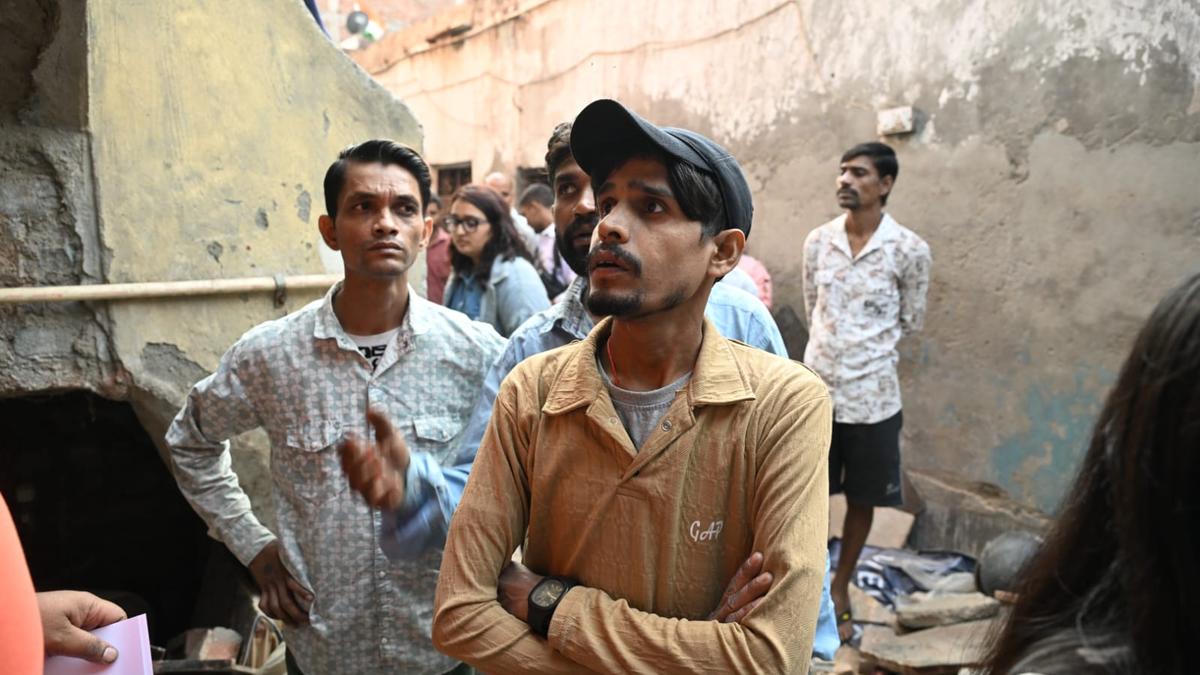
Kanhaiya was at the Hedgewar Hospital, tending to his eldest daughter, who had been injured after falling from the roof of their house on Deepavali, when a portion of his Jwala Nagar home came crashing down on Tuesday (November 17, 2026), trapping his wife Khushboo and their three-year-old son Divyansh under the debris. Soon, both of them were also rushed to the same hospital, where Mr. Kanhaiya saw them minutes after they had been pulled out of the debris. Divyansh was among the two people killed in the collapse. The other victim was Pintu (35), a worker at the gajak factory operating on the ground floor of the building.At around 10 a.m., Khushboo was getting Divyansh ready and packing food before leaving for the hospital to visit her daughter and husband. The family had been taking turns staying at the hospital since their eight-year-old daughter, Kaira, was injured on Deepavali.“My elder daughter fell from the roof while playing on Diwali and was admitted to hospital. Since my wife and I were taking turns staying with her, we sent our younger daughter, Trishi, seven, and Divyansh to my sister’s house in Mayur Vihar,” Mr. Kanhaiya told The Hindu.Divyansh had returned home only on Bhaidooj, after spending several days with his aunt. “I wish he had not returned home,” Mr. Kanhaiya said, struggling to hold back tears. His two daughters escaped the collapse — Kaira was at the hospital, while Trishi was still staying with her aunt.Mr. Kanhaiya’s sister Aarti said the family had initially decided to keep both children with her while their parents attended to Kaira. “We had kept Divyansh and Trishi with us. But Divyansh was not used to staying away from his parents. When Kanhaiya came to our house on Bhaidooj, Divyansh went back home with him. Who would have thought that was our last meeting. Had he stayed back, might have been saved,” she said.The tragedy has left a family that had called the building home for nearly four decades grappling with the loss. Though the family’s roots were in Gaya, Bihar, Mr. Kanhaiya was born and brought up in the same house. He continued to occupy one of the four rooms on the upper floor with his wife and children, while his younger brother and sister-in-law lived in another. The remaining two rooms were occupied by other families who had gone to their native villages for Chhath Puja.At the time of the collapse, Mr. Kanhaiya’s younger brother was at work, his sister-in-law was away in her hometown and his father was also out for work. Of his immediate family, only Khushboo and Divyansh were at home.The family alleged that they had repeatedly raised concerns about the building’s condition and asked its owner to undertake repairs, but their pleas went unheeded.“The roof used to leak frequently. I had applied several layers of cement to stop the seepage. We repeatedly told the owner about the leaking roof and the cracks in the house, but he never listened,” he said.Aarti said the building would also shake whenever trains passed on the nearby railway tracks, adding to residents’ concerns about the condition of the old structures in the area. Mr. Kanhaiya’s younger brother, too, said repeated requests to the owner to carry out repairs had gone unanswered.The family continued to rent the room for ₹4,000 a month, partly because Mr. Kanhaiya worked at a tailoring unit just behind the building. His daughters had also been admitted to schools in the neighbourhood only last year. “He was familiar with the area and his workplace was right behind the house. The girls had just started going to nearby schools after the couple struggled to save some money. We knew a disaster was waiting to happen, but the owner never listened,” Ms. Aarti said.The two-storey building, located in Gali No. 6 of the Sabji Mandi area in Jwala Nagar, was being used for both commercial and residential purposes. A gajak factory operated on the ground floor, where five workers worked and stayed, while four families occupied rooms on the upper floor.Situated in a congested residential lane, the building stood amid several old structures packed closely together, leaving little space between them.Residents recalled hearing a loud sound before rushing towards the building, only to find a heap of debris where the structure had stood.“I heard a loud sound and came rushing towards the house. We tried looking for people, but no one was visible. All we could see was debris and metal,” a neighbour said.
‘I wish he had not returned home’: Father loses three-year-old son in Delhi building collapse, while away at hospital with injured daughter
Full Article
Original Source
Read the full article at Thehindu →KhanList aggregates and links to publicly available news content. We do not host full articles from third-party sources. Always verify important information with original sources.