
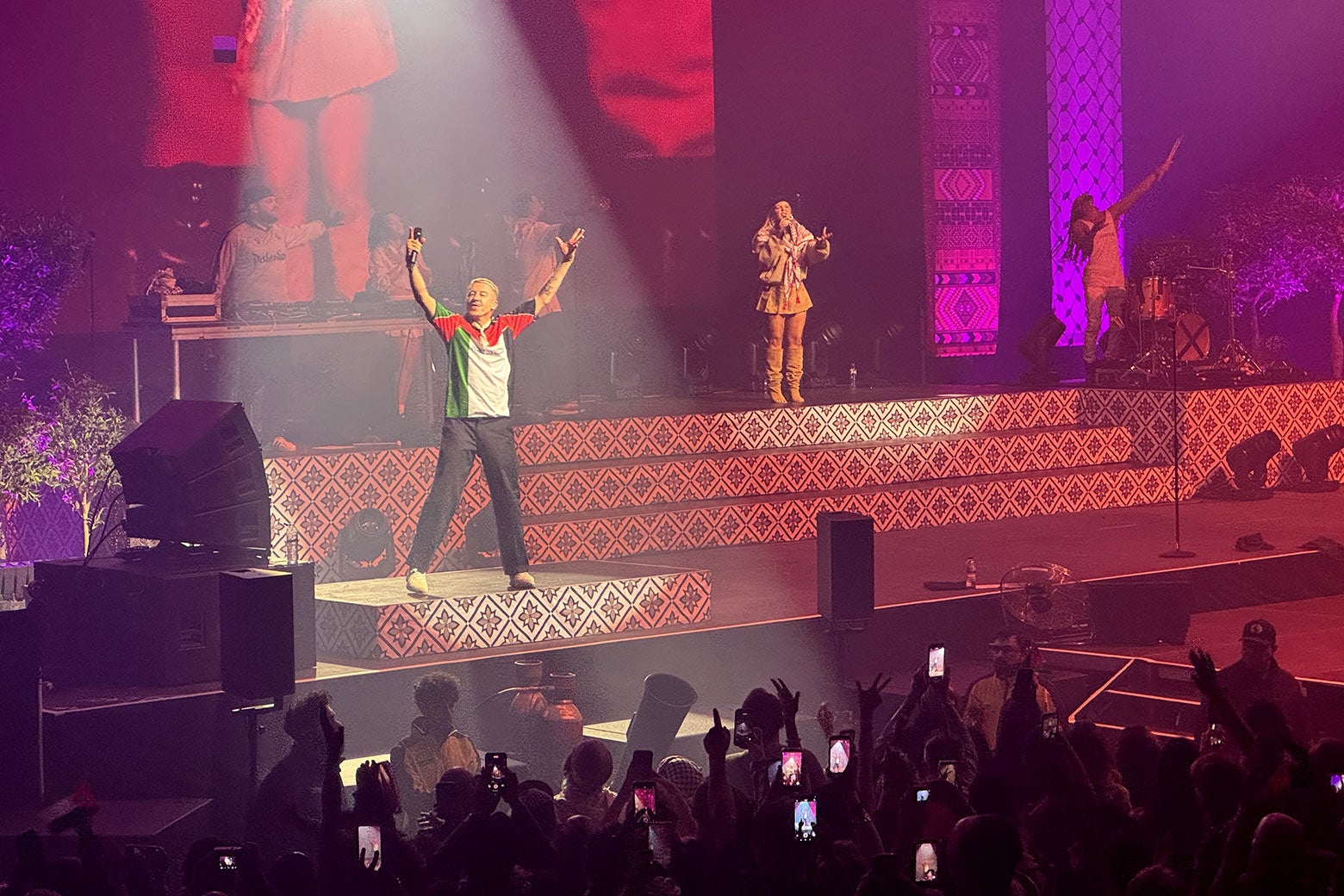
Music “The Great Macklemore, Praise Macklemore” Inside the London show devised after the rapper was kicked off Ed Sheeran’s tour, I saw quite a scene. Behlul Cetinkaya/Anadolu via Getty Images Sign up for the Slatest to get the most insightful analysis, criticism, and advice out there, delivered to your inbox daily. Back in 2012, when the novelty hit “Thrift Shop,” about looking awesome in someone’s granddad’s clothes, was being pumped relentlessly into student club nights I was attending, I would have been surprised to be told that a decade-plus later, the rapper behind it would be at the forefront of defending the liberty of Palestine. And yet so it has proved. Macklemore, real name Ben Haggerty, has had a wild couple of months. In September, he was kicked off Ed Sheeran’s tour because Robert Kraft, the billionaire businessman and sports owner, took offense to Macklemore performing his pro-Palestinian protest song “Hind’s Hall” and pressured venue owners around the U.S. to cancel Sheeran’s remaining tour dates if Macklemore would also be performing. The response to Macklemore getting dumped from the tour has been extraordinary in a number of ways. First, every one of Sheeran’s other support acts bowed out in protest, and Sheeran was forced to reckon with the fact that a lot of people were no longer willing to accept hand-wavy claims of being “apolitical” (not that that’s stopped him from commenting on Ukraine and Brexit, for instance) from celebrities with a huge platform. Then there’s what Macklemore decided to do next, which was immediately embark on what he titled the “Macklemore and Friends Free Palestine Tour” across three cities in Europe: Dublin, Paris, and finally London. At the behest of my editor, I got tickets to the London date, and watched all week to see whether Macklemore would even be allowed into the country to play it. Fifty members of the House of Lords agitated to get Macklemore’s right to enter the U.K. taken away ahead of the show. They failed, and so off I went to Wembley, to see how Macklemore would meet the moment. Each night of the tour has featured different acts supporting Macklemore. In Dublin, it was a star-packed lineup including Hozier and Kneecap. I suspected that the U.K. date would be a different kind of affair. In Ireland, it is not controversial to support Palestine. In the U.K., it decidedly is. Only two weeks ago, Sally Rooney made headlines around the world with her announcement that because she has chosen to donate royalties from her book sales to Palestine Action, a group that has been designated a terrorist organization by the U.K. government, her work would no longer be sold in the country. Still, punters here in the U.K. seem keen to support artists who are willing to stand up for what they believe, if the Macklemore ticket sales are anything to go by. The London show sold out, and Wembley was full of people decked out in kaffiyehs on the walk to the OVO Arena. Inside the arena foyer, there was almost no sign at all that Macklemore was even playing that night. The merchandise on sale were T-shirts and tote bags that read “I Love Palestine,” and the few that had Macklemore’s name on them had it in small lettering announcing the tour dates. There were stalls around the venue for Palestinian charities—all proceeds from these three tour dates are going to organizations supporting Palestinians—and everyone who was dressed up for the event was dressed up for Palestine, not for Macklemore. I passed a preteen boy having a full-body-length Palestinian flag tied tighter around his neck by his mother, several people in Hind Rajab football shirts, and watermelon accessories of every kind you could name. My fellow ticket holders were an interesting mix. There were some Macklemore fans, for sure. A little girl stomping around near the hot dog stand singing “Same Love” before the show, say. But a lot of the people I spoke to hardly knew who he was. Nicola, a woman in her 30s who came down from Scotland to attend the show, admitted she couldn’t name a single Macklemore song. “It’s more because, yeah, we wanted to support the Palestinian cause, and we bought tickets because of that,” she said. Janek, a fintech worker, said he and his two friends came down because they like Macklemore well enough, but it wasn’t the main reason. “His music has always been message-forward,” he said. “He’s got tunes like ‘Same Love,’ which explore homophobia. And I think he’s an artist that has demonstrated recently that staying true to your values as an individual, rather than prioritizing your professional career, you’ll never lose fans and importance.” Sheeran, he thinks, has been enormously disappointing. “To be apolitical is what Ed Sheeran tried to pursue. Doesn’t wash anymore. I don’t think he’s a bad bloke, I just think he could have done a lot more.” Behlul Cetinkaya/Anadolu via Getty Images Martha and her friend Amy were Macklemore fans, and come to see him whenever he plays in the U.K., but their adoration has now reached new heights. They’ve been impressed by his commitment to speaking up for Palestine. The “Thrift Shop” era is now a long time ago for Macklemore, and over the past three years, since the Oct. 7 attacks, he has consistently been making music and speaking about Palestinian rights. “He’s not just talking the talk,” Amy said, “he’s walking it. So that’s why we’re here.” Up until recently, they would have described themselves as Sheeran fans too. Not anymore. “I think every step he’s made has been the wrong thing to do. I think at this point, where it’s so clear what’s going on, to say nothing is to basically agree with what is going on,” Martha said. “People being like, ‘Oh, he’s just jumping on the attention.’ But he’s really not. He’s using the momentum to make something so much bigger than himself.” The show started at 7 p.m. with a speech from Greta Thunberg, of all people, emphasizing the need for policy change, alongside evenings like this showing solidarity and raising funds for Palestine. Then there were short sets from spoken-word poets like Lucas Jones; video messages from celebrities like Cynthia Nixon and Javier Bardem; performances by singers and rappers like Cure for Paranoia (who rose an enormous cheer from the crowd when he name-dropped Miss Rachel); and a series of activists, including a Palestinian journalist who spoke about her dead family and colleagues, and Antoine Raffoul and Stephen Kapos, Nakba and Holocaust survivors, respectively, sharing the stage. Arab Barghouti, the son of Marwan Barghouti, a Palestinian politician imprisoned by Israel, spoke to rapturous applause about his father. When Raffoul referred at one point to “the great Macklemore,” a woman in front of me threw her hands to the sky and said “The great Macklemore, praise Macklemore,” and giggled. There is something a little funny about the idea of the guy who wrote “Thrift Shop” now being hailed as a godlike defender of human rights. I get it. There are those who’ve griped that Macklemore, who has released several songs in the past three years explicitly railing against the genocide in Palestine, is jumping on some kind of gravy train to self-promote by wading into this area of politics. But based on what he put together with these shows, I can’t say that I agree. The show did not have the flavor of Macklemore giving a middle finger to Sheeran by naming a tour after what he got kicked off Sheeran’s tour for saying. Despite it all, it came across as a sincere and considered attempt to give Palestinian people, and their supporters, a platform on which to discuss the heavy realities of what is happening. Macklemore himself took the stage at 9:30 p.m., and began with what he wryly referred to as the “anti-capitalist anthem ‘Thrift Shop’ ” before moving through his other hits, including “Hind’s Hall.” It was a good show. He’s full of energy, and there was judicious use of pyrotechnics and a confetti cannon. But he repeatedly reminded the audience, in addresses between songs, that his music was not the focus of the event. Nor was it one in the eye for Sheeran. The focus was Palestine. “I don’t believe that saying something is brave,” he said. “I don’t believe that saying something is courageous. I believe that saying something is human. And those children in Gaza are our children. There is no separation.” Paloma Faith, while not generally known outside the U.K., was the most famous act who joined Macklemore in London, in fact perhaps the only truly famous person of the night other than Macklemore himself. In between songs, Faith spoke frankly about how she was scared to come and stand on this stage, as the breadwinner for her family of three young children. She decided, ultimately, that whatever professional repercussions might come her way for supporting Palestine mattered less to her than speaking up for the children of Gaza. At one point in the show, as the seventh or eighth person was invited onstage to speak, a woman sitting a few rows ahead of me remarked, “How many friends can one person have?!” The sad answer, really, is not enough. “Macklemore and Friends” was a moment for artists to do what Sheeran could not and demonstrate public outrage against what is being done to Palestinians, and I couldn’t help but wonder how many more had been asked, or how many had wanted to but felt they couldn’t risk it. The rewards could well be more than just spiritual if more artists do speak up, though. On the way back to the tube station after the show wrapped up, I spoke to two friends, Rangel and Elise, who were fizzing with enthusiasm for what they had seen. Would they have said they were into Macklemore before? “No. But I’m definitely a Macklemore fan now. One hundred percent,” Rangel said. Music Politics Palestine
I Went to the Macklemore Show Devised After He Was Kicked Off Ed Sheeran’s Tour. It Was Quite Something.
Full Article
Original Source
Read the full article at Slate →KhanList aggregates and links to publicly available news content. We do not host full articles from third-party sources. Always verify important information with original sources.