
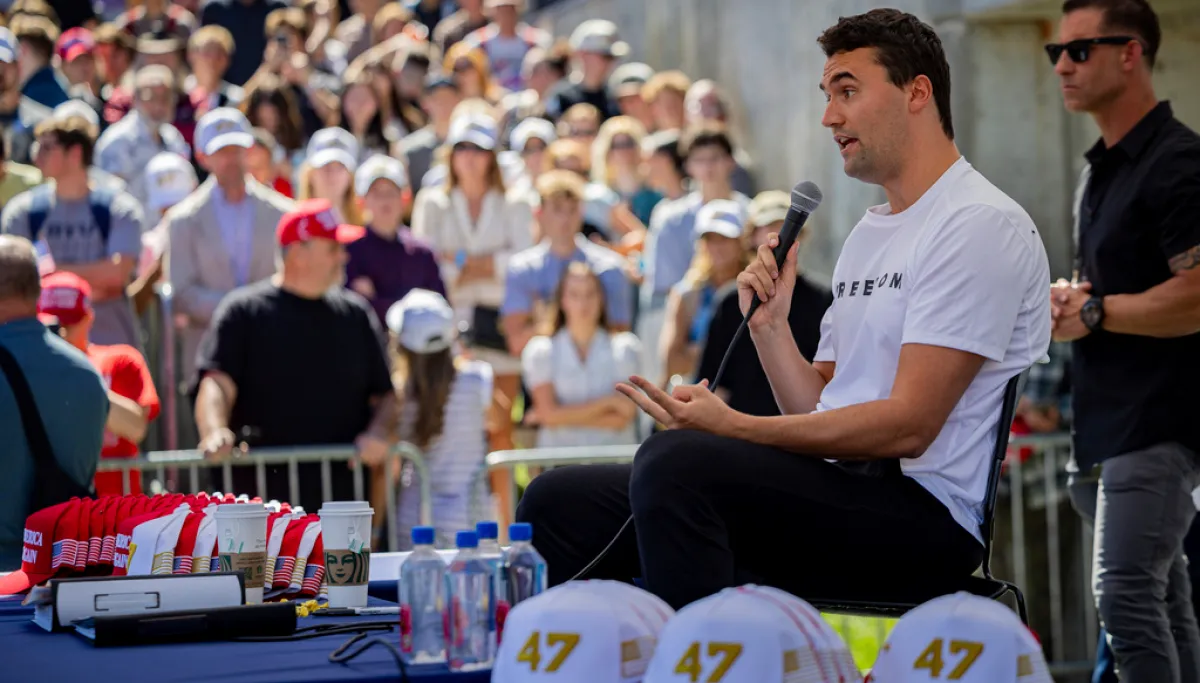
One year after Charlie Kirk was assassinated on Sept. 10, 2025, the man accused of murdering him has pleaded not guilty and is headed to trial. But another trial has been taking place in American politics since the day Kirk was shot, on whether we still possess the moral and epistemic foundations necessary to overcome political violence. About a year before Kirk’s murder, President Donald Trump survived his first assassination attempt in Butler, Pennsylvania. I wrote then in the Hill that the answer to political violence was political discourse. I still believe open discourse is necessary in a liberal republic. But I was wrong to think it is sufficient. Charlie Kirk embodied the principle of open discourse more than almost anyone in modern politics. A high school graduate, he built his career visiting university campuses and inviting people who despised his views to challenge him. He opposed political violence and gave his opponents the space to speak. Then someone shot and killed him while he was doing exactly that. CHARLIE KIRK’S MENTOR REVEALS WHAT LATE TPUSA FOUNDER ‘WANTED PEOPLE TO KNOW’ ABOUT THE GOSPELWhat followed has been alarming. Prominent voices on the left responded to Kirk’s murder with apathy, rationalization, or celebration because they despised his politics. Meanwhile, prominent voices on the right promoted baseless theories that Kirk’s murder was a sinister conspiracy involving his colleagues, his wife, or the government of Israel. These reactions are materially different, but both are dangerous. Too many on the left have treated violence as morally negotiable, while too many on the right have treated factual reality as negotiable. Both make political violence more likely.Kirk’s murder exposed the weakness in my old argument. Discourse depends on two deeper commitments.The first commitment is moral: Political opponents remain human beings, and disagreement does not make them legitimate targets for violence.The second is epistemic: Our political beliefs must be constrained by evidence, facts, and common sense.Failure to embrace these commitments can reinforce each other. Moral collapse produces violence and chaos, creating uncertainty and opportunities for rumors and conspiracy theories. Epistemic collapse can transform opponents into imagined conspirators or existential threats, making demonization and ultimately violence easier to rationalize.Neither commitment is as strong in America today as it should be. Reactions to Kirk’s assassination, the attempts on Trump’s life, and the murder of UnitedHealthcare CEO Brian Thompson reveal a disturbing minority on the left willing to treat political or ideological grievance as justification for violence. The concern is amplified by influential figures such as Hasan Piker, who said in 2025, “If you cared about Medicare fraud or Medicaid fraud, you would kill Rick Scott.” The targets and motives differ, but the underlying moral error is the same: Once objectionable views can justify violence against those who hold them, politics devolves into deciding who may permissibly be harmed. Parts of the right suffer more from the epistemic problem. From unsubstantiated accusations surrounding Kirk’s assassination to persistent claims about the 2020 election, conspiracy theories increasingly thrive despite contrary evidence. Regarding Kirk, figures such as Candace Owens and Tucker Carlson have promoted egregious, unsupported explanations of his murder even as prosecutors have presented surveillance footage, DNA evidence, and alleged confessions implicating defendant Tyler Robinson.There is reason for hope. Mainstream Democratic leaders condemned Kirk’s murder and political violence, as did Republican leaders. But neither political coalition has consistently applied that principle when violence comes from its own side. Republican efforts to minimize or recast the violence at the Capitol on Jan. 6 have continued, while some voices on the left rationalized violence during the unrest of 2020 or reacted callously to later political attacks. A societal norm against political violence survives only if it is applied when condemnation is politically inconvenient. WHEN POLITICS BECOMES YOUR IDENTITY, DISAGREEMENT BECOMES WARThe year since Kirk’s murder has shown that open discourse, however important, is not enough. A liberal republic also requires a shared moral commitment that political opponents are not legitimate targets of violence, and a shared epistemic commitment that facts constrain our beliefs.I still believe, as I wrote after Butler, that political discourse is an answer to political violence. I was wrong to believe it could work without those foundations. Strengthening them must be a national priority.Jeremy Etelson has written political commentary for the Hill and has appeared on Fox Business and NewsNation discussing national politics. He previously worked in Democratic politics and served as a judicial law clerk in Maryland. He holds a J.D. from George Washington University Law School and an M.Phil. in Political Thought and Intellectual History from the University of Cambridge.
I thought free speech could save America. Charlie Kirk’s murder proved me wrong
Full Article
Original Source
Read the full article at Washingtonexaminer →KhanList aggregates and links to publicly available news content. We do not host full articles from third-party sources. Always verify important information with original sources.