
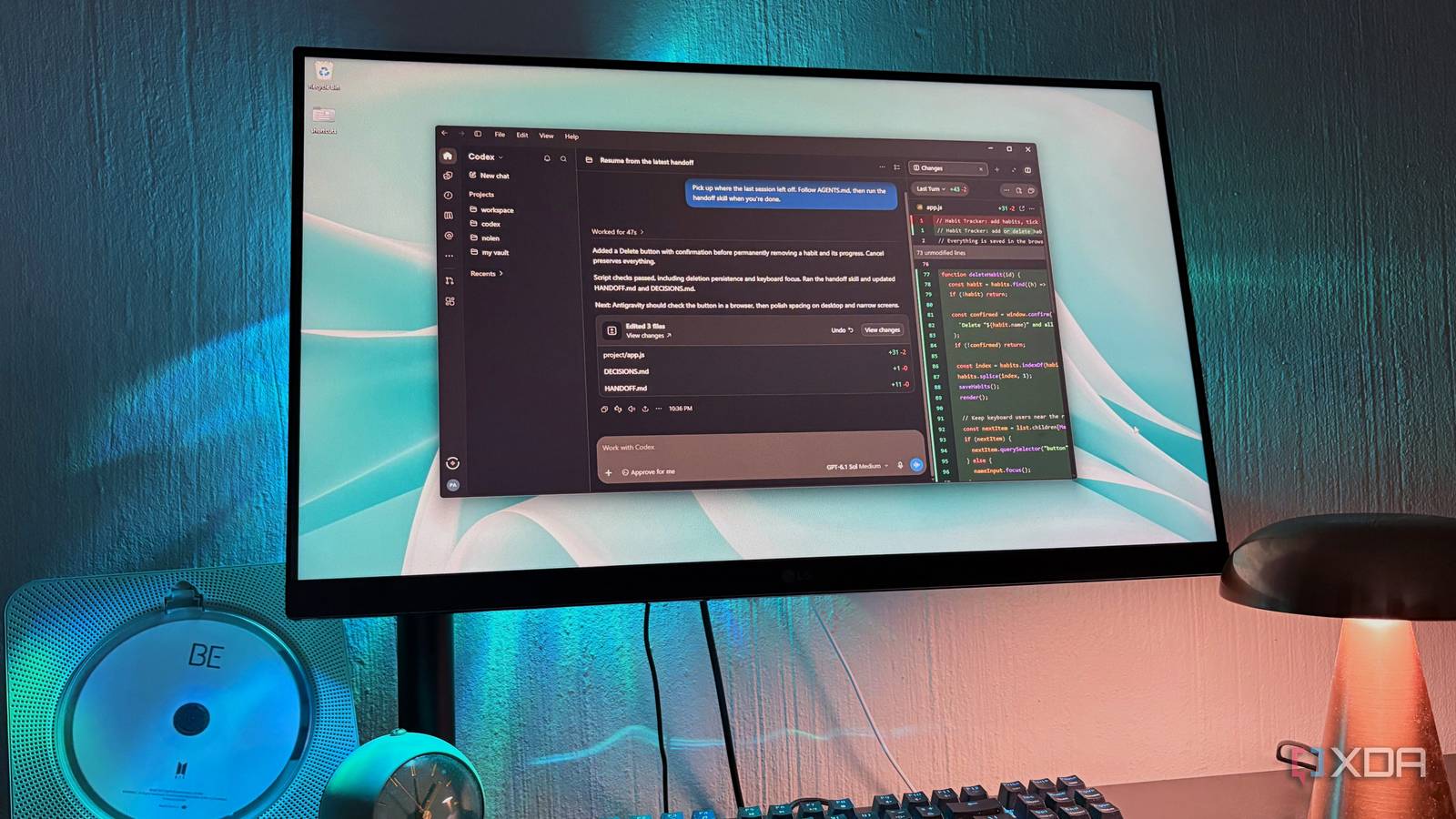
Published Nov 1, 2026, 2:01 PM EST Nolen began their writing career in 2019, with three years dedicated to editing the Creative section at MakeUseOf. Their expertise lies at the crossroads of technology and creativity, covering areas like photography, video editing, and graphic design. Outside of work, you'll often find Nolen diving into a good book, writing their own stories, or playing video games. Anthropic, OpenAI, and Google are the three big players when it comes to coding agents, and anyone who's paid for two or more of them has probably tried to work out which agent gets to be "the main one". I certainly have, because I've juggled all three subscriptions at this point. Claude Code, Codex, and Antigravity can all open a folder on your computer and build things inside it, so they look like they're up for the same job. Most comparisons, including a few I've written, set them against each other and pick one. But the problem starts when you actually try to stick to one. Usage limits can run out halfway through a project, and when that happens the next move is usually to move onto the next agent, but then you have to start a fresh session and re-add all the context. Juggling all three just turned into a copy-paste marathon, so I decided to give them all the same shared workspace, which is really just a folder of context. The problem with picking one coding agent Every switch meant retyping my project Claude was meant to be my only subscription. Then ChatGPT and Gemini crept in mainly just so I could test out their newer models, but it ended up filling the gaps Claude wasn't good at. So here I am, paying for three different AI tools, even though I swore I never would, and still comparing them as if only one could stay. Every comparison ends the same way though. One of them would run out of usage or stall on a bug, and I'd move the project to another app. Re-explaining the project is the part that ends up costing you: the whole thing lives in one app's history, which the next agent can't see, so even if I point the second agent at the same folder, I'd still end up retyping the context and giving it a rundown of where I'm at. It doesn't help that each of them has their own strengths and weaknesses too. Codex tends to finish code that Claude leaves half-done. Antigravity is the one I reach for when something needs checking by eye, since it can open a page in a browser and look at it. So crowning just one winner means giving up the other two, but I was still paying for them anyway, so what I really wanted was for all three to have a spot in my agent stack. And I did that with a shared workspace. How I set up one folder for all three The project remembers itself, regardless of which agent opens it What I ended up building keeps the project's memory in the folder instead of in any one app's chat history. Coding agents already look for an instruction file when they open a folder, and this whole setup only works when you tap into that mechanism. Claude Code looks for its own CLAUDE.md, but that file can import another with a single line, so mine just points at AGENTS.md, an instruction file a lot of coding agents have agreed to read, Codex and Antigravity included. So basically, they all have the same rules from the get-go because it's just one batch of files in the same folder. AGENTS.md is the rulebook for all three, which is also the only one I edit and update, and the CLUADE.md never needs touching. I used Claude to help me scaffold these files, but the overall pipeline came from my own input regarding how I actually bounce between these three apps. The rulebook tells every agent to read HANDOFF.md before touching anything. That's a running log with the newest note at the top. Each agent signs a note there before it leaves, saying what it finished and what it didn't, and where the next one should start. DECISIONS.md is the other important part of the puzzle. Once something's settled, for example sticking to plain HTML for a small project, it goes on that list and no agent can reverse it. If one disagrees, it flags it in its handoff note for me instead. Without that rule I reckon one agent could easily undo a choice another made a session earlier, but I haven't tested it and don't really want to (because that would probably wreck my projects). The rulebook also gives each agent a lane based on what I've seen it do well. Antigravity gets the visual checks in a browser, for example, and the other two split planning and fixing between them. Another part of this method is that I only let one work in a folder at a time, it just keeps the pipeline smoother in my experience. Wrapping up in Claude Code and Codex runs through a handoff skill, which is a saved set of instructions the agent follows when I call it by name, and since everything's plain Markdown I can open any of the files in my notepad at any point. Handing the work between agents for real projects The first sign it was working was how each session opened. I hadn't briefed any of them, but Codex read the folder and said it was picking up from the last note. When Antigravity took over after that, its first line named Codex as the agent it was continuing from, and Claude Code did the same with Antigravity's handoff later on. A part of me was kind of expecting there to be a broken link somewhere because honestly coding work is not my strong suit (hence why I rely on AI for it), but the pipeline functioned exactly as I wanted it to. The biggest benefit to this method is probably usage limits. If one agent runs dry mid-project, I open the same folder in another app and the work carries on from the last note, rather than having to rebuild the entire context. But the other benefit is reaping the unique advantages of the different models as well. The handoff log actually ended up turning into something I didn't plan for. It's a plain-language history of the project that I can skim in a minute to see what changed while I wasn't watching. Questions meant for me land there instead of getting buried in one app's chat. Antigravity, for example, finished its turn by telling the next agent to check with me before adding anything new. It isn't zero effort. Every session ends with a handoff, and the agents don't follow the rules identically - Antigravity needed a more explicit prompt than Codex before it wrote its note. And again, running two agents in one folder at the same time is probably something I'd avoid because they could be editing the same files without reading each other's notes first. Keeping the rulebook relatively short helps as well. Google caps Antigravity's rule files at 12,000 characters, and mine is about 2,400. I stopped asking which agent is best Right now, I still have all three subscriptions. Though I could continue using this setup even if I were to cancel my Google and OpenAI subs. Either way, these agents feel less like rivals now and more like collaborators that I can tag in on the same project. If a fourth agent shows up next month, I'd probably just point it at the same folder and see whether it reads the notes, rather than jumping straight into another comparison. Google Antigravity Codex
I stopped choosing between Claude Code, Codex, and Antigravity, and one shared folder lets them pick up each other's work
Full Article
Original Source
Read the full article at Xda-developers →KhanList aggregates and links to publicly available news content. We do not host full articles from third-party sources. Always verify important information with original sources.