
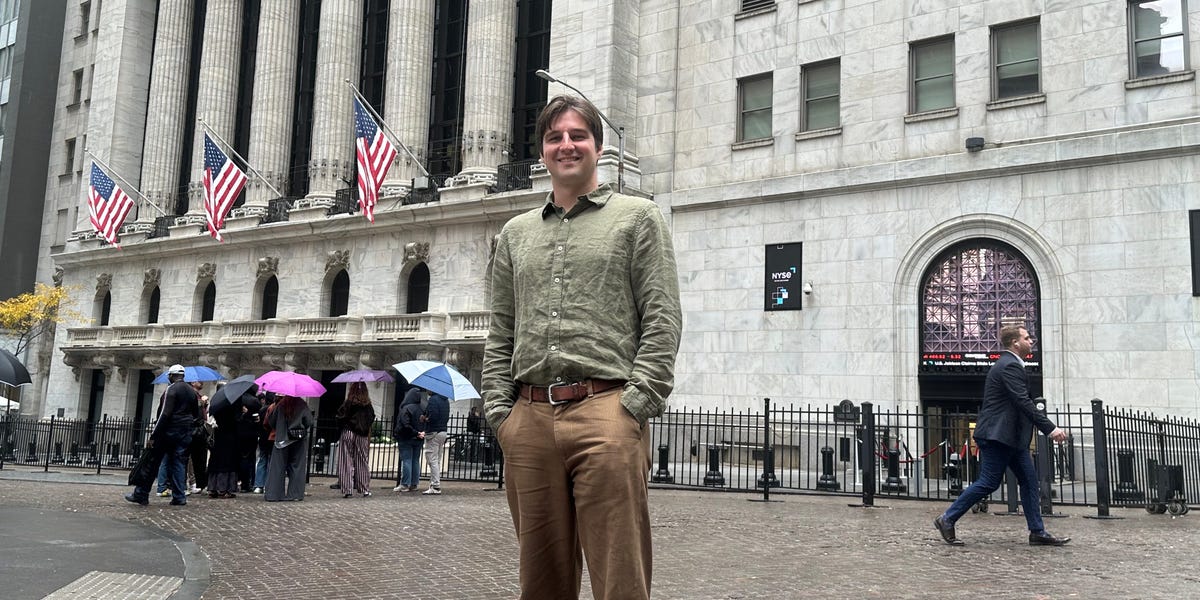
Patrick Kelly, the founder of a community of forward-deployed engineers in New York, says demand for the role is growing. Courtesy of Patrick Kelly This as-told-to essay is based on a conversation with Patrick Kelly, the Brooklyn-based cofounder and CEO of Port of Context, which helps companies connect AI to their existing systems. Kelly founded Forward Deployed Engineers of New York in June 2026, which frequently hosts events and has a list of FDE job openings on its website. The conversation has been edited for length and clarity.I was a forward-deployed engineer before I ever had the title.I started out as a solutions engineer at a legal AI company, before large language models took off. I'd go into a big company, figure out where AI could help, and work with the people there to build something they could actually use.When we started Forward Deployed Engineers of New York, a few friends left tech companies to work at fast-growing startups. There's a lot of pressure on you when you're the one going into a customer's business and figuring out what to build, and we thought people could use a place to trade notes.When people talk about a tech job recession, we have actually seen the opposite in this specific role. Here are some of the latest hiring trends in FDE roles and how people of different backgrounds could all move into the job.The job finally got a name everyone agrees onSolutions engineer, solutions architect, customer engineer, implementation engineer, field engineer — I have a whole list of names of what this role used to be called.While the job description did not change, the explosion in AI subscriptions helped make the job more visible. People started chatting with Claude and pretty quickly found out that getting from a chatbot to a system a business can trust to run on its own is hard. That's where an FDE comes in.The role is different from that of a traditional software engineer. You go into a big company and figure out where AI could actually help. You work with the customer's engineers to get access to the systems and with the business team to figure out how you'll measure the value. You might spend a few weeks or a few months writing code and building the workflow, and then you hand it over before you leave.New hiring trends in FDEMany new opportunities and FDE-adjacent roles are opening up. I have an analogy for FDEs: You have to be a jack-of-all-trades and a master of three. Those are AI, software engineering, and learning a new business domain fast. That last one is basically like being a McKinsey consultant. Each of those things could be a career on its own.New York has AI companies hiring FDEs and has a whole lot of places to deploy them. Banks and other big companies have seen how the work gets done, so now some banks are building internal teams to run those projects themselves without relying on the AI companies.Big consulting firms are also changing how they deliver AI projects.I'm seeing very technical consultants from places like McKinsey and Bain find a path into forward-deployed engineering. There's also a role for people who haven't spent time as software engineers. At my company, we're pairing FDEs with deployment strategists, which is a role first invented by Palantir.While the FDE does the coding and technical work, a deployment strategist works with the customer and keeps the technical project moving as a manager. You have to speak the language, understand the AI product, and be very good at delivering for clients.Landing the jobIf you're a software engineer who's never worked directly with a customer, think about a project you got off the ground inside your own company. Maybe you spotted a multimillion-dollar opportunity, figured out how long it would take, and pulled together the team to do it. That's a good story to tell in an interview.It is also important to explain the project in terms the business cares about. What was the opportunity? How did you get people on board? What did the work deliver? If you can point to a return on the investment, bring that number.Ultimately, the rise of FDE is a reflection of where the job market is going.Agents are doing more of the coding now, and teams can deliver results faster. That puts more weight on deciding what to do and how to do it. Being able to explain what you chose to build, why it was worth doing, and what the business got out of it matters more than technical skills. Read next Business Insider tells the innovative stories you want to know Business Insider tells the innovative stories you want to know Business Insider tells the innovative stories you want to know Business Insider tells the innovative stories you want to know Katherine Li is a reporter on Business Insider's West Coast business news team. She covers career, the future of work, and how AI is changing hiring practices and workplace trends.Previously, she was a newsroom fellow who wrote international breaking news and produced newsletters for Semafor. Before that, she wrote about climate policies for The Lever, covered the AAPI community for the SF Chronicle as a freelancer, and wrote about the 2019 Hong Kong protests as an intern for The New York Times.She is an alumna of the Graduate School of Journalism at UC Berkeley and a graduate of the international journalism program at Hong Kong Baptist University with minors in French and English literature. Email Katherine at katherineli@insider.com and follow her on Bluesky @katherineli.bsky.social. Tech Job Market Hiring More Jobs New York City Careers as told to
I run the first forward-deployed engineer club in New York. Here's how to break into the role.
Full Article
Original Source
Read the full article at Businessinsider →KhanList aggregates and links to publicly available news content. We do not host full articles from third-party sources. Always verify important information with original sources.