
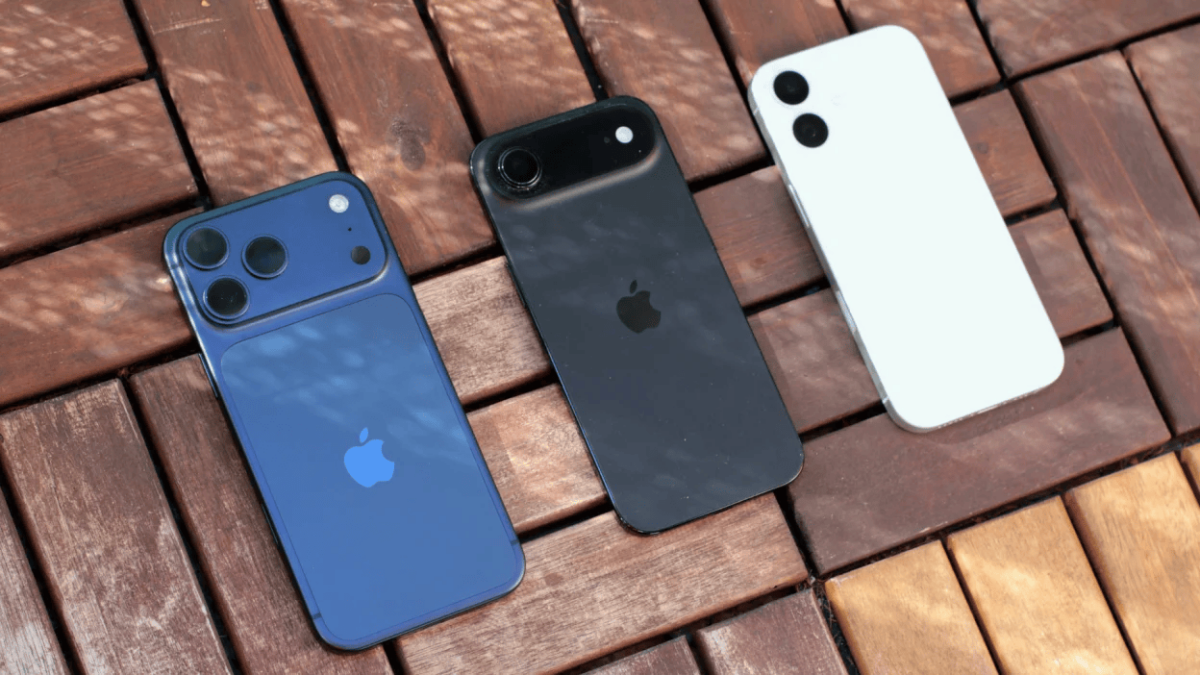
Who should upgrade to the new iPhone Duo? We have thoughts. By Haley Henschel Haley Henschel Senior Shopping Reporter Haley Henschel is a Chicago-based Senior Shopping Reporter at Mashable who reviews and finds deals on popular tech, from laptops to gaming consoles and VPNs. She has years of experience covering shopping holidays and can tell you what’s actually worth buying on Black Friday and Amazon Prime Day. Her work has also explored the driving forces behind digital trends within the shopping sphere, from dupes to 12-foot skeletons. Read Full Bio on November 7, 2026 Share on Facebook Share on Twitter Share on Flipboard All products featured here are independently selected by our editors and writers. If you buy something through links on our site, Mashable may earn an affiliate commission. Credit: Stan Schroeder / Mashable Table of Contents What's the best iPhone to buy right now? This fall, that question got a lot more interesting. In mid-September, Apple launched the new iPhone 18 Pro and Pro Max with upgraded cameras, a revamped vapor chamber cooling system, longer battery life, and a fresh, AI-ready chipset. A month later, it released the long-awaited iPhone Duo, its first-ever foldable. Mashable senior editor Stan Schroeder deemed it "the most exciting iPhone since the first one."The new Apple phones join the standard iPhone 17, the budget iPhone 17e, and the super-slim iPhone Air to round out the 2026 iPhone roster, which now runs on iOS 27. We've tested the entire iPhone family, and we've compared them all to pick the best iPhone for every type of user. Best iPhones at a glance: A note on Apple's iPhone price increasesApple's smartphones have never been more powerful, feature-rich, or diverse in their form factors. Alas, they've also never been pricier. Every current iPhone has gotten more expensive due to the ongoing global memory crisis, which has jacked up the cost of electronic components over the past year. (The Duo turned out to be slightly less of a splurge than the gossip mill predicted, though it's still the most expensive iPhone ever.) Unfortunately, there's no escaping higher prices with any other brand: All the best smartphones have seen price increases this year. So, is it worth splashing out on the Duo or one of the new Pro models? Or would you be perfectly happy with something less snazzy and more wallet-friendly, relatively speaking? After extensively testing every single iPhone, Mashable's experts have recommendations for all budgets and usage needs. One more thing: Before you buy your new iPhone, be sure to check out our coverage of the latest carrier deals. If you trade in an older device and sign up for a new line or data plan, you could pay a fraction of the price — or nothing at all.Best iPhone for most people: iPhone 17 In addition to plain white (pictured), the iPhone 17 also comes in mist blue, sage, lavender, and black finishes. Credit: Stan Schroeder / Mashable Read our full review of the iPhone 17Who it's for: In all likelihood, you. We think the iPhone 17 is the model most people should buy. It's also the most colorful iPhone on the market.The new iPhone 18 Pros and iPhone Duo are amazing phones, but they're overkill for the average user. Last year's iPhone 17 is still the most well-rounded, "just right" phone in Apple's lineup. (We don't expect the new base model iPhone 18 to land until spring 2027.) The iPhone 17 is a fast-enough, long-lasting-enough, nice-looking-enough smartphone that feels "Pro" where it counts for most people. Namely, it has a 120Hz, always-on display and an ultrawide camera with a dedicated macro mode, but none of the extra photography or thermal fixings intended for superusers. Compared to the budget iPhone 17e, which costs $200 less, it has a brighter, smoother screen, nicer cameras, and 15 percent more battery life.Was the iPhone 17 an earth-shattering upgrade over the iPhone 16? Not really, but it got better in some crucial yet practical ways without straying over the $1,000 mark. Mashable's Schroeder christened it "the most compelling standard iPhone in years." $0 with trade-in on select Experience plans at T-Mobile iPhone 17 specsScreen size and display: 6.3-inch OLED display with 2,622 x 1,206 resolution and 120Hz variable refresh rateCameras: 48MP (wide), 48MP (ultrawide), and 18MP (front)Battery life (rated): Up to 30 hours of video playbackProcessor: Apple A19Storage: 256GB or 512GBColors: Black, white, mist blue, sage, or lavenderDimensions: 5.89 x 2.81 x 0.31 inchesWeight: 6.24 ouncesSoftware: iOS 27Best cheap iPhone: iPhone 17e The iPhone 17e is Apple's first budget smartphone with MagSafe support. Credit: Stan Schroeder / Mashable Read our full review of the iPhone 17eWho it's for: We recommend the iPhone 17e for frugal shoppers who just want the core iPhone experience, as well as those who like small, pocket-friendly phones. It would also make a great starter phone for a teenager.The iPhone 17e delivers your go-to iOS features like FaceTime and Siri AI, plus the classically clean Apple look — now with MagSafe! — for the least amount of money. It's a compact little device with a sharp, if not super-smooth display, and a battery that should last you a day between charges. It runs on the same A19 chip as the regular iPhone 17 and starts with the same amount of storage (256GB), which makes it more future-proof than last year's iPhone 16e (which started with half that). Mashable Light Speed The cameras on the iPhone 17e aren't as "versatile" as the ones on the iPhone 17, Schroeder said; it lacks an ultrawide lens and has a noticeably inferior front camera. But at least it takes marginally better low-light pictures than its predecessor. $0 with trade-in on Experience Beyond plan at T-Mobile iPhone 17e specsScreen size and display: 6.1-inch OLED display with 2,532 x 1,170 resolution and 60Hz refresh rateCameras: 48MP (wide) and 12MP (front)Battery life (rated): Up to 26 hours of video playbackProcessor: Apple A19Storage: 256GB or 512GBColors: Black, white, or soft pinkDimensions: 5.78 x 2.82 x 0.31 inchesWeight: 5.96 ouncesSoftware: iOS 27Best iPhone for photography: iPhone 18 Pro Good riddance, cosmic orange. Credit: Stan Schroeder / Mashable Read our full review of the iPhone 18 Pro and Pro MaxWho it's for: Get the smaller iPhone 18 Pro if you're a mobile photographer or creator looking for the best cameras.Both the iPhone 18 Pro and Pro Max feature the latest Apple camera technology, but we think the former has greater appeal for on-the-go shutterbugs because it's more compact and less expensive. The best tech deal this week The Apple iPhone 18 Pro is free right now with T-Mobile What's new with those cameras? A new physical variable aperture on its main camera lens, for starters. This gives you more control over the exposure and depth of field of photos. It works automatically, but you can also adjust it manually via the Camera app. There, you'll find other new Pro controls for tweaking settings like white balance and shutter speed; new Photographic Styles; new Cinematic effects that can be applied to videos after they're recorded; and a new Focus Tracking tool that locks on moving subjects. The average user might appreciate those upgrades, "but I do bet that the majority of people will try out the manual aperture setting once and then leave it on auto," wrote Mashable's Schroeder in his review. Power users will make the best use of them.Besides the new camera features, the new A20 Pro chip also provides extra support for AI tasks, including the newer, smarter Siri AI. There's plenty of storage space, too: Unlike older iPhones, the 18 Pro supports up to 2TB of storage. $0 with trade-in on Experience Beyond plan at T-Mobile iPhone 18 Pro specsScreen size and display: 6.3-inch OLED display with 2,622 x 1,206 resolution and 120Hz variable refresh rateCameras: 48MP (wide), 48MP (ultrawide), 48MP (4x telephoto), and 18MP (front)Battery life (rated): Up to 36 hours of video playbackProcessor: Apple A20 ProStorage: 256GB, 512GB, 1TB, or 2TBColors: Black, silver, glacier, and burgundyDimensions: 5.91 x 2.83 x 0.34 inchesWeight: 7.44 ouncesSoftware: iOS 27Best iPhone for battery life: iPhone 18 Pro Max The iPhone 18 Pro Max (left) is a slightly larger and even longer-lasting version of the iPhone 18 Pro (right). Credit: Stan Schroeder / Mashable Read our full review of the iPhone 18 Pro and Pro MaxWho it's for: The latest iPhone Pro Max is geared toward battery life maximizers who hate being chained to an outlet and Apple fans with large hands. That's not a euphemism for anything: This is a big ol' phone. The iPhone 18 Pro Max is rated for up to 45 hours of video playback per charge, making it the longest-lasting iPhone ever. (Its battery is so big that Apple had to come up with a way to get around shipping restrictions that limit battery sizes, according to MacRumors.) Inside, you'll find the powerful A20 Pro chip and an improved vapor chamber cooling system that helps prevent overheating during extended heavy use. Schroeder tried to push this new hardware to the limit "by playing a few games of PUBG: Battlegrounds on the highest settings for a full hour," he wrote, and "The phone barely got warm." What's more, its battery only fell by nine percent. The regular iPhone 18 Pro has the same chipset and cooling system as the Max version, though it's shorter-lived and smaller. The iPhone 18 Pro Max's size is an advantage for mobile gamers and movie-watchers who value immersion (but not so much that they can justify an iPhone Duo). $2.78/month for 36 months with trade-in on Experience Beyond plan at T-Mobile iPhone 18 Pro Max specsScreen size and display: 6.9-inch OLED display with 2,868 x 1,320 resolution and 120Hz variable refresh rateCameras: 48MP (wide), 48MP (ultrawide), 48MP (4x telephoto), and 18MP (front)Battery life (rated): Up to 45 hours of video playbackProcessor: Apple A20 ProStorage: 256GB, 512GB, 1TB, or 2TBColors: Black, silver, glacier, and burgundyDimensions: 6.43 x 3.07 x 0.34 inchesWeight: 8.78 ouncesSoftware: iOS 27Best foldable iPhone: iPhone Duo Credit: Stan Schroeder / Mashable Read our full review of the iPhone DuoWho it's for: The iPhone Duo is a worthy investment if you're a well-off early adopter, tech enthusiast, or avid multitasker who consumes most of their entertainment on their phone. It's not for people who rely heavily on Face ID — it only has Touch ID.Apple's first foldable is a feat in hardware and user interface design. It has some first-gen quirks, but they're not dealbreakers. And though it's expensive, "it's a quality-made product with enough novelty to justify the high asking price," said Schroeder.The Duo features a passport-style design with a roomy matte inner display, a smooth hinge, and an extremely subtle crease. This form factor opens up a world of usage possibilities. You can use it closed like a normal phone. You can snap it open to play games and watch movies on it, like you would a tablet. You can have two apps running side by side. (It has the same peppy A20 chip as the new iPhone 18 Pros, so it's got plenty of horsepower for heavier workloads.) You can even draw or take notes on either display using a USB-C Apple Pencil. The Duo's battery life isn't Pro-tier, but it's quite good for a device that powers two screens at once. In typical mixed use, it lasts about as long as the cheap iPhone 17e. Its cameras are probably the most lackluster thing about it, especially its crummy inner selfie camera, but that's typically the case with foldables, in our experience. $799 with new line and port on Experience Beyond plan at T-Mobile iPhone Duo specsInner screen size and display: 7.6-inch OLED display with 1,878 x 2,670 resolution, 120Hz variable refresh rate, and nano-texture finishOuter screen size and display: 5.4-inch OLED display with 1,398 x 2,034 resolution and 120Hz variable refresh rateCameras: 48MP (wide), 48MP (ultrawide), 12MP (front, outer), and an additional inner, under-display FaceTime camera (resolution TBA)Battery life (rated): Up to 44 hours of video playback when using the outer display; up to 31 hours of video playback when using the inner displayProcessor: Apple A20 ProStorage: 256GB, 512GB, 1TB, or 2TBColors: Night sky and star whiteUnfolded dimensions: 4.64 x 6.48 x 0.21 inchesFolded dimensions: 4.64 x 3.31 x 0.44 inchesWeight: 8.96 ouncesSoftware: iOS 27Best iPhone for design snobs: iPhone Air Left: The iPhone Air is so thin. Credit: Stan Schroeder / Mashable Right: Like, REALLY thin. Credit: Stan Schroeder / Mashable Read our full review of the iPhone AirWho it's for: This is the iPhone for minimalists and aesthetes who care more about their phone's looks than its performance. Its camera system, in particular, is pretty mediocre for the money.People who bought the iPhone Air often say the same thing: Its svelte form factor ruins you for other phones.The iPhone Air is the thinnest handset Apple has ever made — and arguably the "sexiest," said Schroeder. If you set it next to one of the iPhone Pros, "it feels like a Ford F-150 parked next to a Porsche," he wrote. "The Porsche may not have the utility that a pick-up has, but it turns heads." The bezels on its smooth, detailed display are virtually invisible, and its rear camera bump blends into the back of its chassis when you look at it straight-on. It's made from titanium, so it's not easy to scratch up, and it's super comfy to hold. It's peak Apple sleekness.An A19 Pro chip makes the iPhone Air mildly faster than the A19-powered iPhone 17, though it doesn't last as long. (Apple makes a MagSafe battery that you can slap on the back of it, but costs $100 extra and works against the device's "ultra-thin" thing.) Camera-wise, it has better zoom than the iPhone 17, but it misses out on an ultrawide shooter à la the iPhone 17e. While you probably won't win any photography prizes with the Air, it's perfectly fine for selfies and everyday snapshots. $0 with trade-in on Experience Beyond plan at T-Mobile iPhone Air specsScreen size and display: 6.5-inch OLED display with 2,736 x 1,260 resolution and 120Hz variable refresh rateCameras: 48MP (wide) and 18MP (front)Battery life (rated): Up to 27 hours of video playbackProcessor: A19 ProStorage: 256GB, 512GB, or 1TBColors: Space black, cloud white, light gold, and sky blueDimensions: 6.15 x 2.94 x 0.22 inchesWeight: 5.82 ouncesSoftware: iOS 27Mashable tech editor Timothy Beck Werth also contributed to this guide. Frequently Asked Questions Apple hasn't announced the standard iPhone 18 yet, just its Pro counterparts. It probably won't launch until next March alongside the iPhone 18e and a second-generation iPhone Air, as Mashable previously reported. If your current phone doesn't have any critical issues that mandate an immediate upgrade, like a laggy processor, a shot battery, or a cracked screen, you might consider waiting for the iPhone 18. Just know that it probably won't involve a massive redesign. The iPhone 18 Pro and iPhone 18 Pro Max currently have the best cameras in the iPhone lineup. Both phones feature 48MP rear cameras with wide, ultrawide, and 4x telephoto lenses, plus a 18MP Center Stage selfie camera. They also introduce new advanced photography settings and effects, including — for the first time in Apple history — a physical variable aperture.For videographers, Apple's new iPhone 18 Pros can shoot 4K footage at 120 frames per second for professional-quality clips. The iPhone 17 ($899) has the best value of all the Apple smartphones available in 2026:For $200 more than the entry-level iPhone 17e, it gets you a smoother, brighter, and slightly larger display, better cameras, newer wireless tech, and a longer battery life. The 17e also lacks support for Apple's interactive Dynamic Island interface; it still has a selfie camera notch.The iPhone 17 isn't as sleek as the iPhone Air, but it offers better cameras and more stamina for $200 less.The iPhone 17 has a slower processor and a shorter battery life than the iPhone 18 Pro and Pro Max, and its cameras aren't quite as advanced. Notably, it lacks a telephoto lens. However, it costs up to $400 less than its Pro counterparts.Compared to the foldable iPhone Duo, the iPhone 17 has a slower chip, slightly less battery life, and no Apple Pencil support, but it features vastly better selfie cameras and Face ID. We also think its traditional "slab-style" design has broader appeal. And lest we forget, it costs $1,100 less the Duo. Haley Henschel is a Chicago-based Senior Shopping Reporter at Mashable who reviews and finds deals on popular tech, from laptops to gaming consoles and VPNs. She has years of experience covering shopping holidays and can tell you what’s actually worth buying on Black Friday and Amazon Prime Day. Her work has also explored the driving forces behind digital trends within the shopping sphere, from dupes to 12-foot skeletons.
The best iPhones for 2026: We compared cameras, battery life, and overall value
Full Article
Original Source
Read the full article at Mashable →KhanList aggregates and links to publicly available news content. We do not host full articles from third-party sources. Always verify important information with original sources.