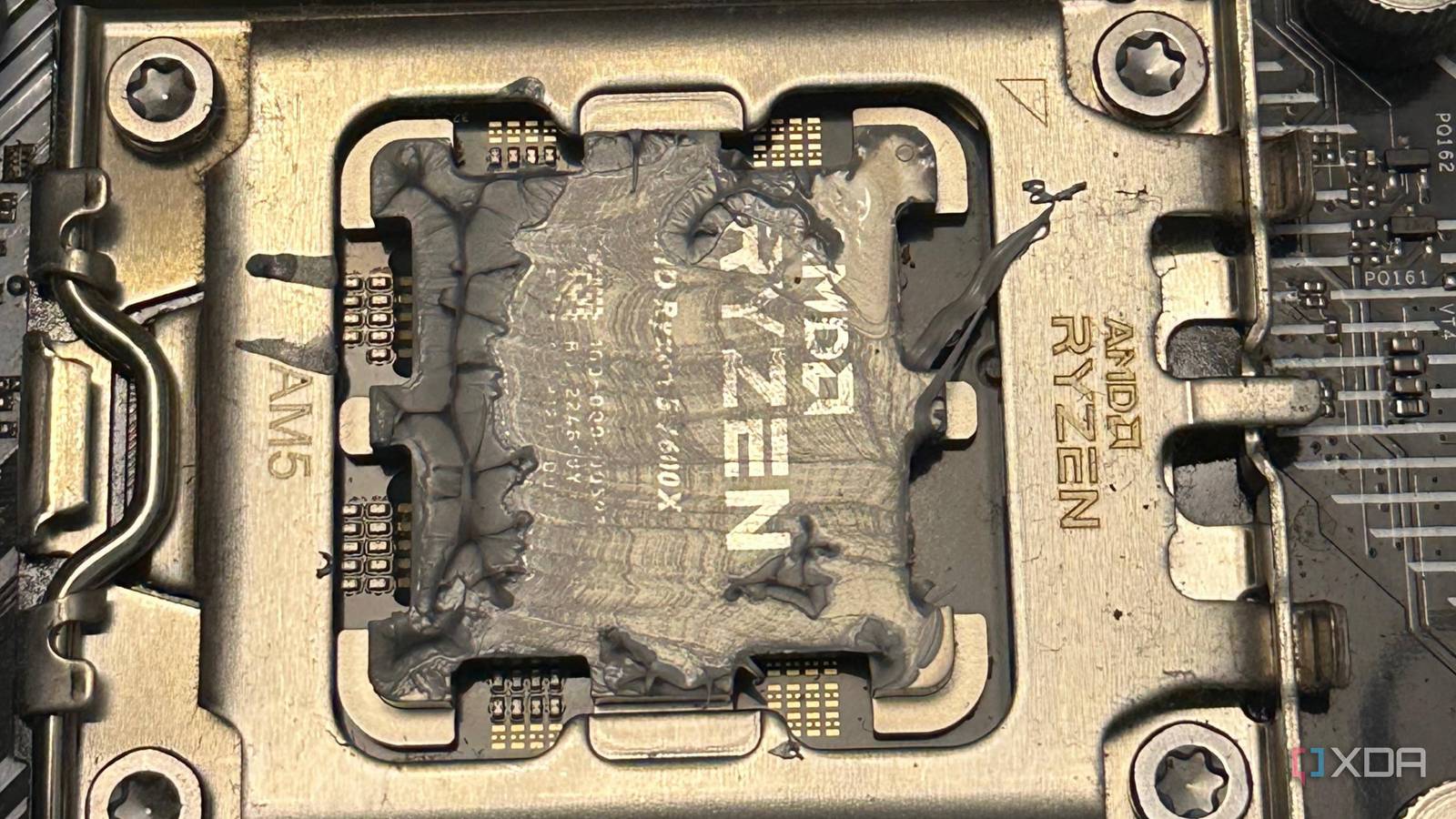
Published Aug 2, 2026, 7:00 AM EDT Hamlin has been in the tech field for over nine years. Since 2017, his work has appeared on MakeUseOf, Android Police, OSXDaily, Beebom, and more. He served as the Senior Editor at Valnet's MakeUseOf for over two years before joining XDA. He uses a high-end gaming rig for desktop use and a MacBook for traveling, but dislikes some of the quirks of macOS. You're more likely to catch him at the gym or on a flight than anywhere else. It has been a little over a year since I repasted my old Ryzen 9 5900X, which I used to build my PC back in 2020. Until then, I treated thermal paste application as a one-time thing. After all, I used to upgrade my CPU every three or four years, so its temperatures never became concerning enough to make me want to reapply thermal paste. Unlike every other CPU I'd used before, my 5900X always ran on the hotter side. It wasn't unusual to see temperatures spike to 80C while gaming, even with a 360mm AIO. But toward the end of my time with AM4, I noticed it occasionally touching 90C while playing AAA titles like Call of Duty: Warzone and Cyberpunk 2077. The worst part? It was running hotter even though its boost clocks were lower than what I was used to seeing in MSI Afterburner. That's what convinced me to repaste my CPU, and the results were immediately obvious. Not only was my CPU running cooler, but it also sustained its boost clocks for much longer. I probably should've done it sooner, but at least now I know better. Lower boost clocks were costing me performance When your CPU runs hotter, it's not going to push as hard I'm sure many of you already know that CPUs these days run hotter out of the box. That's because they're designed to run close to their thermal and power limits to squeeze out every last bit of performance they can. When my 5900X was new, I was shocked to see it hover around 80C while playing the latest games despite using a high-end 360mm AIO. A decade ago, I would've had to overclock my CPU to see those temperatures. Eventually, though, I got used to it because I learned that's simply how Zen 3 behaved. Despite that, my CPU was hitting pretty close to its advertised boost clock of 4.8GHz, which meant I was getting the performance I paid for. But that wasn't the case a few years down the line. My boost clocks dropped to roughly 4.4GHz to 4.5GHz, even as the CPU was running close to 90C in the same games. I knew 90C was its thermal limit, at which point the CPU would start throttling. But it didn't need to hit that number for its clock speeds to drop. And that reduction in boost clocks was enough to leave some performance on the table. Repasting didn't just fix temperatures It gave my CPU the thermal headroom it had when it was new When I first installed my 5900X, I just used the thermal paste that came with my AIO. This time, though, I went with Thermal Grizzly Kryonaut Extreme because I wanted a bigger improvement in temperatures. And yes, premium aftermarket pastes are well worth the investment, even if the difference is only around 2–3 degrees in most cases. They tend to last longer, and some of them are more resistant to the pump-out effect, so you wouldn't have to repaste nearly as often. In my case, my old paste had almost completely dried out, so I knew a fresh application would make a night-and-day difference. Now, my CPU was hovering closer to 80C in the same games, but more importantly, my boost clocks were close to 4.8GHz. I probably could've gotten better results by cleaning the radiator and fans, but I'll save that for another day. That temperature drop was all it took to give my CPU the thermal headroom to sustain higher boost clocks again. It's hard to tell the FPS difference with all the fluctuations, but if there's one thing I know, it's that those higher boost clocks weren't just for show. You don't have to repaste just because it's been years Your CPU will tell you when it's time for a reapplication I'm not telling you to all consider repasting your CPU just because it's been a few years. If you're still comfortable with your CPU temperatures and your boost clocks are holding steady, there's really no reason to take your cooler and apply fresh thermal paste. As the saying goes, if it ain't broke, don't fix it. Most thermal pastes won't dry out after just a couple of years. If anything, pump-out is more likely to become an issue, in which repeated heating and cooling cycles gradually push the paste away from the center of the CPU, reducing its effectiveness over time. Either way, the signs will be there if you monitor your temperatures and boost clocks using MSI Afterburner. Temperature is the obvious one, but clock speeds are just as important, as they indicate whether your CPU still has enough thermal headroom to boost as intended. If you do end up needing a repaste, the thermal compound you choose can also affect how long it lasts. Certain aftermarket pastes, such as Thermal Grizzly Kryonaut, are more prone to the pump-out effect than others, like Arctic MX-7. If longevity is a concern, you can also switch to a phase-change material such as Honeywell PTM7950. My CPU just needed thermal headroom to perform at its best The peace of mind I got from knowing that my old CPU was running cooler alone was worth more than the price of a tube of thermal paste. But that temperature drop is more about the thermal headroom that allowed it to boost as aggressively as it did on day one. Repasting is just one way to get there. I've since undervolted my CPU to lower its temperature and power draw, and that has allowed it to sustain its boost clocks for significantly longer. At the end of the day, your CPU's peak performance comes down to the headroom it has. Whether you get there by repasting, undervolting, or upgrading your cooler, the end goal is the same. JOYJOM PTM7950 The JOYJOM PTM7950 is a phase-change material thermal pad. It features a thermal conductivity rating of 8.5W/mK, and the phase change occurs at 45C.
I replaced the thermal paste on a five-year-old CPU, and got back performance I didn't know I'd lost
Full Article
Original Source
Read the full article at Xda-developers →KhanList aggregates and links to publicly available news content. We do not host full articles from third-party sources. Always verify important information with original sources.