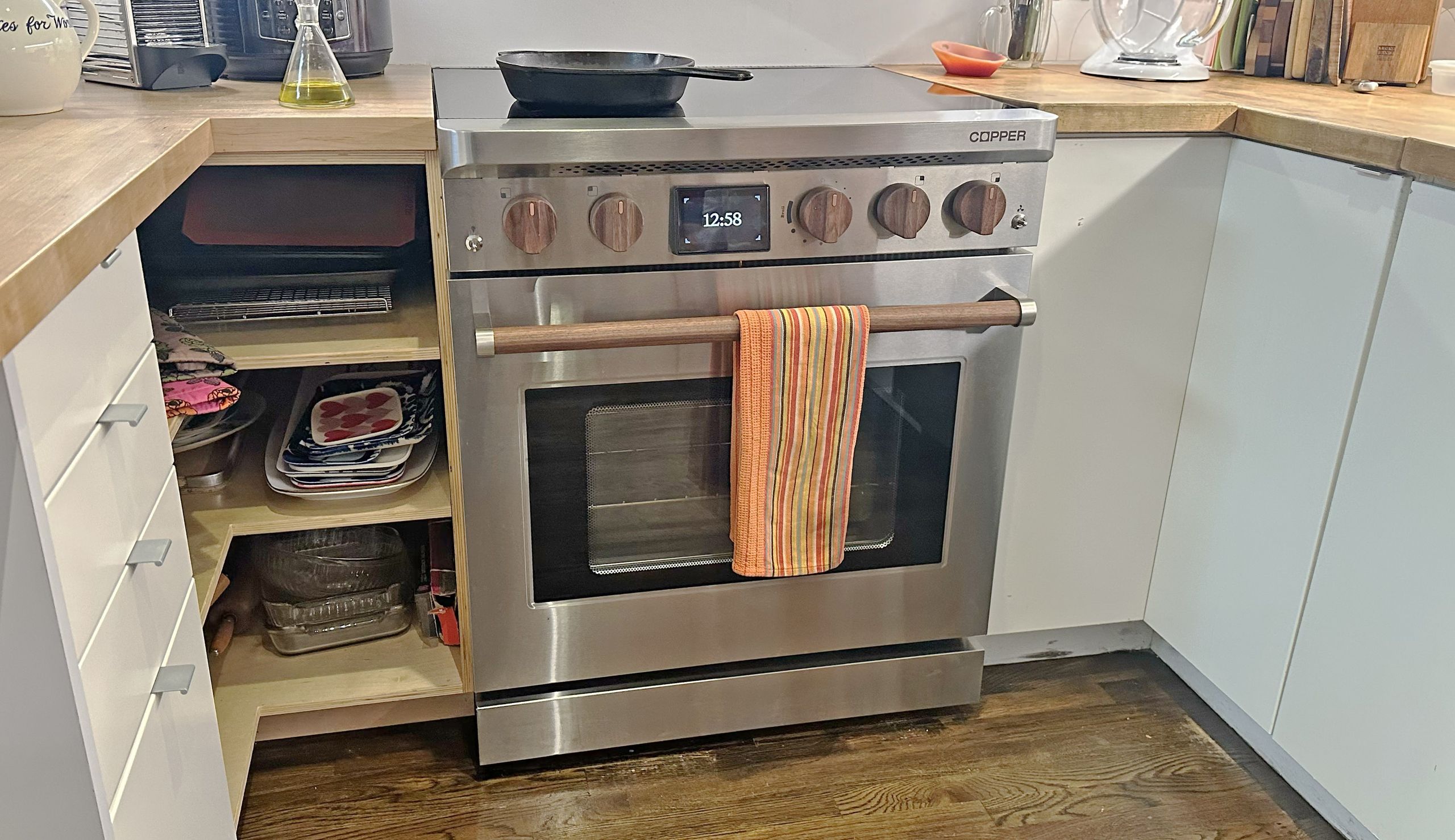
(Image credit: Future) The oil sizzled as I placed the scallops in the pan. On the counter next to me sat a tray of just-baked chocolate chip cookies, their aroma wafting through the air. In the oven, a tray of chicken thighs was slowly baking atop a mixture of Chinese vegetables, their juices infusing with the cabbage and boy choy beneath.I was cooking it all on the Copper Charlie, an innovative induction stove that doesn’t require any special installation, thanks to a massive battery. And while it's an early adopter in the world of early adopters, it could represent the future of home appliances.Renovation is the mother of necessity (Image credit: Future)I tested out the range in the Brooklyn apartment of Ted Booth, who switched from a traditional gas oven to the Copper about a year ago. At the time, his building was facing a million-dollar renovation bill to upgrade the ancient gas pipes leading into, and threading through, the entire 33-unit building.Rather than forcing the entire building to front the cost of fixing each unit’s gas line, the condo board gave each owner an option to switch to an induction stove. However, most induction stoves require a 220-volt electric line — which would have meant an equally expensive bill.But there was an alternative: the Copper induction stove. This range has a large battery in the bottom, where the warming tray would sit. Not only does this provide a steady source of energy, even when the power goes out, but it also allows the stove to use a regular 110-volt outlet, so you can plug it in almost anywhere.“To me, it was an opportunity to get off gas,” Booth said. “And, you can call me a bit of an early adopter, so it appealed to me that way.”Modern but retro (Image credit: Future)"It's the most analog experience I've had with a tech product"— Ted BoothWhile the Charlie uses a very new type of technology, and has Wi-Fi and can be updated over the internet, it’s surprisingly low on connected features.Get instant access to breaking news, the hottest reviews, great deals and helpful tips.“I like how simple it is,” Booth said. “It's connected to the Wi-Fi, it has a battery, but it's the most analog experience I've had with a tech product. You have the little light indicator on the side, and the screen shows you what it's doing — it's 350 degrees. That's all you need to know. It's great. And then the two little switches for the light and convection.”The cost of upgrading (Image credit: Future)The Copper Charlie isn’t cheap. The base model, with black plastic knobs, costs $6,000, while the model with black walnut knobs is $6,300. That’s more than twice as expensive as some popular models from LG and GE — though it should be noted the GE Cafe series can get up to $5,000.The Charlie is not Energy Star-certified, so you can’t get any government rebates from that program, but there are several other local clean energy tax credits that can help ease the cost.However, it did get the seal of approval from the New York City Housing Authority, which is installing 100 Copper Charlie stoves in apartments throughout the city as a pilot program for lower-income residents, as all city-owned apartment buildings get converted from gas to electric.“There are so many families that haven't had the ability to cook for years because they had their utility to get the gas shut off,” said Lisa Pickney, a professional chef who created the Official Dessert of the 1996 Atlanta Olympics, served on the Obama White House culinary team, and now works for Copper.“And so they just gave them a hot plate and a rice cooker and a teapot. And it's just not right. They can't make a Thanksgiving turkey. So that kind of broke my heart. And now they'll be able to have Thanksgiving and do proper cooking now.”The Copper Charlie isn’t the only induction stove of its kind; a rival company, the Electra Induction Stove, works in much the same way. Rather than the lithium ion batteries you might find in your phone or electric scooter, these stoves use a lithium phosphate battery, which is more stable, and more suited for how it’s used with the stoves.Now we're cooking (Image credit: Future)As I (well, mostly Lisa) were cooking, I was impressed with how fast the oven heated up. While I didn’t time it, the Copper Charlie seemed far shorter than my oven at home. Similarly, its cooktop element warmed up the pan in no time, and put a sear on the scallops as good as I’ve ever done on any range, gas or electric.Booth said that his cooking game has improved since getting the Charlie. “I like to make a Spanish potato omelet,” he said. “I like it because you can get a really nice, low temperature, so it doesn't brown too quickly. With the gas, I could get a low flame, but then the heat doesn't distribute quite as well, and so it's like cooking more in one spot and less on the edges.” (Image credit: Future)Booth said he could no longer do the Mark Bittman trick of cooking a steak by placing a pan on the very bottom of the oven, but the Charlie proved its worth when the outlet behind the stove stopped working.“At first, I was like, what are we gonna do?” he said. “It's gonna take a while to get an electrician to come, and then I was like, oh, no, wait, it's fine. We have an outlet behind that cluster of little appliances in the corner is a four-prong outlet with a GFCI. So I just plugged it into that.”“That to me really proved to me how much power this draws, because we've got an Instapot, we've got a kettle, we've got an espresso machine. And we never had an issue, it never popped the GFCI.”How it's working out (Image credit: Future)Ultimately, eleven owners in Booth’s building ended up getting a Copper Charlie. It proved to be more expensive than those who merely opted to replace their gas line, but Booth said it was worth the expense.“We're gonna spend all this money for these pipes in the wall, and all I get is to get a blue flame?” he asks. ”I want something better than that.” Follow Tom's Guide on Google News and add us as a preferred source to get our up-to-date news, analysis, and reviews in your feeds. More from Tom's GuideI used an induction cooktop for the first time — here are 3 things I learned5 mistakes I made when I switched to an induction cooktopWe tested 3 portable induction cooktops from $50 to $1,500 Michael A. Prospero is the U.S. Editor-in-Chief for Tom’s Guide. In his spare time, he also tests out the latest drones, electric scooters, and smart home gadgets, such as video doorbells. Before his tenure at Tom's Guide, he was the Reviews Editor for Laptop Magazine, a reporter at Fast Company, the Times of Trenton, and, many eons back, an intern at George magazine. He received his undergraduate degree from Boston College, where he worked on the campus newspaper The Heights, and then attended the Columbia University school of Journalism. When he’s not testing out the latest running watch, electric scooter, or skiing or training for a marathon, he’s probably using the latest sous vide machine, smoker, or pizza oven, to the delight — or chagrin — of his family.
I put a battery-powered induction stove to the test — here’s what surprised me
Full Article
Original Source
Read the full article at Tomsguide →KhanList aggregates and links to publicly available news content. We do not host full articles from third-party sources. Always verify important information with original sources.