
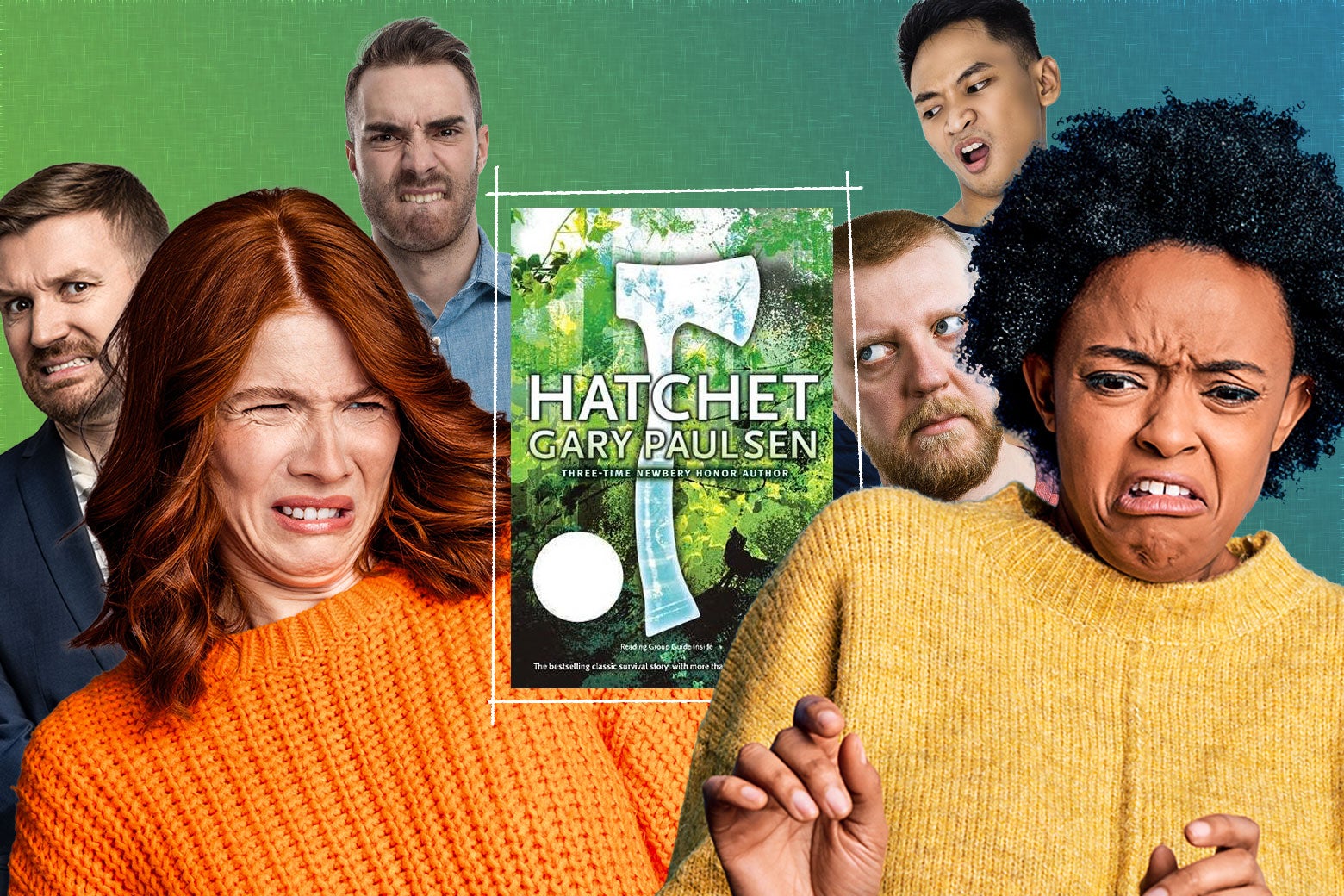
Books It’s All Part of the Plan Millions of kids had to read Hatchet in school. That was no accident. By Enter your email to receive alerts for this author. Sign in or create an account to better manage your email preferences. Unsubscribe from email alerts Are you sure you want to unsubscribe from email alerts for Luke Winkie? Nov 06, 20265:45 AM Photo illustration by Slate. Photos by Amazon and Getty Images Plus. Sign up for the Slatest to get the most insightful analysis, criticism, and advice out there, delivered to your inbox daily. For much of my youth, Hatchet—the coming-of-age novel by Gary Paulsen, published in 1987 and disseminated far and wide since then—was my favorite book. A teacher assigned it to me in sixth grade, partway through my first semester of middle school. The story is a compact 192 pages, all flesh and bone: little exposition, seldom writerly digressions. A 13-year-old boy named Brian is marooned in the northern Canadian wilderness. He forages berries and snares rabbits. He fashions a primitive shelter under a stony ridge. He is equipped only with the titular hatchet, which he wields with deftness as the calluses of frontier life solidify. Brian whittles driftwood into arrow shafts. He notches together fishing spears and coaxes embers into roaring cookfires. Occasionally Brian fends off the ornery wildlife surrounding him—wolves, bears, and most memorably, a rampaging bull moose. The culmination of the drama has Brian retrieving the emergency radio from the wreckage of the plane crash that grounded him. His SOS signal is reciprocated, and Brian is reunited with his father—with a newfound steeliness in his gut. When I was a preteen, this is all I wanted out of fiction. Hatchet is a paean to the tenacity of young boys, validation of all we thought we were capable of if no grown-ups were around. I read my paperback copy over and over again, savoring the gory details. I dog-eared my favorite passages, I closed my eyes and attempted to internalize some of the rough-hewn lessons it dispensed about the hinterlands—maybe, with enough practice, I too could string a bow and arrow. And for years, I assumed that everyone else felt the same way. After all, Hatchet is often cited as one of the classics of young adult literature: It has sold 13 million copies in America alone, and remains one of the most frequently taught novels in English classes far and wide. But a few weeks ago, something curious happened. Netflix announced that a film adaptation of Hatchet was in the works, and the topic of the novel reentered the public square. That’s when I learned something startling. A lot of people really, really hate this book. The person who first clued me in to this dynamic was—who else?—my wife. She was assigned Hatchet in her final year of elementary school and recalls the reading with bitter resentment—as if the novel diminished her childhood as a whole. Her gripes are voluminous and wide-ranging. My wife remembers the plot feeling stunted and hemmed in, mostly due to the narrative isolation. (“You know what’s really boring to read about? A child alone in the wilderness,” she said, in a lengthy text message she sent me on the subject.) She was unmoved by the grim realities of subsistence living; the drama of poison oak, or live prey, or brutal rainstorms, all elements I found totally captivating. But frankly—and this is crucial—the real reason my wife hates Hatchet is that she felt like she was forced to read it out of deference to the boys in her class who wouldn’t read anything else. Or, more directly, my wife hated Hatchet because of students like me. “It represents this widespread misconception in public education that in order for boys to open a book, it has to be about the most stereotypical boy stuff imaginable,” she said. “I realize that many teen boys probably feel this way when they’re assigned Jane Eyre, but the thing is, Jane Eyre is a masterpiece, and Hatchet is just sort of whatever. There simply has to be a better way to reach the hearts and minds of would-be incels other than, like, a story about a kid finding self-actualization with a weapon.” My wife’s sentiment has proved to be surprisingly common as I polled other millennials about Hatchet. I don’t want to be too reductive here. There are a lot of women who adore the book, who found themselves seduced by its primalist fantasies and its solemn exaltation of nature—who, like me, were enthralled by its didactic recounting of bushcraft—and who have carried that fascination with them for the rest of their lives. (It ought to be noted that The Hunger Games, a survivalist dystopian series written by a woman and starring a teen-girl protagonist, is deeply indebted to the Paulsen estate.) Having said that, it is telling that the people who harbor the most umbrage for Hatchet were once young girls, and they hate it in precisely the same manner that my wife does. Consider Leila Sales, a children’s author and editor, who has never forgiven her teachers for foisting Hatchet upon her. “The main character kept suffering. He’s vomiting constantly. He’d be sitting there, getting eaten by a million mosquitoes. It was just ceaseless misery. I was a little girl. I wasn’t moved by stories of great suffering,” she said. (Sales’ disgust for Hatchet is so potent that she once penned a gender-swapped satire of the story for a book fair.) “Like, what was the moral of this book? What was I supposed to take away from it?” Sales continued. “Not to get stranded alone in the Canadian wilderness?” Or how about Katie Orenstein, a theater professional who went to an all-girls private school in New York City. Somehow, she too was pressed into reading Hatchet. “It felt very thin on character, and very long on description, like the author was going through a checklist of things he wanted to teach kids about the outdoors,” she said. Orenstein regarded the assignment like an encroachment on her world—as if her private realm of books and stories was suddenly being infringed upon by the jocks. “It was like, ‘Ugh, why can’t I go back to reading books that were my choice?’ ” she said. ” ‘Books that are for people like me?’ “ It went on and on like this. One friend of mine told me that the mere image of the Hatchet cover art induces within her a knee-buckling wince, and Slate staffers weren’t much kinder. (“It was just a sad boy in the woods with no plot,” commented managing editor Abby McIntyre.) These revelations have been personally destabilizing. I loved Hatchet—I still love Hatchet—and for the first time in my life, I’m confronting the possibility that this love was nurtured out of a desperate ploy to engage my remedial literacy, cooked up by exasperated English teachers who knew there was no shot they could sucker me and a bunch of other doofus sixth graders into the joys of reading with, say, the elliptical syntax of Great Expectations. Were we given Hatchet because they knew we trembled in fear at the sight of the Penguin Classics logo? Was I a far less adroit student than I imagined myself to be? Has Hatchet stuck around in the kids’ book canon because, plain and simple, boys are bad readers? I wasn’t exactly sure how to answer that question. So I reached out to William Roemmich—or, as I know him, Mr. Roemmich—my seventh grade English teacher, and the one of the most kinetic educators I’ve ever encountered. Roemmich could transfix a classroom with the tragedy of John Keats; he could kindle nascent curiosities in Latin and Shakespeare. But when the chips were down, and he was facing off against a fleet of dead-eyed reluctant readers—most likely during a bleary second period—Roemmich could turn to Hatchet, a novel that never let him down in his career. “We absolutely rely on that book to seduce young boys into reading,” he told me. “You’ve got to find books that boys will like. “The hatchet itself is like the tool of the gods. Achilles has his shield, and Brian has this hatchet,” Roemmich continued. “I think that reels them in. Boys tend to be fascinated by toys and weapons.” This is more than just his hunch. There is a surprisingly dense amount of scholarship printed about Hatchet—specifically how the novel can be deployed like a pedagogical Trojan horse, slipping past a supposed masculine aversion to fiction. Entire instruction manuals have been written about how to teach Hatchet. Another pamphlet, published by Virginia Tech in 1999, heralded Hatchet as a “thought-provoking piece of literature” that could “entice young skeptics” who “find traditional literary works boring at best or obscure and irrelevant at worst.” (The pamphlet goes on to advocate for the book to be taught in literally every subject—science, history, social studies, and so on—further underscoring the idea that for some teachers, Hatchet was regarded as a miracle cure.) As for why the book earned its gendered reputation, Sara Schwebel, director of the Center for Children’s Books at the University of Illinois Urbana-Champaign, thinks that was a self-conscious choice made by educators putting together their curriculum. After all, most English teachers are women, and perhaps they needed to be extra accommodating to the tastes of boys. “That awareness was there. What if we’re doing a disservice, in a very gender-minded world, to the boys in our class?” she said. “What if we could help close the gap by offering them material to help make them lifelong readers, and that is our responsibility to do so?” There is also the basic fact that, by and large, young boys tend to demonstrate lower literacy proficiency than the young girls in their classes—an uncomfortable dichotomy of childhood development that is nonetheless scientific consensus. (“They’re thought to be behind in their reading skills in middle school,” said Jonna Perrillo, a professor of English education at the University of Texas at El Paso. “A lot of times, when we’re talking about resistant readers, we’re trying to capture boys.”) In that sense, how can you blame a teacher reaching for something as digestible as Hatchet, even if it might alienate all the young Austenites in the room? “Hatchet doesn’t push any buttons. It doesn’t get sucked into the culture wars. It doesn’t have violence and other problems that a book like The Hunger Games can have,” added Perrillo. “Books sometimes get adopted because of what they aren’t, or because they provide a kind of safety.” Ironically, all of these discussions are less pertinent than they used to be. Full novels have rapidly fallen out of style in English classes. Today students are much more likely to be assigned a passage, or a collection of excerpts, rather than an entire book—even one as lightweight as Hatchet. Perrillo told me there are a number of reasons for this trend. English curricula are wrapped around the pressures of standardized test scores, a format in which kids read only a couple of paragraphs before bubbling in their answers. It’s a pivot to teaching reading as a skill, rather than a crucial spice of life. And, naturally, Perrillo finds it “completely depressing and dystopian.” “It changes what reading is for students. When we talk about low literacy rates, I wonder how much that has to do with how kids are reading in school, and learning why they would want to read for fun,” she continued. “I bet when you were reading Hatchet, you were thinking about how to survive, and what kinds of skills and talents you had, and what you didn’t. Those kinds of questions, which are at the heart of literature, have almost no purchase in the curriculum anymore.” I suppose that means everyone should mourn the legacy of Hatchet—even those who hate it. Here is a book put on earth to widen the aperture of literature. It accomplished exactly what it intended, for years on end. This is a bit of a tangent, but I’m currently partway through Killing Floor, the first entry in the venerable Jack Reacher series by Lee Child. Here, too, is a book brimming with masculine fantasy—full of prison brawls, dirty cops, and femme fatales. I’ve enjoyed the hell out of it, and if she ever leafed through its pages, I’m certain my wife would be horrified. There, again, is the power of Hatchet. Thank God I spent that summer with Brian in the Canadian wilderness. Thank God there are books out there for boys like me. Books Education Kids Women Men
I Love Hatchet. Millions of People Don’t. I’m Just Now Realizing the Unsettling Reason Why.
Full Article
Original Source
Read the full article at Slate →KhanList aggregates and links to publicly available news content. We do not host full articles from third-party sources. Always verify important information with original sources.