
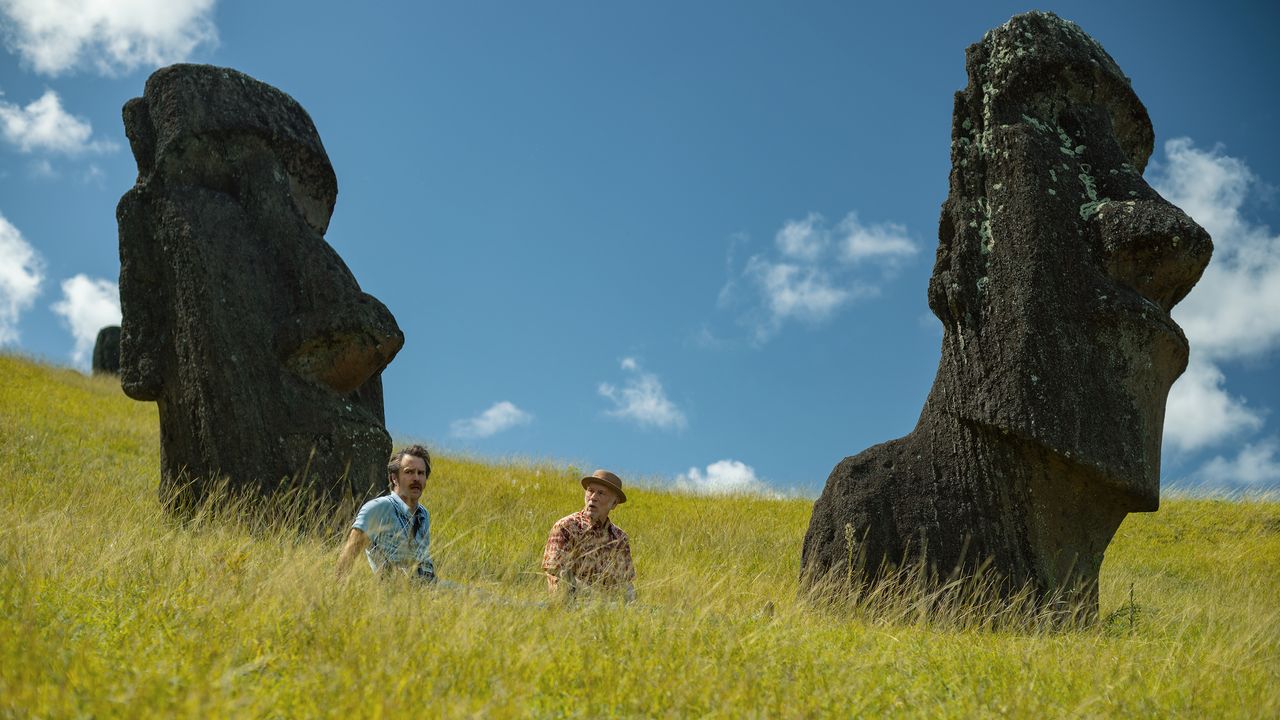
In anticipation of Martin McDonagh's new film about two CIA agents in 1970s Chile, writer Lale Arikoglu seeks out the locations and the real people behind them.Diego Araya CorvalánWithin a few minutes of arriving at archaeological site Ahu Tongariki in Rapa Nui, where 15 gargantuan moai statues stand with their backs to the sea, my guide Gina’s phone lights up with the words “Tsunami Alert.” I ask her if this is a relatively normal occurrence on the island. “No… Although there was one [tsunami] in 1960 that washed several of these away towards the hill,” she says, gesturing towards the large sacred monolithic heads carved from volcanic stone, the Pacific Ocean sitting vast and blue behind them. The alert was later lifted, but I still felt a sense of impending doom as I posed for a photo in front of the moai.Martin McDonagh's new film, starring Sam Rockwell and John Malkovich, follows two CIA agents through Chile. Searchlight PicturesFlirting with one’s own mortality at the edge of the world sits right at the heart of Wild Horse Nine, a new film written and directed by Martin McDonagh and filmed partially on Rapa Nui. Starring Sam Rockwell and John Malkovich, the dark comedy charts the journey of two CIA agents in Chile as they travel from their station in Santiago to the Polynesian island for a week-long vacation. Their trip also happens to be just before the country’s 1973 military coup, which would oust socialist president Salvador Allende and install dictator General Augusto Pinochet—an event that, for those at all familiar with the history of American foreign policy in Latin America, these two agents have clearly meddled in as operatives. I’d come to Chile to follow in the film's wake—to trace the real-life locations and history behind the silver-screen fiction.The film’s characters Chris Carlisle (Malkovich) and Lee Chesterfield (Rockwell) form the kind of acerbic buddy duo that’s become associated with McDonagh films like In Bruges. The older, brasher Chris, now in the waning years of his spy career, considers their trip to Rapa Nui his final act following a terminal cancer diagnosis, bullishly demanding to see “the big heads” in reference to the moai. Lee, meanwhile, functions as exasperated colleague, grieving friend, and increasingly, minder, as his mentor’s memory begins to slip, sometimes returning loudly in moments of unguarded truth—or perhaps deathbed confessions. (One such example: a monologue where he cheerily reminisces about other elected governments he’d helped overthrow on the job.)Chris and Lee are an uncurious pair of travelers, bristling at polite requests to educate themselves about Rapa Nui's Indigenous culture, and showing little interest in taking its history seriously. (“Why are you here if you’re just going to make fun of the place?” a fellow tourist asks Chris.) They play the part of ugly American tourists astutely—and yet, it’s largely through their eyes that we see both a 1970's Santiago and Rapa Nui on the screen.Chris Carlisle (Malkovich) and Lee Chesterfield (Rockwell) travel from Santiago to Rapa Nui once character Chris receives a teminal diagnosis. Searchlight PicturesThe rising interest in traveling to film locations is why tour operator Abercrombie & Kent has launched a 9-day itinerary, which allows guests to chase Wild Horse Nine's trail. I traveled to Chile to road-test the new offering. And like the characters of Carlisle and Chesterfield, I begin my trip in Santiago.Unlike in the movie, the city is experiencing an unseasonable amount of rain on the morning I arrive. The Andes, which usually loom imposingly over the skyline, are concealed behind thick clouds, and the Mapocho River, which cuts through the city like an artery, is close to bursting its banks. But the 19th-century architecture of bohemian Barrio Lastarria is much more familiar. I’m met outside my hotel by my guide Lisette Matamala, who will spend the next couple of days introducing me to the fraught political history that serves as the backbone of Wild Horse Nine’s suspenseful plot.The rain is lashing down, but we forge ahead on foot to nearby Plaza de la Constitución, and stand under comically sized umbrellas to have a look at La Moneda Palace. The seat of the Chilean president, this palace was bombed during the coup, resulting in one of the most memorable images from that day. In the movie, viewers see the regal structure, still intact, glimpsed through the office window of cranky CIA bureau chief MJ (Steve Buscemi), a key player in orchestrating the chaos. According to production designer Denis Schnegg, who I will speak to later on the phone, the team filmed that scene in an office opposite the palace that really had been used by the CIA during that time: “To stand in that room and look out at the palace, knowing how these people had been orchestrating it from their window, that the whole thing was planned—it's quite chilling.”Santiago's presidential palace La Moneda in the aftermath of the 1973 coup d'etat led by Commander of the Army General Augusto Pinochet. GettyThe consequences of their work are etched within the Salvador Allende Museum of Solidarity, a contemporary art museum in the historic neighborhood of Barrio República that has lived several lives: First, as an affluent mid-20th-century family home; then a left wing exhibition space founded in 1971 by a group of creative intellectuals; and, later, as a detention center and listening station operated by Pinochet’s Directorate of National Intelligence (DINA). It has since returned to its original form as a museum, resurrected after the return to democracy in 1990.While not a Wild Horse Nine filming location, it’s an important stop to help place the film within the context of these very real historical events. “This house has a lot of layers of history and meaning,” museum director María José Lemaitre tells me as we walk down a flight of wide, winding wooden stairs. “And also, darkness.” When the art was reinstalled, secrets were uncovered within the bones of the building: transcriptions of tapped phone calls were hidden by DINA in the ceilings, and phone-tapping equipment sat in the basement.Lemaitre and her colleague, museum curator Caroll Yasky, bring me to see the latter, housed in a dusty, windowless subterranean room. We linger over the handwritten names and phone numbers of families the DINA had spied on—tangible evidence of the horrors enacted by the history driving McDonagh’s plot. “The museum may show the past, but what is important is the future,” says Yasky as we walk back upstairs into the daylight.The fingerprints of Pinochet’s regime are never far away in Santiago. I spend a pisco sour-filled evening dining with a university professor whose father had been one of the dictator's driver—a role that, he suggests, haunted his father so deeply he had a stroke to forget it. (It's an anecdote I can’t help but thread back to Chris’ struggles with redemption in Wild Horse Nine, which we often see him exploring in misguided attempts to write a memoir that he plans to leave behind following his imminent death.)Much of Rapa Nui feels—and appears in the film—as though it sits on the edge of the world. Searchlight PicturesAnother afternoon, we visit Villa Grimaldi, a once-notorious detention center on the outskirts of the city that now serves as a memorial. Two of its survivors are Alvaro Ahumada and Ignacio Puelma, smartly dressed and in their early 70s, who meet us under the trees near the entrance for a tour. We pass sobering remnants of the detention center’s structures, but also clusters of fragrant roses, colorful mosaics, and water features. “We didn’t want to have a horror museum,” says Ahumada, who is also the president of the foundation. “Instead, we wanted to wash away what happened here.”The pair, I realize, would have been around the same age as the character of a young, optimistic left-wing student in the film named Monica, played by Mariana di Girolamo. These two were both members of the student-led Movement of the Revolutionary Left, and at just 19 and 21 at the time, they had been transferred from Villa Grimaldi to the same concentration camp where they connected over music, even forming a band during their imprisonment. “Our bond is very deep,” says Puelma, as a flock of squawking parakeets fly over us. “We were both rockers, so we had a lot to talk about,” adds Ahumada. “Helping each other, and looking after each other, was an act of resistance.”Their story evokes a poignant scene in Wild Horse Nine, when they later reach Rapa Nui, during which Chris meets up with Monica at a low-lit, moody bar. As the ill-fated folk singer Victor Jara (Aron Hernandez) performs on stage, Chris tells her with disturbing frankness that he is not just a CIA agent, but one who has come down to Chile to “destabilize your democracy,” a direct reference to the United States’ involvement in installing Pinochet.In one of the film's scenes, young Chileans are confronted by Chris's character, who tells them he has come to Chile to “destabilize your democracy.” Diego Araya Corvalán / Searchlight PicturesMcDonagh’s decision to depict Jara, who was murdered by members of Pinochet's regime, is yet another reminder that beyond the buffoonery of Chris and Lee, lie the stories of real people like Ahumada and Puelma. Some of the film’s cast still feel its impact, too. “Monica [is based on] a real character: Comandante Tamara, a left-wing student and [guerilla leader] who attempted to assassinate Pinochet. And, of course, we know what happened to Victor Jara, the singer who is playing a Violeta Parra song in that bar,” di Girolamo tells me after the trip. “I was born in the first year of democracy, but my parents were students in school in ‘73. [This history] is just something you grow up with, and it's still an open wound for us.”I arrive in Rapa Nui the same way Chris and Lee do: on vacation, via the one daily flight from Santiago, landing at a thatched airport where ukulele music wafts through the air and chickens toddle around baggage claim. Gina Pakarati, who was born and raised on the island, picks me up outside in her white Suzuki Jimny, and we set off to visit the same moai sites that, in the film, Chris tells Lee he wants to see before he dies. In fact, it’s when they first reach the island that it’s revealed to viewers that Chris has asked Lee to put a gun to his head and end things right here on Rapa Nui.Wild horses run across the open, lush green plains of Rapa Nui island. GettyPakarati, who knows the island like the back of her hand, blasts local Polynesian folk-country band Topatangi as we trace the rugged coastal drive captured in the film, past swathes of electric-green grassland and black volcanic rock. We pause for herds of the same chestnut-brown wild horses McDonagh frequently turns his camera to.I wind my window down, and the air smells sweet yet woody. There is a surreal, heavenly quality to being here. At one point, Pakarati pulls over and plucks a small guava off a tree, so ripe that she can pull it apart with her hands, for us to eat at the side of the road.As we drive up towards Ahu Akivi, one of several imposing moai sites on the island, small groups of tourists are milling around, some of whom I recognize. (Given the island’s size, you tend to cross paths with the same visitors fairly quickly.) Just like Chris and Lee, we’ve all come here for the same once-in-a-lifetime experience—albeit without a Super 8 camera and guns in holsters. But finally laying eyes on the moai feels like seeing a myth come to life. Pakarati, who is 43 and comes from a long lineage of Rapa Nui people, explains to me that of all the ceremonial platforms here, this one is particularly special because its seven statues are “looking towards Polynesia, the land where they came from.”Towering moai made from volcanic stone—which Malkovich's character refers to as “the big heads”—are a living piece of ancient Polynesian history on Rapa Nui. GettyShe recalls playing among the statues as a child (an activity now deterred by a rope) and hearing her grandfather’s stories of helping the visiting archeologist William Mulloy with their restoration in the 1960s. Thanks largely to Mulloy, that period drew more attention to the island and, after the first commercial flight arrived in 1967, ushered in the first real wave of tourism. Though it is a territory of Chile, life on Rapa Nui felt awfully far away from the coup, I'm told. Hotels began opening, more cars appeared on the roads, and in 1993, the first Hollywood film crew arrived. Despite the fact that the subsequent Kevin Costner-produced movie Rapa Nui was a widely criticized box-office flop, Pakarati says, economically everything changed after it, due to how many jobs were created—and she suggests that the spotlight of Wild Horse Nine might prompt another such wave of activity.That initial Hollywood-driven boom on the island inspired hospitality ventures like still-operating, family-run Iorana Hotel. It’s an eccentric ocean-view property just outside of town that opened in the 1990s but feels frozen in the '70s. So much so that, in Wild Horse Nine, Chris and Lee both stay there, picking fights with unsuspecting tourists and waving their guns around in the rooms. Cars from the era were temporarily shipped over to drive past the property in certain shots, says Schnegg, but when it came to the interiors, which feature floor-to-ceiling wood paneling, tiki-style floral-patterned upholstery, and buttercup-yellow room doors, little was changed. (“The hotel is actually sort of disconnected from [town], which is probably why it's a bit stuck in time,” Schnegg notes.) One addition, however, were the protagonist’s rooms, which were specially built for the film. The owners plan to keep the set and turn it into a tourist attraction. “The last night [of filming] we were set up until 7 a.m. and then had a huge celebration in the morning,” says the owners' daughter, Carolina, as we take a look at the set. “I think this film will be good for the island.”The family-run Iorana Hotel transports visitors—and viewers—straight to the 1970s. Diego Araya Corvalán / Searchlight PicturesWe watch Chris and Lee ramble around many of the moai sites, but the one that stuns me most in its scale and beauty is the quarry at Rano Raraku, where hundreds of moai protrude at different levels from the hillside of an extinct volcano. Many lie solemnly in situ among the grass, while others now stand, having been hauled up into a standing position by archeologists in the ‘70s. Some are massive, and others unfinished. A view towards the coastline offers a spectacular vantage point of the fifteen statues of Ahu Tongariki, which all look back upon the quarry where they were created.In Wild Horse Nine, we witness Chris and Lee unravel at this very site in a dramatic final shootout. I, in contrast, sit on a bench with Pakarati, the breeze making the grass shimmer (nowhere else have I been so astounded by the green of the grass), as she explains how these mammoth works were constructed and moved around the island by her ancestors. It may be a thrill to stand where the actors of Wild Horse Nine stood, but there’s much more gravity in knowing that I’m treading the same soil as those who carved the hulking statues before me. These days, Rapa Nui's archaeological sites can only be entered with an authorized guide—and I’m grateful for it as Pakarati shares her stories.Rapa Nui provides a pensive setting for the film's character's, particularly Chris who knows his days are numbered. Diego Araya CorvalánToward the film's end, Chris, death knocking on his door, describes isolated Rapa Nui as a lonely place. But I find it to be quite the opposite. On my final morning, we wake early and drive back over to Ahu Tongariki to watch the sun rise. The atmosphere is similar to gathering in anticipation of an eclipse. Locals and tourists alike set up camping chairs and drink coffee out of flasks as the sky changes hue: deep purple merging into soft blues, followed by shades of pink, ochre, and yellow bursting from behind the silhouettes of the moai.Standing in the early dawn light, it’s easy to understand why such an epic natural landscape was used as a burial ground on ancient Rapa Nui—and why McDonagh thought a CIA agent like Chris, dying and trying to seek redemption from his darkened memories, may want to swagger over to such a place before his morally disreputable life comes to an end. Even with his internal struggle, does he have the right to such a bucket list? “When I read the script for the first time, I felt a little guilty about laughing [while they do] these terrible things,” di Girolamo had told me during our conversation. “Yet I’d felt empathy for these agents. I cried.”The sun fixes itself high above the moai and we all clap. Another new day at the edge of the world.Wild Rapa Nui is a 5.5-hour flight from Santiago, and feels a world away. emesilvaHow to plan itI flew direct from New York City to Santiago, before catching the 5.5-hour flight to Rapa Nui on LATAM Airlines—currently the only commercial flight to get you there. My itinerary was booked through tour operator Abercrombie & Kent, which has crafted an exclusive Wild Horse Nine trip tailored to the movie locations, while also connecting travelers with the real-life Chileans who lived under the Pinochet regime and want to share their stories.Where to staySantiago: I spent three nights at the Singular Hotel, a boutique property in the center of artsy Barrio Lastarria. Rooms are spacious and comfortable, but the real winner here is the buzzy rooftop bar serving excellent pisco sours. It’s also walking distance from La Moneda Palace and the must-visit Chilean Museum of Pre-Columbian Art, which features several artifacts from Rapa Nui.Rapa Nui: While there is an Explora property further inland, most hotels are clustered in and around the sole town of Hanga Roa, a laid-back, sunny community lined with seafood restaurants, surf shops, and cafes and bars wafting ukulele music. Check into Nayara Hangaroa for oceanfront rooms, a pool set upon volcanic rocks, and a concierge to assist with arranging excursions. Rumor has it that John Malkovich stayed here while filming Wild Horse Nine.Visit the filming locations from Wild Horse NineLa Moneda Palace: A 15-minute walk from the Singular Hotel, Chile’s presidential palace is worth a pause as you pass through downtown. Buttressed by the Plaza de la Constitución and the Plaza de la Ciudadanía, it’s a largely civic area, but it’s hard not to be stirred by the location knowing, as Schnegg noted, that everything that took place here.In Wild Horse Nine, the still-operating Municipal Theatre of Santiago is turned into an upper-class restaurant. Searchlight PicturesMunicipal Theatre of Santiago: “For a pivotal scene with Chris and Lee, we turned the opera house into a sort of upper-class restaurant where [you’d imagine] the political elite would meet,” says Schnegg of the Municipal Theatre of Santiago, a beautiful, fully operational theater in the center of the city. Buy tickets for a performance to see its grand 19th-century interiors, or do as I did and request Abercrombie & Kent arrange a tour for a behind-the-scenes glimpse.Museum of Memory and Human Rights: While not a location in Wild Horse Nine, this museum is an essential stop to confront Chile’s recent history and understand the lasting trauma of the Pinochet dictatorship. “It's an open wound for us because we didn't have justice,” says di Girolamo. “There are still mothers looking for their sons.” Set within a brutalist building near Quinta Normal Park, the museum displays testimonials from survivors, preserved artifacts, memorials to the missing, and government documents from the time—including several declassified CIA documents revealing its role in the 1973 coup.Iorana Hotel: One of the main locations in Wild Horse Nine, this family-owned property overlooking the ocean is fully in operation and taking bookings. With furniture clad in tiki prints, retro wood paneling, and palm trees swaying outside the windows, it’s also a fun place just to snap a couple of photos. Ask to see the set that still remains—just watch out for the grumpy resident dog, who is best admired from afar.Anakena Beach is a scenic tourist site on Rapa Nui, and actor Mariana di Girolamo's favorite filming location. GettyAnakena Beach: “My favorite location in the movie is Anakena Beach,” says di Girolamo of the scene where she and Chris strike up a brief, unlikely friendship at the Rapa Nui tourist spot, where a bar serving piña coladas sits side by side with the Ahu Nau Nau moai. “That beach is so beautiful, but I was also able to go to a very special place nearby that you can only visit with someone local: the Cave of the Virgins [or Ana o Keke] set inside a cliff.”Ahu Tongariki and Rano Raraku: These two moai sites are within short driving distance of each other (as are most sites on Rapa Nui) and make frequent appearances in the movie. Book a local authorized guide to visit them, or arrange a guided excursion through Nayara Hangaroa. And don’t rush, either: the statues and the landscape look vastly different throughout the day as the light changes. “We were filming there for weeks on end, just living with the sky and the wind and the water and the sounds and the horses,” says Schnegg. “I’d just think, is this real?”Lale Arikoglu is the Director of Special Projects at Condé Nast Traveler and host of the award-winning Women Who Travel podcast, interviewing high profile guests including Eva Longoria, Gabrielle Union, and Brooke Shields. Working across print and digital platforms, her reporting has taken her all over the world, from Patagonia ... Read More
Tracing Wild Horse Nine's Route Through Chile—From Santiago to Rapa Nui
Full Article
Original Source
Read the full article at Cntraveler →KhanList aggregates and links to publicly available news content. We do not host full articles from third-party sources. Always verify important information with original sources.