
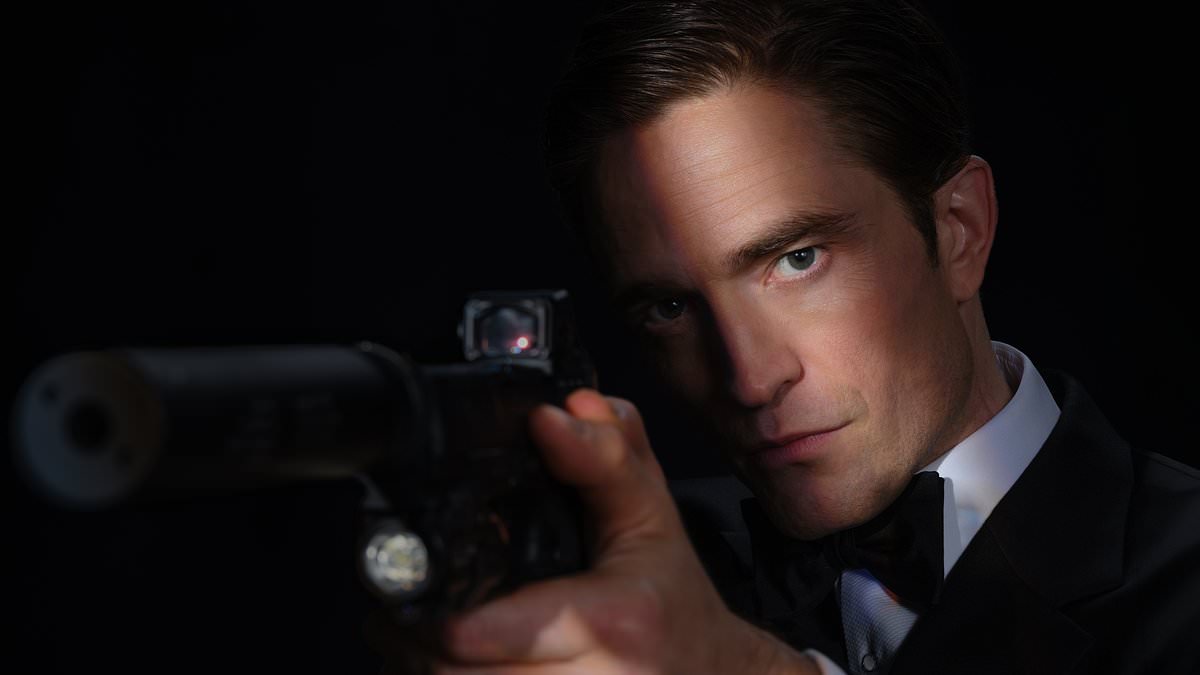
James Bond has had an enormous impact on the world of espionage. I can testify to that as a writer of spy thrillers and someone who worked at the Central Intelligence Agency (CIA) for eight years.But what makes this such a strange observation is that, in all my years in the spy game – which included liaison work with British Intelligence – I never once met anyone the slightest bit reminiscent of Bond. There was nobody like 007. Anywhere. Ever.In fact, a CIA case-officer friend of mine once told me that in all his years of service he had only once worn a tuxedo – and that was for his daughter’s wedding. Bond, of course, is hardly ever out of his.Now that the casting of Robert Pattinson has brought the world’s most famous Intelligence officer back into the crosshairs of public conversation and opinion, it’s worth considering his influence on actual spycraft.My sense is that British Intelligence has a mixed relationship with Bond. Given that he spends much of his time running around the world killing people and bedding women, there’s an impulse to distance the service from him. After all, Ian Fleming’s slightly unreconstructed view of the fairer sex, which is reflected in his novels and some of the early films, can sit unhappily with modern-day sensibilities.But this understandable discomfort in the higher echelons of MI6 over the behaviour of its primary mascot is accompanied by an acknowledgment that he is useful. Robert Pattinson (pictured) was named as the next James Bond this week, a movie franchise which has had an enormous impact on the world of espionage While MI6 are uncomfortable with some of Bond's behaviour, they acknowledge that, as a mascot, he is useful, David McCloskey writes While I was researching my latest book, London Station, I talked to a large number of sources who have spent time inside MI6’s head office at Vauxhall Cross, on the Thames in London.They told me there’s a pub inside with a sign that says ‘Licence to Grill’. There also used to be, if there isn’t still, a poster of Sean Connery as Bond.So they are clearly very conflicted. My friend Gordon Corera, who was the BBC’s security correspondent for 20 years and co-presents The Rest Is Classified podcast with me, points out that Sir Richard Moore, who until last year was the chief of MI6 – the real-life ‘C’ – once tweeted out the hashtag ‘ForgetJamesBond’. Sir Richard wanted people to understand that they’re an open, progressive service and don’t behave like Bond.But before his tenure, when Sir David Spedding was chief, and Judi Dench was chosen to be the first female ‘M’ in GoldenEye, he invited her to lunch. That was only a few years after the government had even acknowledged MI6 existed, in 1994. And there was its top guy inviting Dame Judi to lunch.I’d wager a small part of Sir David’s motivation was to give her a sense of the role, and perhaps have some influence over its portrayal, even if the primary motive went no further than having lunch with such an acclaimed actress.The relationship goes both ways. Gordon also tells a story that a former chief once told him, about a young case officer who was meeting a contact somewhere in Africa. Daniel Craig as Bond in No Time To Die, 2021 where the characters friend from the CIA Felix Leiter turns up asking for helpHe didn’t even know whether this person spoke English. But as he walked into the room the contact extended his hand and said: ‘Hello, Mr Bond, I’ve been expecting you.’ As the former chief said: ‘I doubt if he would have received such a warm welcome if he’d been from the Belgian secret service.’That’s the thing about Bond. He’s a global brand and responsible for a mystique around British Intelligence which down the years has quite possibly attracted assets purely because they wanted to work for the Brits.And not just assets; it’s also possible he has helped attract talent into MI6 itself. Perhaps it has even contributed to MI6’s ranking as the most powerful foreign intelligence service in Europe, according to a review by 60 professionals from 25 countries. The movies especially have created a brand that makes Bond’s line of work seem extremely cool. The way he dresses, the way he talks, what he drinks, the fact that in the films and books his missions are played for extremely high stakes.By the time most officers join the service, they doubtless understand that this is not the reality of the job they’ve signed up for. But they also very likely signed up for the job because they grew up thinking it was cool, in part because of James Bond.In my case it was kind of like that. When I applied to join the CIA as an undergraduate intern, I was already very familiar with the Fleming novels, which my dad had on our bookshelves at home, and of course with the films, of which my favourites at the time were probably Goldfinger and On Her Majesty’s Secret Service.That was one of the main reasons why it seemed cool to me when the CIA recruiter turned up to my International Politics 101 class at college in Illinois. It felt different from the recruiters coming in from JP Morgan or from AT&T. That coolness had something to do, however indirect, with the 007 brand.That brings me to Bond’s significance in America. A lot of people have asked me why there has never really been an American equivalent of Bond, and I think it’s this: Ian Fleming conceived Bond partly as an antidote to Britain’s post-war loss of empire. Sean Connery as Bond in From Russia With Love, 1963. It was when John Le Carré's book The Russia House came out in 1989 that the CIA group which was focused on Russia – not officially called ‘Russia House’ then – adopted the nameThere was real economic hardship in the UK after the war, food rationing and so on, and a major decline in Britain’s importance on the global stage. Enter James Bond, a kind of post-imperial fantasy, very attractive to British readers in the 1950s and, from Dr No in 1962, to cinema audiences, too.Bond emerged from Britain’s postwar economic, cultural, and geopolitical context. In the US it was different. There was no American post-imperial fantasy in the 1950s because the US version of empire was rapidly expanding.American spy fiction and films certainly contain characters cut from the Bond mould, but none that has so effectively captured the zeitgeist and been transformed into global brands.Also, consider what an American answer to Bond would look like. He’d be well educated, probably from the north-east, he’d dress impeccably, he’d eat in expensive restaurants and be a member of exclusive clubs. I suspect in the American market these traits – while appealing when layered onto a Brit such as Bond – would instead be interpreted as snobbish.But that doesn’t mean American writers haven’t tried to create a Bond-type figure or that there isn’t an element of jealousy surrounding Bond in America. The CIA officer E. Howard Hunt, who was mixed up in the Cuban Bay of Pigs fiasco and later Watergate, had a real go at it in the 1960s. He created a debonair character called Peter Ward. But how many of you have heard of Peter Ward? Exactly.Even further back than that, in Eisenhower-era America, Allen Dulles, head of the CIA, became very friendly with Fleming. He loved the Bond novels and was so intrigued by some of the outlandish gadgetry that he is said to have approached his technical people to ask whether they could develop something similar.That’s a great example of fiction bleeding into reality, which also applies to the vocabulary of espionage, although that maybe relates more to John le Carré. It was when his book The Russia House came out in 1989 that the CIA group which was focused on Russia – not officially called ‘Russia House’ then – adopted the name. And the word ‘moles’, meaning an asset recruited inside an intelligence service, was popularised by le Carré’s 1974 novel Tinker Tailor Soldier Spy. Like Fleming, le Carré used his experience of working in the spy business to inform his books, and that’s what I do, too. I worked at the CIA between 2006 and 2014, but I like to explain the distinction between analysts, which I was, and case officers. They’re the ones who do the recruiting and running of assets, the people with secrets we want.Analysts such as me – and I have been chastised for this analogy by some investigative reporters but I think it broadly makes the point – are a kind of clandestine journalist. When there is a question that policy-makers want answered, the analyst tries to do so by using a wide variety of sources – signals Intelligence, human Intelligence, satellite imagery and so on.You take that and construct a coherent story out of it. The report then goes to the National Security Council, the White House and other policy-makers. So although I was many rungs down the ladder at the CIA, I wrote for the President’s Daily Brief, basically his classified newspaper. That was not work that landed me in life-or-death situations, but I worked closely with case officers – I observed them in the wild. I’ve tried to feed all of that into my books, but the latest one is different from the others.I wrote about the Syrian civil war in my first novel, Damascus Station, and the Israel-Iran shadow war in The Persian, fictional takes on real situations, but London Station imagines a scenario in which the US and the UK are spying on each other again.When I say ‘again’, it happened in the 1920s and 1930s, when the Brits broke US diplomatic ciphers to read our communications, and again in the early years of the Second World War when there was a British operation run out of New York to try to get the Yanks into the war. British Intelligence reportedly fabricated a Nazi map of South America, a partition plan, and fed it into the US military in an effort to frighten us. So there’s a precedent.It wasn’t so much that, though, or the actions of the Trump administration, that made me want to write it. It was really that ‘what if?’ question, which is always a great way into a story. What if there was this espionage battleground between the US and the UK? Could I make it seem plausible? It was so much fun writing it because it enabled me to get into the so-called Special Relationship between the two countries, which in many ways is like a dysfunctional marriage. And who doesn’t love writing, and reading, about dysfunctional marriages?Also, I really enjoyed setting a book mostly in London, which is a great spy town, perhaps not in the way that Berlin or Vienna were during the Cold War, but it’s a target-rich environment, with Iranians, Russians, Saudis, Pakistanis, and Chinese nationals all present.And I liked bringing back Artemis Procter, one of my favourite characters, as the CIA’s chief of station. She’s a devoted reader of the Daily Mail, by the way. Some of the plot is even powered by the Mail’s news scoops.I have probably spent two months this year in London and it has helped to turn me into a proper Anglophile. I grew up in Minnesota with a mother who was obsessed with the Royal Family, and as I mentioned earlier, a dad who loved the Bond novels. So it was always there in my background, but getting to know London with my wife and kids has really pushed it along. London Station by David McCloskey is published by Swift Press, priced £20It’s been fascinating to learn more about MI6. The first head of what was then the Secret Intelligence Service was Sir Mansfield Cumming, appointed in 1909. He used to sign his documents C (for Cumming, not for chief) in green ink. So all chiefs since then have been known as C, and all have used green ink. I confess that when I was able to get one of my books to Sir Richard Moore, I signed it in green ink. I hope he didn’t mind.Like every other Bond enthusiast, I will be watching with great interest to see what Pattinson does with the role. I’m very optimistic. Of all the screen depictions of Bond, I think Daniel Craig and before him Timothy Dalton did a good job of giving a sense of Bond as a person with an interior life (as Fleming wrote him in the novels).The Craig era maybe leaned a bit too far in making him bruised and damaged, but that kind of Bond appeals to me more than the slightly camp renderings in the 1970s. As a fan, but also as a writer myself, I prefer the films with proper story arcs and I suspect that’s what the new creative team will do. Also, Pattinson has a kind of eccentricity about him, which I like. I think Bond is in good hands, and that’s wonderful. We need him back.London Station by David McCloskey is published by Swift Press, priced £20.READ MORE: Robert Pattinson 'won't return for third Batman instalment as Amazon bosses battle with Warner Bros to get filming wrapped ahead of new Bond film' READ MORE: Robert Pattinson humbly accepts huge congratulations after being unveiled as the new James Bond as he makes his first public appearance since the 007 news at The Odyssey screening
I know James Bond has helped make Britain's real spies the world's best, writes ex-CIA spook DAVID MCCLOSKEY
Full Article
Original Source
Read the full article at Dailymail →KhanList aggregates and links to publicly available news content. We do not host full articles from third-party sources. Always verify important information with original sources.