
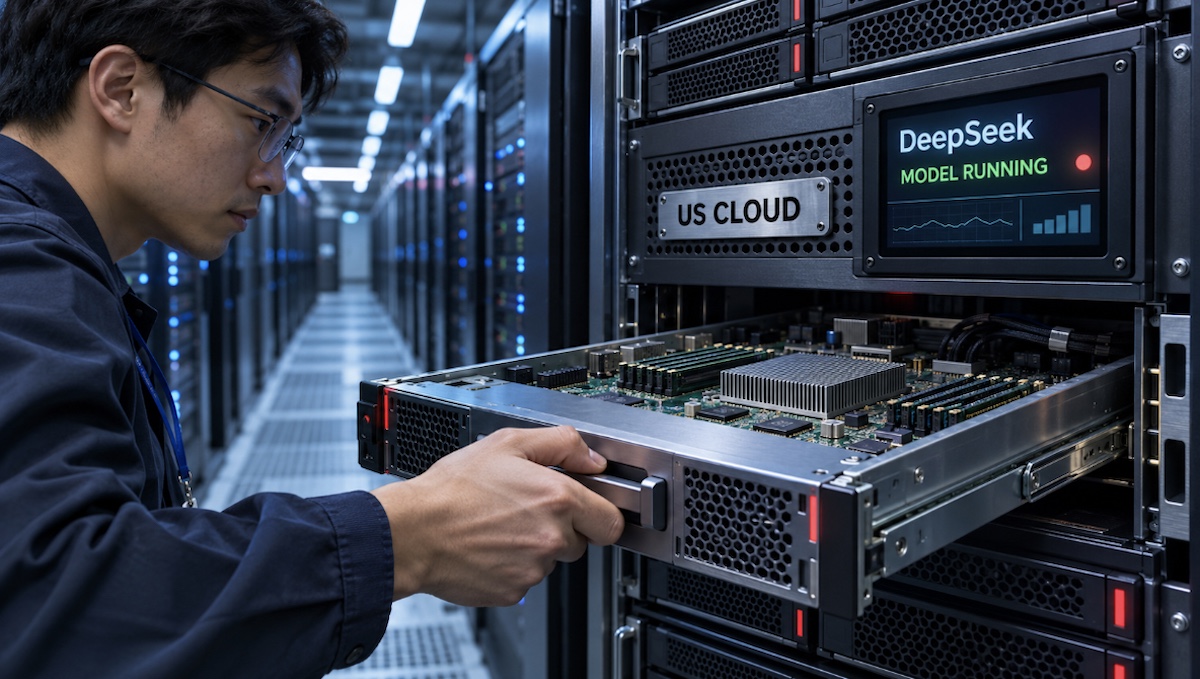
The Trump administration is weighing whether to require American companies to disclose their use of Chinese artificial intelligence, Reuters reported on November 18. The deliberation comes as models from Chinese developers, including DeepSeek, Alibaba and Moonshot AI, gain traction among US enterprises seeking capable, lower-cost alternatives to flagship offerings from leading American labs. Airbnb, for one, runs its customer service bot on Alibaba’s Qwen. Yet even as Washington debates disclosure rules, American tech giants are actively selling access to those very rivals. In March 2025, Amazon Web Services added DeepSeek-R1 to Bedrock, its cloud AI platform. A US business can now deploy an AI engine built in China while paying an American provider to run it securely on domestic servers. That arrangement captures a fundamental shift in the US-China tech rivalry. Chinese developers are building global market share by giving their software away, while American cloud providers make money from the infrastructure required to run it. For frontier AI labs like OpenAI and Anthropic, which rely on premium subscription and API fees, the pressing question is how much pricing power they can retain when a free-to-download alternative performs nearly as well. What China gains by opening the weights Alibaba’s Qwen and DeepSeek’s R1 are frequently described as “open source,” implying their underlying code is entirely free to inspect and rebuild. “Open-weight” is the more accurate term. Think of weights as the mathematical memory a model builds up while training on vast amounts of data. Publishing these weights allows anyone to download and run the finished AI, even though reconstructing it from scratch still requires the original training data and engineering recipe. For corporate buyers, downloadable weights alter the financial equation. A firm can run a model on its own hardware, host it through a preferred cloud vendor, or lock in a vetted version without worrying about sudden changes from an outside provider. Running the software still costs money for computing power, maintenance and legal compliance, but open weights give buyers control over where that money goes and who touches their data. For Alibaba, the strategy serves a clear commercial funnel: every engineer who learns to build on Qwen becomes a prospective customer for its cloud business. Familiarity carries from one project to the next, extending Alibaba’s technological footprint far beyond its own servers even when it collects nothing upfront. This approach only succeeds if the models deliver in practice. Stanford’s 2026 AI Index found that the performance gap between top US and Chinese models has effectively closed on standard benchmarks, though American systems still hold an edge in certain specialized domains. The same report adds a caveat that matters here: the best closed models have pulled slightly ahead of the best open ones again, by about 3%. For an enterprise processing thousands of invoices a day, leaderboard rankings matter far less than two practical measures: reliability on its own documents and cost at scale. Where the money goes Cheaper, downloadable models place different parts of the US tech sector under very different pressures. Pure-play AI labs like OpenAI and Anthropic operate much like utilities, selling access to proprietary intelligence over the internet. When buyers find comparable capability at a fraction of the cost, those margins come under pressure. Cloud giants like Amazon and Microsoft play a different game. Acting as digital landlords, they host dozens of competing models and collect rent regardless of which engine a client selects. More importantly, they sell the indispensable “plumbing”: the security layers, databases and monitoring tools that connect an AI brain to a company’s internal data. Paying a cloud provider to manage an open-weight model has clear advantages. A bank can demand strict contractual guarantees on data privacy, uptime and technical support, so that someone is on call if the system breaks. Running a downloaded model in-house gives the bank full control, but it shifts the burden of cybersecurity and maintenance onto its own IT staff. Widely distributed weights also raise unresolved questions about how security patches reach users and whether firms can fully verify the supply chain behind a downloaded file. Meanwhile, competitive strategies on both sides of the Pacific are converging. OpenAI has released its own downloadable gpt-oss models under an Apache 2.0 license, allowing developers to run them freely. Alibaba, for its part, gives away model weights while competing aggressively for enterprise cloud contracts. Both are using free software to win developers, and both are banking on hosting, support and enterprise integration to generate returns. The stakes grow sharper as this dynamic moves from computer screens into the physical world. China already dominates global manufacturing of drones, industrial robots and electric vehicles. Open-weight models are a natural fit for these machines: a delivery drone or warehouse robot can run a downloaded model directly on its onboard chip, avoiding network delays, per-query cloud fees and the security risk of sending sensitive camera feeds off-site. If Chinese models become the default brain for physical machines as well as for enterprise software, the consequences will extend well beyond cloud computing. What Washington would be regulating Against this backdrop, Washington’s disclosure proposal runs into a thorny practical question: what actually counts as “using Chinese AI”? A US firm might send customer queries directly to a server in China, run a Chinese-built model inside Amazon’s US cloud, or deploy downloaded weights on its own private servers. The model’s origin is identical in all three cases, yet data exposure, control over updates and legal accountability differ entirely. Not everyone in Washington accepts that distinction. Representative John Moolenaar, who chairs the House select committee on China, welcomed the proposal and told Reuters that risks remain even when US companies run Chinese models on their own infrastructure. The argument behind that view is about the model itself rather than where the data goes: a downloaded file can carry hidden behaviors or biases that no hosting arrangement removes. That is a fair point, and it argues for testing models, not only tracking where they run. But a disclosure rule that treats all three cases alike would tell buyers and regulators very little about the risk they actually face. Ultimately, the decisive test for enterprise buyers comes when a faster or cheaper model reaches the market. If a company can swap out its underlying AI engine without rebuilding its software or redoing months of security reviews, open-weight models give buyers enormous leverage. If switching means overhauling the everyday tools employees depend on, the cloud providers, and their plumbing, will remain firmly in control.
China’s open-weight AI models are coming for America’s market
Full Article
Original Source
Read the full article at Asiatimes →KhanList aggregates and links to publicly available news content. We do not host full articles from third-party sources. Always verify important information with original sources.