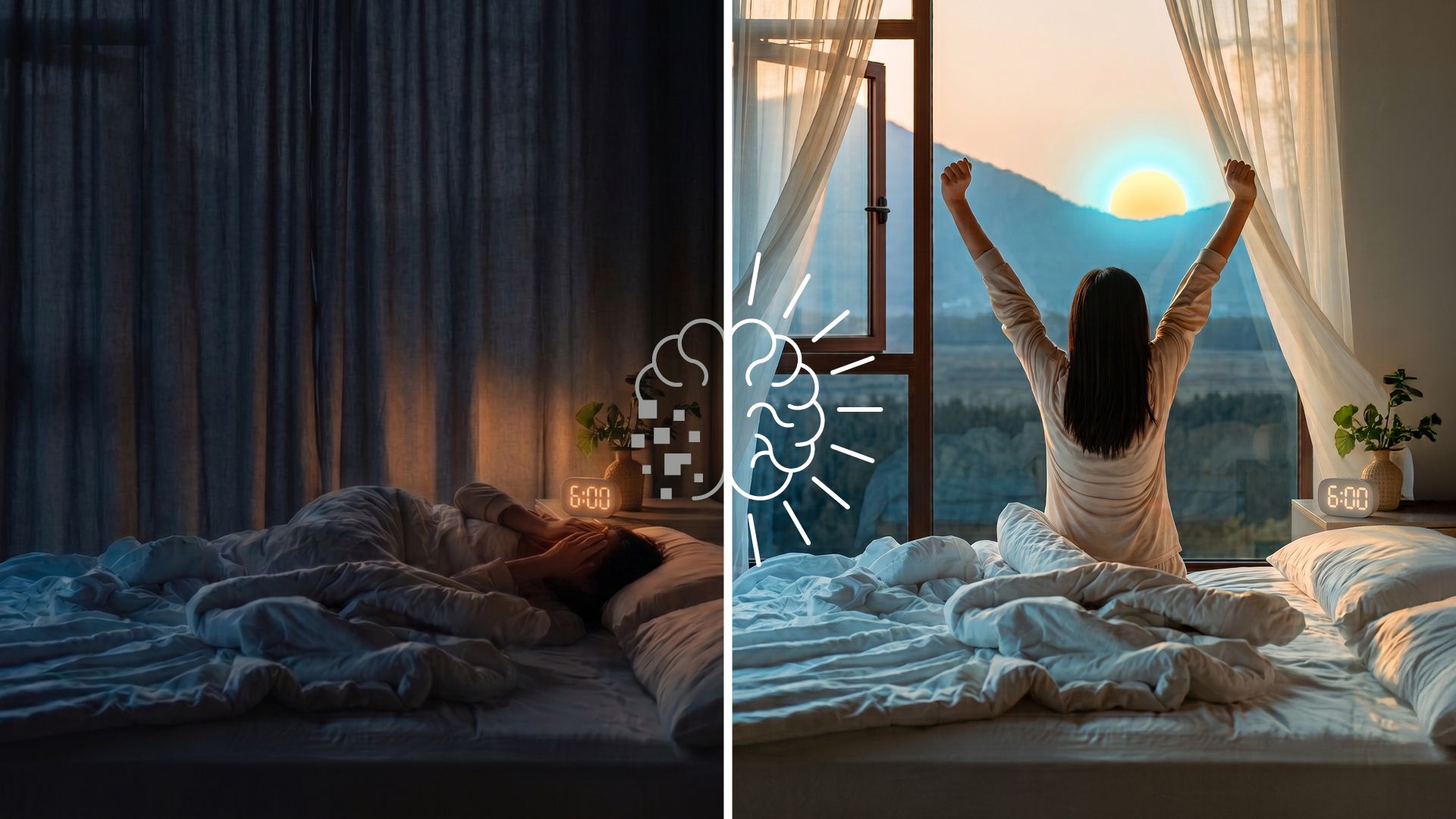
(Image credit: Future/Getty/Edited by Adobe AI) Astronauts on the International Space Station experience sleep inertia (grogginess upon waking) because they work in shifts, are rolling a chronic sleep debt, and see 16 sunrises and sunsets every 24 hours, among many other factors.I experience sleep inertia because my pre-schooler doesn’t believe in sleeping through the night. And that build-up of broken sleep makes me feel punch-drunk some mornings.I tried easing the grogginess with caffeine, but it didn’t work. And after speaking with Dr. Erin Flynn-Evans, Director of the Fatigue Countermeasures Laboratory at NASA Ames Research Center, I now know why…“Caffeine takes time to take effect, so it’s not the best tool to use if you have to wake up and act quickly,” Dr. Flynn-Evans explains, whereas light activates retinal pathways immediately.Well, my job doesn’t require me to perform complex tasks straight after waking. But my son is full bore from the moment he opens his eyes — sitting on the couch to watch him play while I'm still struggling to wake up fully is not an option. These are the AYO Blue Light Therapy Glasses I've been using since earlier this year. My three year old calls them "robot glasses" (Image credit: Future)Let there be (blue) lightWhile caffeine isn’t a fast-acting off-switch for post-sleep grogginess, the right type of blue light within 30 minutes of waking is.Get instant access to breaking news, the hottest reviews, great deals and helpful tips.Yes light therapy glasses and lamps can help to reduce sleep inertia, but devices cost money. For a $0 solution, Dr. Flynn-Evans says to step outside your front door: “Going outside when the sun is out will expose you to blue light from the sun naturally.”Even though it looks yellow from Earth, the sun contains blue light (and many other colours). “There are specialized photoreceptors in our eyes that are very sensitive to blue-wavelength light that are different from the rods and cones that we use for vision,” explains Dr. Flynn-Evans.Sleep inertia is the groggy feeling when you wake up from a deeper part of sleep, and the body is still transitioning from 'sleep to wake'Dr. Lindsay Browning, Chartered Psychologist and Neuroscientist“They are most sensitive to blue-enriched light, because the light that we receive from the sun has a strong blue component. When these photoreceptors detect light, they send a signal to our internal clock (circadian rhythm) to indicate that it’s daytime.“This initiates a cascade of other effects throughout the body that promote alertness. For example, our bodies immediately stop producing melatonin when the photoreceptors detect light.”Little wonder that blue light is being studied as a powerful off-switch for melatonin production (a master sleep hormone), and a powerful on-switch for wakefulness signals.Key takeaways: At a glanceThe biological switch: Natural morning light triggers specialized photoreceptors in your eyes. These instantly signal your brain to stop producing melatonin.The $0 NASA solution: While blue light therapy devices are helpful for night-shift workers and in the darker months of the year, natural light outside contains all the blue-cyan light you need to help ease sleep inertia.Blue light isn’t a 24/7 enemy: Reduce your exposure at least one hour before bed, then embrace it soon after waking to reduce grogginess.The weekend trap: Sleeping in creates ‘social jetlag’, which throws off your circadian rhythm and makes your sleep inertia worse on Monday.6 a.m. cement brain (Image credit: Getty Images)At the start of this year, my son started going through a rough patch with sleep and my father-in-law was receiving end-of-life care in hospital. I was stressed day and night, and my sleep took a hit.It didn’t matter how many hours of sleep I got, either – because it was so broken, I felt deeply groggy each morning.“Sleep inertia is the groggy feeling when somebody wakes up from a deeper part of sleep, and the body is still transitioning from sleep to wake, so they don’t feel fully alert yet,” explains Dr. Lindsay Browning, Chartered Psychologist, Neuroscientist and the founder of Trouble Sleeping. (Image credit: Future)It was winter when my grogginess drifted in. Sun-dappled mornings were replaced by deep black 6 a.m. skies, and I had lent my trusty Lumie Vitamin L light to a friend battling Seasonal Affective Disorder.So I became reliant on a daily vat of caffeine to ‘power up’.Call it divine timing (or forgetting that I had requested the product for testing), but a few weeks later I was sent a pair of 470nm blue-turquoise light-emitting glasses. My morning grogginess was beginning to ease up when wearing them, but they weren't an instant 'on' switch to take me from punch-drunk to instantly alert at 7 a.m..“The circadian rhythm is a forward feeding cycle, so if you generally wake up at the same time each morning, your internal clock will anticipate when it’s time to wake up and begin to turn off sleep signals and turn on wake signals at your typical wake time," explains Dr. Flynn-Evans....most people need to minimize light in the evening in order to fall asleep, and maximize light in the morning to wake up.Dr. Erin Flynn-Evans, Director of The Fatigue Countermeasures Laboratory at NASA Ames Research Center“You’re also likely to be exposed to light at about the same time in the morning if you get up around the same time, so any light you are exposed to may simply be interpreted by the body as the expected daily light signal.”So if I always wake up at 7 a.m., my internal body clock already anticipates light at 7 a.m., so that burst of artificial blue light isn't a ‘shock’ system boost and won’t be as potent against sleep inertia as it would be at, say, 2 a.m. when I'm normally asleep.The right light at the right time (Image credit: Future)“Bright light exposure soon after waking is one of the best ways of helping you feel more awake more quickly,” explains Dr. Browning.Ok, but is there a difference between the blue light that helps wake us up versus the ‘melatonin-disrupting’ blue light we’re told to avoid before bed?“Nope! It’s the same,” says Dr. Flynn-Evans. “The difference is that light in the evening shifts the drive to sleep and wake later. Light in the morning shifts the drive to sleep and wake earlier.“As a result, most people need to minimize light in the evening in order to fall asleep, and maximize light in the morning to wake up.”Staying in bed, repeatedly pressing snooze, is unlikely to help you quickly wake upDr. Lindsay Browning“Additionally, physically getting up out of bed and moving can also help you wake up and feel more refreshed,” adds Dr. Browning. “Staying in bed, repeatedly pressing snooze, is unlikely to help you quickly wake up.” (Image credit: Getty Images)This is a trap many of us fall into on weekends; a time when we feel we deserve a lie-in, or have the chance to catch up on sleep.Truth is, this ‘social jetlag’ confuses our circadian rhythm and perpetuates our sleep issues. A consistent sleep schedule, especially your wake-time, is arguably the MVP of good sleep hygiene.“Sleeping in later at weekends can shift your sleep-wake schedule later, making a Monday morning alarm feel more like waking up during your ‘biological night’,” Dr. Lindsay explains.“This effect may be more pronounced in naturally later chronotypes (owls) compared to earlier chronotypes (larks)."Less is more: How long to use blue light forIt’s important to remember that Dr. Flynn-Evans’s work at NASA is focused around how to help astronauts reduce sleep inertia fast when working in space.Using enriched blue-light helps them go from groggy to alert when they wake up for a shift in a place where they have few circadian cues, yet many physical stressors.Back on Earth, shift workers who sleep in the day and work through the night might also benefit from blue light exposure.So how long should a person be exposed to this light before their brain switches from ‘sleepy and groggy’ to ‘awake and energized’?Our studies typically use a minimum of 20 minutes of bright light exposureDr. Erin Flynn-Evans“We don’t know exactly, because it depends on the time of day and the stage of sleep that a person has awoken from,” Dr. Flynn-Evans explains, before revealing more about her team’s lab protocol: “Our studies typically use a minimum of 20 minutes of bright light exposure.”For most of us, getting outside soon after waking is still the gold standard approach for easing sleep inertia. Dr. Browning: “At the end of the day, natural daylight is easy, free and one of the most effective practical options for most people.” Why some people experience sleep inertia more than others (Image credit: Getty Images)“If you wake up from a deeper part of sleep, particularly slow-wave sleep, you are more likely to experience sleep inertia.” Dr. Lindsay explains.“If you wake up from a much lighter part of sleep, typically at the beginning or end of a sleep cycle, you are less likely to experience as much sleep inertia.“Also, if you set your alarm for a different wake-up time from your usual one, either earlier or later, you might find yourself waking from a deeper part of sleep and therefore experience more sleep inertia.”Dr. Lindsay's point rang true when I had to wake up around 3 a.m. for a family flight to Spain—not even the excitement of a holiday could override that crushing sleep inertia we all felt.Even through closed eyelids, you can sense the sunlight increasing, which has been suggested to help pull you from a deeper part of sleep into a lighter part of sleepDr. Lindsay Browning“Our sleep cycles tend to have more deep, slow-wave sleep in the first half of the night, and sleep tends to get lighter and less deep with each subsequent sleep cycle towards the morning,” Dr. Browning reveals.“Therefore, if you wake up when your body clock thinks you should still be in the middle of your night’s sleep, you are more likely to wake up from a deeper part of sleep and experience sleep inertia.”I used my light therapy glass to power through at the airport, giving me enough energy and concentration to lug my sleepy son in a hip carrier whilst also dragging a 20kg suitcase up a steep hill.Other ways to reduce sleep inertia (Image credit: Future)In the lighter months where mornings are awash with daylight early doors, sleeping with your curtains partially open is a great way to harness natural light cues.“Even through closed eyelids, you can sense the sunlight increasing, which has been suggested to help pull you from a deeper part of sleep into a lighter part of sleep.” Dr. Browning then recommends opening your curtains fully as soon as you’re up. “This helps to shift sleep inertia more quickly.”A good sunrise alarm clock is an excellent solution here.Her other top tip is to keep a consistent wake time, even on weekends. “This helps your body get used to that time as ‘wake-up time’, and it helps your body shift to that time being a more natural waking point between sleep cycles rather than from a deeper part of sleep.“So, in summary," continues Dr. Browning, "getting some natural daylight shortly before waking and as soon as you wake up, and having a consistent wake-up time, may both help to reduce the likelihood of sleep inertia.”When to see a doctor (Image credit: Getty Images)“People who consistently wake up exhausted often have an undiagnosed sleep disorder," explains Dr. Flynn-Evans, "so the first thing I would recommend is talking with your doctor about a referral to a sleep clinic.For those who do not have sleep disorders, it’s important to maintain a regular bed and wake time, with regular bright morning light exposure.Dr. Erin Flynn-Evans“For those who do not have sleep disorders, it’s important to maintain a regular bed and wake time, with regular bright morning light exposure.“Night owls tend to struggle with waking up in the morning, which makes it more important for night owls to turn down the lights before bed and maximize morning light exposure to adapt to their work or social schedule." Dr. Flynn-Evans says. "It’s also important to have an appropriate cool, dark, and quiet sleep environment.” (Image credit: Future)Dr. Browning adds: “If you find that you experience severe sleep inertia most mornings, or it doesn't shift after waking and the sleepiness and grogginess persists long into the day, then this might be a sign that you aren't getting enough sleep, you might have circadian misalignment, or you might possibly have another sleep disorder such as sleep apnoea.”If you only occasionally experience sleep inertia, it’s nothing to worry about: “Making sure that you get enough sleep is more important than worrying about avoiding sleep inertia, because even if you wake up with sleep inertia, it will usually wear off fairly quickly.”Sleep tech to help banish morning grogginess Dyson Solarcycle Morph Desk AYO AYO+ Light Therapy Glasses Lumie Task SAD Light Therapy Desk Lamp Phillips Twilight sleep and wake-up light Follow Tom's Guide on Google News and add us as a preferred source to get our up-to-date news, analysis, and reviews in your feeds. Claire is a Certified Sleep Science Coach, the Managing Editor of Sleep at Tom's Guide, and a senior health journalist with over 16 years product review experience. Claire oversees our rigorous mattress testing procedures and our sleep buying guides. She is connected to a wealth of globally renowned sleep experts including mattress designers, neuroscientists, and board-certified doctors. Claire is certified to advise people on how to choose products that suit their individual sleep needs, and to help them create a nighttime routine and bedroom environment for better sleep. Previously, Claire worked at T3 and TechRadar, testing the latest wellness products and sleep tech.
I kept waking up exhausted until a NASA scientist shared her $0 lab-tested tip for beating morning grogginess — here’s how it works
Full Article
Original Source
Read the full article at Tomsguide →KhanList aggregates and links to publicly available news content. We do not host full articles from third-party sources. Always verify important information with original sources.