
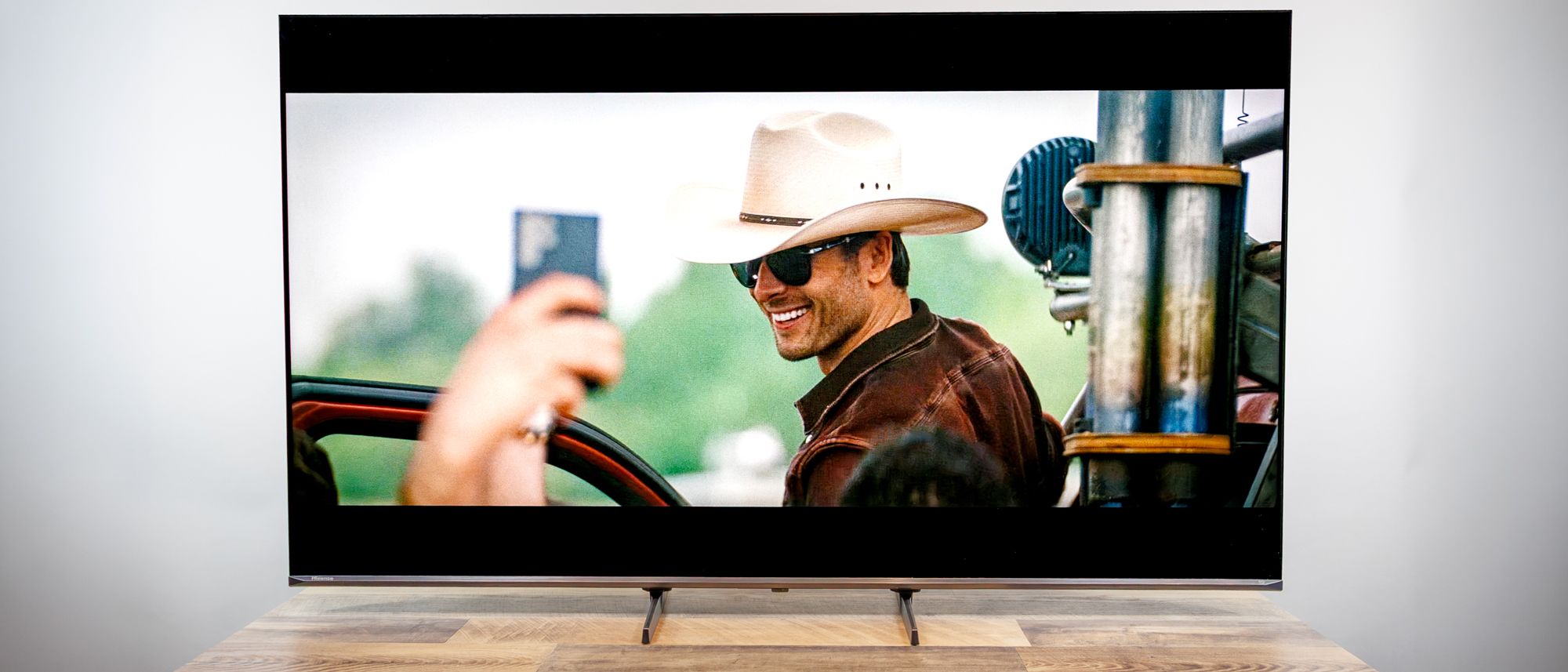
Tom's Guide Verdict The Hisense U6SF Pro won't make anyone forget about OLED, but at this price, it doesn't need to. A bright, glare-resistant Mini-LED panel, a built-in subwoofer that actually adds something, and a native 144Hz gaming-friendly display make it one of the better budget TVs you can buy in 2026, as long as you're not chasing perfect blacks. Pros +Glare-resistant screen that holds up in bright rooms +Built-in subwoofer that outperforms most stock TV speakers +Native 144Hz panel is great for gaming +Impressive brightness and color performance for the price Cons -Some noticeable blooming in dark scenes -Fire TV interface is clunky and full of ads -Only two HDMI 2.1 ports Why you can trust Tom's Guide Our writers and editors spend hours analyzing and reviewing products, services, and apps to help find what's best for you. Find out more about how we test, analyze, and rate. Jump To: Price & release date Design Ports How we test TVs Performance Test results Audio Interface & apps Remote Verdict I've spent a lot of time this year with TVs that cost more than most people's monthly rent, so it's a nice change of pace to sit down with something like the Hisense U6SF Pro, a Mini-LED TV that starts under $900 (under $600 on sale) yet still feels like a premium pick. Hisense has quietly become one of the best budget TV makers out there, and the U6SF Pro is evidence of that.The U6SF Pro sits just above the standard U6SF in Hisense's 2026 lineup. The big differences include a brighter, glare-resistant screen, a beefier speaker system, a native 144Hz panel that's great for gaming, and upgraded software features.I spent some time with the 65-inch model, watching everything from prestige streaming dramas to World Cup highlights, and by the end of it, I was totally won over by the U6SF Pro. It’s not going to take on the best OLED TVs in sheer picture performance, but at this price, there’s almost nothing else like it.Latest Videos FromTom's GuideHisense U6SF Pro review: Price and release date The U6SF Pro launched in March 2026 as part of Hisense's broader U6 and U7 refresh, and it's sold alongside the cheaper, non-Pro U6SF. Here's how the lineup breaks down:Hisense U6SF Pro (55-inch): $849 | Sale: $547Hisense U6SF Pro (65-inch): $1,099 | Sale: $597Hisense U6SF Pro (75-inch): $1,399 | Sale: $797Hisense U6SF Pro (85-inch): $1,999 | Sale: $1,099Hisense U6SF Pro (100-inch): $3,499 | Sale: $2,497 (Image credit: Tom's Guide)Like most budget and mid-range TVs, the U6SF Pro hasn't stayed at its list price for long. I've already seen the 65-inch model discounted by as much as $500 at various retailers just months after launch, so it pays to be patient if you can wait for a sale.Hisense U6SF Pro review: DesignThe U6SF Pro isn't reinventing anything here (and I mean that as a compliment). It's a clean, minimalist design with slim bezels that should fit seamlessly into any room. It's not as dramatically thin as something like the Samsung S85H, but at roughly 2.5 inches deep, it still sits relatively flush against a wall without looking too bulky. (Image credit: Tom's Guide)Setting the U6SF Pro up was refreshingly simple: The dual feet were easy to attach, and they felt really sturdy — no wobble and no anxiety about it tipping over, which I can't always say for TVs at this price. If you'd rather skip the stand entirely, the U6SF Pro supports VESA wall mounting via a 400 x 300 mm mount.Tom's Guide: Direct to Your InboxGet instant access to breaking news, the hottest reviews, great deals and helpful tips.Hisense U6SF Pro review: PortsWith the U6SF Pro, you get four HDMI inputs total, with two of them being HDMI 2.1. I would've liked to see all four ports be HDMI 2.1, but for most people, two will be enough for their 4K/120Hz console gaming and soundbar needs. (Image credit: Tom's Guide)Beyond that, there's a USB 2.0 port, a USB 3.0 port, Ethernet, optical digital audio out, and a coaxial antenna input. Wireless duties are handled by WiFi 6 and Bluetooth 5.4.It's not quite as generous as the HDMI setup that you’ll sometimes find on Hisense's other sets, but the U6SF Pro has all the ports that most people at this price point will ever need.How we test TVsWe follow a standard testing protocol for every TV we review at Tom’s Guide. Our benchmarks include a series of technical and subject tests designed to rate the set’s performance. (Image credit: Tom's Guide)For our technical tests, we use a Jeti spectraval 1501-HiRes spectroradiometer, a Klein K10-A colorimeter, a Murideo 8K-SIX-G Metal pattern generator, and Portrait Displays’s Calman TV calibration software to take measurements. We also use a Leo Bodnar 4K Input Lag Tester for determining whether it’s one of the best gaming TVs.Subjective tests vary based on the reviewer, but usually feature anecdotes from a diverse selection of movies, TV shows, and other content reflecting the types of things you may actually want to watch on the TV. (Image credit: Tom's Guide)For a more detailed look at what we do and how we do it, check out our “How we test TVs” page.Hisense U6SF Pro review: PerformanceI threw a pretty wide mix of content at the U6SF Pro during my testing period. Prestige streaming shows like “The Bear”; popcorn blockbusters like “Twisters”; 4K Blu-ray disc versions of “Blade Runner 2049” and “Spider-Man: Across the Spider-Verse”; some 4K YouTube videos; and a bunch of World Cup highlights. (Image credit: Tom's Guide)Hisense rates the U6SF Pro at up to 1,200 nits of peak brightness. That tracks with our lab testing results and with what I saw in person: bright, punchy highlights that held up even in a brightly lit room. A lot of budget TVs, and even some pricier OLEDs, don't manage as well here. The anti-reflection, glare-free screen coating is great, too. Throughout my testing, I never once had to adjust the lights to see the screen better, which really impressed me. (Image credit: Tom's Guide)Colors stayed accurate, and skin tones looked natural pretty much the entire time. I did notice the Mini-LED backlighting struggling with blooming here and there, especially with bright text or objects set against a dark background. In most cases, it's not something you'd catch unless you were looking for it, but it shows up in dark, high-contrast scenes. (Image credit: Tom's Guide)New to the U6SF Pro is an AI Sports Mode, Hisense's answer to Samsung's new soccer-specific picture mode, and it performed similarly well. It boosts pitch and jersey colors, and cranks up crowd noise while cutting through commentary. In practice, I found it easier to track fast-moving plays without the picture looking blurry or oversaturated. (Image credit: Tom's Guide)Gaming performance is really good, too. The U6SF Pro panel runs at a native 144Hz refresh rate and includes AMD FreeSync Premium Pro with full VRR and ALLM support. I spent a good chunk of time playing both “Marvel's Spider-Man 2” and “007 First Light” on PlayStation 5, and the U6SF Pro's low input lag, paired with smooth frame rates, made for a satisfying experience I wasn't expecting from a TV in this price range. Hisense's Game Bar made it easy to check frame rate, VRR status, and more without digging through too many menus.Hisense U6SF Pro review: Test resultsSimilarly-priced TVs Swipe to scroll horizontally Row 0 - Cell 0 Hisense U6SF Pro TCL QM7L Samsung S85H OLED Hisense U7 SDR Brightness (10%, in nits) 358 196 230 185 Delta-E (lower is better) 1.58 2.64 1.69 3 Rec. 709 Gamut Coverage 98.85% 99.48% 99.99% 99.38% HDR Brightness (10%, in nits) 1,265 2,270 770 2,866 UHDA-P3 Gamut Coverage 96.1% 97.64% 97.48% 97.31% Rec. 2020 Gamut Coverage 75.12% 90.28% 72.94% 82.75% Input latency (in milliseconds) 9.3 9.4 9.2 9.8 Taking a look at our lab test results, the U6SF Pro stacks up nicely against similarly priced competition. In terms of SDR brightness (measured while using the TV’s “filmmaker” or most color-accurate picture mode), the U6SF Pro beats the TCL QM7L (196 nits), Samsung S85H (230 nits), and Hisense U7 (185 nits) with its 358 nits of peak brightness. (Image credit: Tom's Guide)In HDR, the U6SF still gets pretty bright at 1,265 nits, making it a great TV for bright rooms across the board. It doesn’t reach the HDR brightness heights of the TCL QM7L (2,270 nits) or the Hisense U7 (2,866 nits), but easily surpasses the Samsung S85H’s 770 nits and solidifies itself as a great middle-of-the-pack performer, especially at this price point. (Image credit: Tom's Guide)In the color accuracy department, the U6SF Pro also stands out with a Delta-E (the lower the number, the better) of just 1.58. That beats all the other TV’s mentioned above by a decent margin, save for the Samsung S85H’s Delta-E of 1.69. The U6SF Pro’s impressive peak brightness and color accuracy test results track with what I saw during use, and made for an overall great viewing experience. (Image credit: Tom's Guide)If you’re into gaming, the U6SF Pro won’t disappoint with its 9.3ms of input latency, which is nearly on par with some of the best gaming TVs. I recently reviewed the more expensive Samsung S85H, and it scored 9.2ms. Overall, the U6SF Pro is a well-balanced TV across regular viewing and gaming, which really boosts the value of this budget Mini-LED.Hisense U6SF Pro review: AudioThe U6 Pro has a built-in subwoofer, part of a 2.1-channel, 40-watt speaker system, and it actually sounds like it. Loud, intense moments in “Blade Runner 2049” and “Twisters” had real weight to them instead of the thin, tinny quality I usually brace for with stock TV speakers, and dialogue stayed clear even at higher volumes. (Image credit: Tom's Guide)It's not going to replace one of the best soundbars or a dedicated surround sound system if you're serious about having a full-fledged home theater, but for casual viewing, this is one of the few built-in TV audio setups I wouldn't rush to upgrade. (Image credit: Tom's Guide)Last but not least, Dolby Atmos support is here too, and while you won't get true overhead effects without external speakers, the mix sounds noticeably more spacious than I expected from the TV alone.Hisense U6SF Pro review: Interface and appsThe U6SF Pro runs Fire TV, so app load times are decently fast, and you'll get access to just about every major streaming service. In addition, built-in Alexa+ allows for easy voice controls. But, my usual gripes with Fire TV apply here as much as ever: the UI feels clunky, and the home screen leans heavily into promoted content instead of the stuff you actually want to watch. (Image credit: Tom's Guide)It's not a dealbreaker, but it's not my preferred interface by any means.Hisense U6SF Pro review: RemoteThe U6SF Pro’s remote is your standard Fire TV remote. The construction of it feels a little flimsy, but it has all the buttons and functions you’ll need for a streamlined TV-watching experience. (Image credit: Tom's Guide)Navigating the U6SF is easy thanks to the remote’s dedicated buttons for Prime VIdeo, Netflix, Disney+, and YouTube. You’ll also find a settings button, as well as one for Alexa voice controls. I would appreciate some more features in future updates, like a lost remote finder, but the U6SF’s remote doesn’t have any glaring omissions that negatively impacted my time with the TV.Hisense U6SF Pro review: VerdictThe Hisense U6SF Pro delivers a bright, glare-resistant, sports-and-gaming-friendly screen with surprisingly capable built-in audio, and a price that undercuts most of its Mini-LED competition. Overall, I think it's a fantastic value.If you want to save some money, the standard U6SF gets you some of the same core experience for less, minus the brighter anti-glare screen,144HZ refresh rate, and built-in subwoofer. If you're chasing something closer to OLED-level contrast, look further up Hisense's TV lineup at the U7 or U8 series. These will offer better contrast with less blooming as they use a greater amount of dimming zones.That said, if you're shopping for one of the best TVs under $1,000 and want one that's bright enough for a sunlit living room, the U6SF Pro is a great pick. Dylan Haas is a Freelance Contributor and Lab Tester for Tom’s Guide. He’s a seasoned journalist with bylines at publications like Mashable, GameSpot, and Paste Magazine where he covered the latest in tech, gaming, and entertainment. You must confirm your public display name before commenting Please logout and then login again, you will then be prompted to enter your display name.
I just reviewed the Hisense U6SF Pro, and it's proof you don't need OLED money for a great TV
Full Article
Original Source
Read the full article at Tomsguide →KhanList aggregates and links to publicly available news content. We do not host full articles from third-party sources. Always verify important information with original sources.