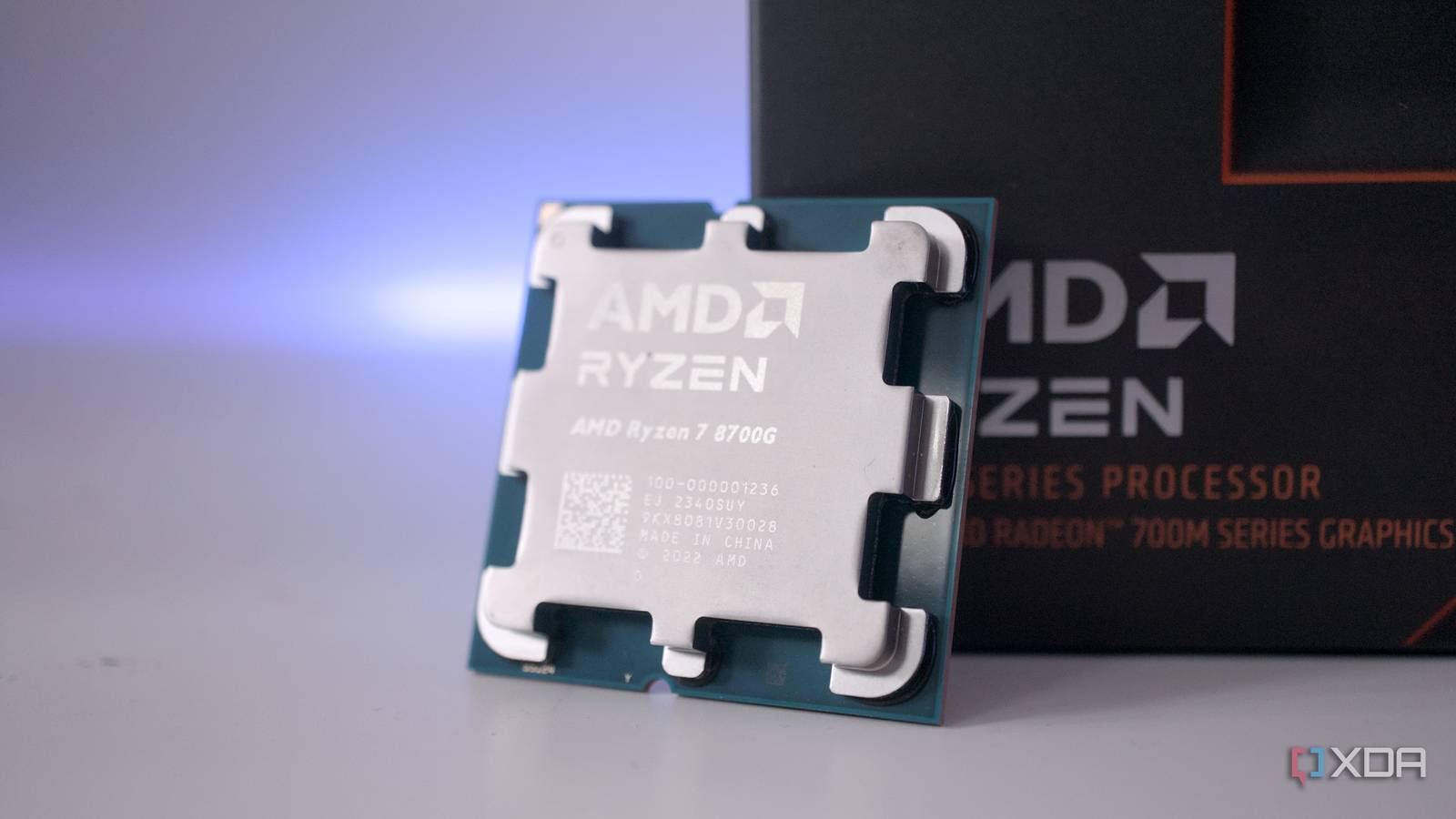
Published Jul 25, 2026, 2:30 PM EDT Abid covers consumer hardware, gaming, and platform updates with an emphasis on accuracy, clarity, and reader-first context. He holds a BSc in Computer Science and Engineering, and his work can be found in multiple publications, including Notebookcheck. Outside of work, he enjoys exploring new gaming hardware, testing system performance, and keeping up with developments across the broader tech landscape. It has been quite a while since I upgraded my main PC, and at the heart of the current setup is a capable Ryzen 7 processor that's based on the AMD Zen 4 architecture. I planned to purchase a GPU and complete the gaming computer this year, but that plan changed. The current graphics card market made me realize that I wouldn't be giving up much by sticking with the built-in GPU in my CPU. As a matter of fact, the iGPU (integrated GPU) still holds up quite well against modern AAA games. Integrated graphics have gotten much better than they were a few years ago AMD did a good job with its Ryzen 8000G Phoenix desktop APUs Before building my current PC, I knew that I wasn't going to pair the system up with a dedicated graphics card right away. However, I didn't want to wait until I purchased a GPU to play games and do some GPU-intensive work on the computer. That's basically why I chose the Ryzen 7 8700G, a performance-focused option from the Phoenix lineup. Well, the temporary solution has lasted much longer than I expected. For reference, this Zen 4 APU features an 8-core and 16-thread CPU configuration, and there's the Radeon 780M iGPU, which is based on the RDNA 3 architecture. It is the same integrated graphics that power gaming handhelds like the ROG Ally X, Legion Go, and GPD Win 4 2025. While the iGPU is nowhere near the level of a modern mid-range GPU, it's also far from the sluggish integrated graphics that many of us grew up with. AMD has basically upped its integrated graphics game with the introduction of the Radeon 780M, which was in 2023, and the recently introduced Radeon 8060S and 8050S in the Strix Halo mobile lineup took things even further. The Radeon 780M in my current PC can handle more than I expected Modern games are surprisingly playable with the right expectations So far, I have played quite a few demanding games on the Ryzen 7 8700G, including Cyberpunk 2077, 007 First Light, Pragmata, and Resident Evil Requiem. Of course, I haven't been able to enjoy all of them at the highest graphical setting, and neither was the resolution set to anything above 1080p. In most cases, the visual settings were dialed to a mixture of low and medium. Modern upscaling technologies have made things even better. With AMD FSR and Fluid Motion Frames, it was possible to squeeze a little more out of the dGPU-less PC with minimal impact on image quality. As for the games where there wasn't support for AMD FSR, I turned to Optiscaler and Lossless Scaling. That said, even with all this, it's not like every new release runs flawlessly on my PC. Some, for example, require further tweaks, and for others, I need to accept below-30 FPS gameplay. Moreover, features like ray tracing are largely out of the question. A dedicated graphics card just isn't worth it for me right now The current GPU market makes waiting the smarter choice When I started planning this build, adding a dedicated GPU felt inevitable. It wasn't a question of if, but when. However, after spending months with the Radeon 780M, the sense of urgency has largely disappeared. Part of that comes down to the current graphics card market. There's no denying that plenty of options exist across different price points, but it's hard to find a relatively modern GPU at or below its launch price. Another factor is how small the performance jump is on current-gen GPUs compared to last-gen options. Waiting a little longer to get a dedicated GPU would mean a more meaningful investment or better value for the same price. Most iGPUs are still not a replacement for a dedicated GPU There are plenty of reasons to buy a discrete GPU right now Just because I didn't feel the need for a dedicated GPU doesn't mean the same will be true for everyone. There are plenty of reasons why someone might want to purchase a discrete graphics card right now, even with the current condition of the market considered. For instance, an iGPU, especially the Radeon 780M, won't be enough for someone who might want to play games at 1440p or 4K. The same applies to users who handle GPU-intensive workloads. Tasks like 3D rendering, video editing with complex effects, and AI model inference will benefit from a graphics card. In my case, those workloads are the exception rather than the rule. I can accept lower graphics settings, slow rendering and editing times, and limited performance in hardware-accelerated applications for a bit longer. PowerColor Reaper AMD Radeon RX 9070 XT $690 $800 Save $110 The PowerColor Reaper AMD Radeon RX 9070 XT, a 16GB GDDR6 PCIe 5.0 gaming graphics card designed for high-end 1440p/4K gaming with strong ray tracing and AI performance. It’s a dual–8‑pin, roughly 289 mm long card aimed at delivering reliable, non‑RGB “no‑frills” performance with solid cooling and multiple DisplayPort 2.1 and HDMI 2.1 outputs.
I gave up on buying a graphics card this year, and my CPU's built-in one is doing just fine
Full Article
Original Source
Read the full article at Xda-developers →KhanList aggregates and links to publicly available news content. We do not host full articles from third-party sources. Always verify important information with original sources.