
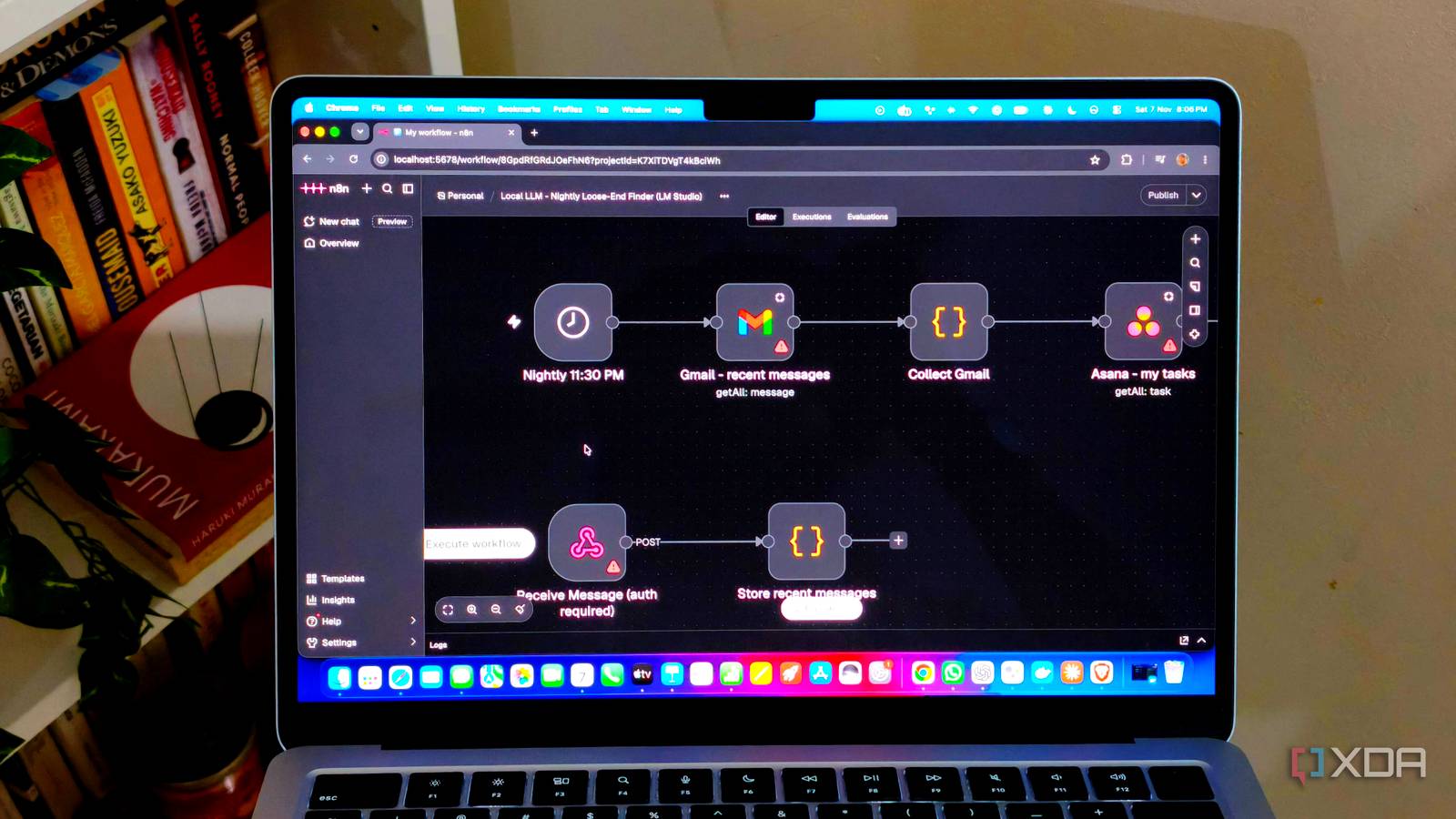
Published Nov 7, 2026, 7:00 PM EST Anurag is an experienced journalist and author who’s been covering tech for the past 5 years, with a focus on Windows, Android, and Apple. He’s written for sites like Android Police, Neowin, Dexerto, and MakeTechEasier. Anurag’s always pumped about tech and loves getting his hands on the latest gadgets. When he's not procrastinating, you’ll probably find him catching the newest movies in theaters or scrolling through Twitter from his bed. I've spent a lot of time experimenting with local LLMs, trying different models, testing their capabilities, and finding practical ways to use them. Some have been surprisingly good, but most of my interactions have followed the same pattern. I open a chat window, give the model a prompt, get a response, and move on. Recently, I decided to try something different – I gave it one job to handle every night. Using n8n and Qwen 3.5 9B, I built a workflow that checks my emails, Asana tasks, and messages for unfinished commitments, missed follow-ups, and things that need my attention. It prioritizes everything and sends me a briefing over email every morning. It's a relatively simple setup, but having used local LLMs for over a year, I can confidently say this is one of the most useful things I've done with one. I wanted my local LLM to do something useful A small job with a real purpose One problem I've always struggled with is keeping track of everything I've committed to doing. My work is spread across emails, Asana, and messages, and not everything makes its way into a proper task list. Sometimes I'll agree to send someone an update over email, promise to look into something during a conversation, or leave a task half-finished in Asana. I could spend some time every evening going through everything manually, but that's another task I'd have to remember to do. And that's where I thought a local LLM could actually help. Most of my experiments with local models have involved asking them to do something on demand, whether that's generating code, summarizing documents, or answering questions. The problem is that I still have to initiate those interactions. If I forget to ask the model about something, it isn't going to remind me on its own. I wanted to change that by giving the model a recurring job. Every night, it would go through the information I already have, identify anything that needs my attention, and prepare a short briefing for the following morning. I wouldn't have to remember what to ask or spend time digging through different apps. This also seemed like a reasonable task for a smaller local model. I just needed it to understand everyday conversations, recognize commitments, and help me figure out what deserved my attention first. And since the workflow would run automatically, I could get something useful out of my local LLM without even opening its chat interface. I built a nightly workflow using n8n and Qwen 3.5 9B Everything runs without me doing anything I already had n8n running on my home server, so that became the backbone of the project. For the actual AI processing, I used Qwen 3.5 9B, running locally. I started with a Schedule Trigger node in n8n, which kicks off the workflow every night. From there, the workflow pulls information from three sources – my emails, Asana, and messages. Email is where most of my conversations and follow-ups happen, Asana contains my assigned tasks and deadlines, and messages often have smaller commitments that never make it into either. Once n8n collects that information, I use a prompt that specifically looks for commitments, pending responses, approaching deadlines, and unfinished tasks. The model also needs to distinguish between something I've agreed to do and something that's merely being discussed. I have the model return structured information rather than a long paragraph. Each item includes the actual task, its source, and a priority based on urgency and available context. That makes it easier for n8n to organize the results, remove duplicate entries, and turn everything into a readable briefing. The final step is another email node that sends the briefing to my inbox every morning. I also made sure the workflow only reports what needs attention rather than automatically replying to messages or changing tasks in Asana. The model can misunderstand context, and I'd rather review an incorrect reminder than have it take an incorrect action. This is the most useful job I've given my local LLM Sometimes the simplest tasks make the biggest difference I've noticed local LLMs are far more useful when you give them smaller, well-defined tasks instead of expecting them to do everything a cloud model can. I've tried using local models to build features from scratch, fix bugs, and handle other complex tasks, but the experience has often been disappointing. I end up spending more time giving additional instructions, correcting mistakes, and getting the model back on track than actually getting things done. That's why I've started integrating these models into automations instead. The idea is to give them tasks that require relatively little intelligence but still benefit from having an LLM involved. My nightly workflow with Qwen 3.5 9B is a good example. It's the same model I've struggled to get useful results from when working on more complicated projects, but here, it has finally proved its worth. I previously integrated Tev1, a decision-making model from Together AI, into an n8n workflow that categorizes emails based on whether they need a reply. That's another simple job where a small, specialized model makes sense. Local LLMs are better when you know their limits I've spent a lot of time trying to get local LLMs to do more, but this experiment has taught me it's better to ask them to do less. A smaller model doesn't need to compete with ChatGPT or Claude to be useful. Give it a clearly defined task, connect it to the right tools, and let it run automatically.
I gave my local LLM one job that runs every night, and it's done more for me than a year of chatting with it
Full Article
Original Source
Read the full article at Xda-developers →KhanList aggregates and links to publicly available news content. We do not host full articles from third-party sources. Always verify important information with original sources.