
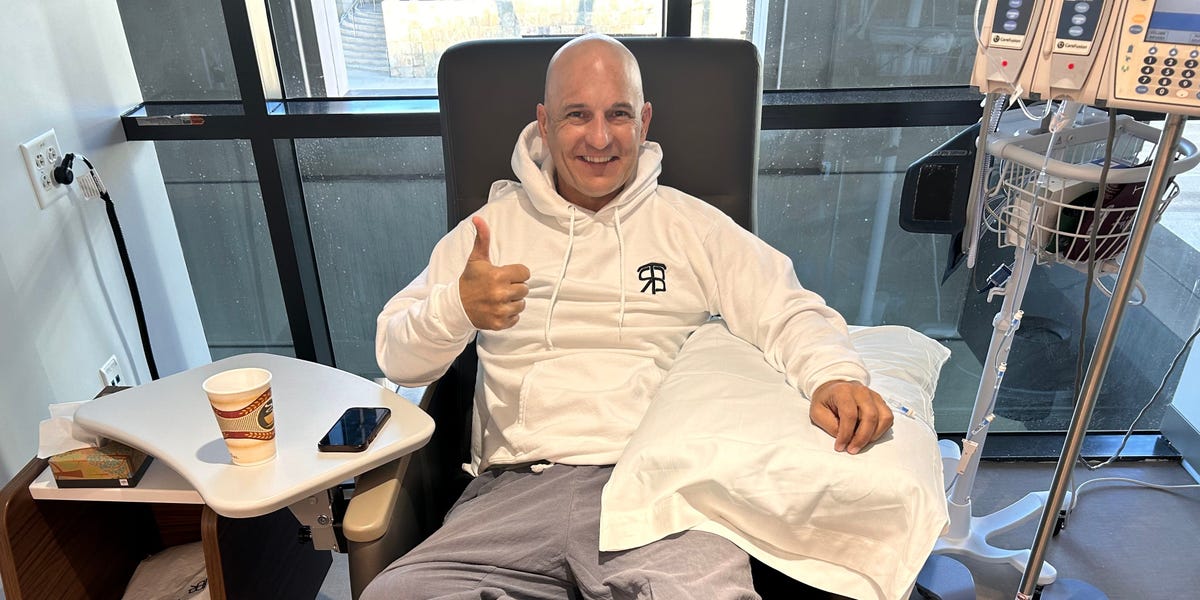
Courtesy of Dr. Ryan Beal Dr. Ryan Beal founded a cancer-focused biotech company. Then, he got cancer himself. This as-told-to essay is based on a conversation with Dr. Ryan Beal, CEO of Dyve Biosciences. It has been edited for length and clarity.My brother and I were about 60 miles into a 120-mile race in Colorado when chest pain made me stop. I thought I was having a cardiac emergency, but doctors diagnosed me with thymoma — a rare cancer of the thymus gland, which sits in the middle of the chest.To say it was a shock is an understatement. I was only 49 and healthy enough to run for six days through the Rockies. Months earlier, my mother had died of cancer; her celebration of life was just days before the race. My brother and I had considered canceling, but decided to run together to reflect on her life.Instead, I found myself in an emergency room in Vail, facing a terrible diagnosis. But I had something few cancer patients do: I'm the CEO of a cancer-focused biotech company. I immediately sent my results to three doctor friends, and they got to work. His mom survived breast cancer, then received a pancreatic cancer diagnosis. Courtesy of Dr. Ryan Beal I'm an MD, but went into business, rather than medicineI've always been a science nerd, and grew up wanting to be a physician. While I was in medical school at UPenn, I developed an interest in business. Med school felt like a lot of memorization and regurgitation of facts; in business classes, there were no rote answers, but more nuance and decision-making.Then, while assisting with a surgery, I overheard two well-respected surgeons saying they wouldn't want their kids going into medicine. That stuck with me.I got my MD, but rather than doing a residency, I started working for McKinsey, the large consulting firm. I left that position because I wanted more time with my kids. I had another startup initially, and co-founded Dyve in 2014. Our technology delivers therapeutic agents through the skin in a noninvasive way, to target the acidic environment that cancer tumors thrive in. He and his brother ran an ultramarathon together, during which he was experiencing chest pains that led to his own diagnosis. Courtesy of Dr. Ryan Beal I didn't fully understand the emotional side until I was a patientAs I led Dyve, I was very much a scientist, focused on solving scientific problems. I knew our work would impact real people, but I very much came at the work through an empirical lens.That changed when my mom was diagnosed with cancer. She survived breast cancer, but eight years later, was diagnosed with pancreatic cancer that killed her within weeks. Then, I was diagnosed. I had sat in boardrooms discussing cancer infusions many, many times. Yet, I'd never sat in an infusion center or the waiting room at the oncologist's office. Being in these spaces as a patient was incredibly emotional. It was eye-opening about not only the reality of cancer, but also the work I was doing.I'm entirely focused on patients nowIn some ways, my expertise helped me through treatment. I was familiar with the chemotherapy drugs I was taking, for example. I thought navigating insurance would be easy, given my background, but it was a nightmare, even for someone who knows the system well.I took a two-year sabbatical during treatment. It took me that long to feel like I was back to myself. My team was kind enough to say they didn't notice my brain fog, but I did.When I returned, the way I thought about my company had dramatically shifted. Now, I'm entirely focused on the patient experience. I understand more acutely that long trials and timelines mean less hope for patients who have been told they have no more options to explore. I'm driven by emotion and my own experience now, more than science.It takes capital to drive innovation, and I want to build a successful business where investors do well. But what drives me is patient outcomes. I want people like me, my mom, and my dad — who died of cancer more recently — to have access to better treatments. Even if that's all that happens with my business, I would be thrilled. Read next Business Insider tells the innovative stories you want to know Business Insider tells the innovative stories you want to know Business Insider tells the innovative stories you want to know Business Insider tells the innovative stories you want to know Kelly Burch has been writing about personal finance for more than a decade.She's particularly interested in how finances impact the most intimate parts of a person’s life, from educational and reproductive choices to love, immigration, or estate planning. Kelly has written about these topics personally and explored them with experts, including entrepreneurs, multi-millionaires, financial planners, and more.Kelly is a first-generation college graduate and homeowner who integrates her personal experience creating financial stability into her reporting. She’s a career journalist, with work appearing in “The Washington Post,” “The Chicago Tribune,” “Boston Magazine” and more.Kelly lives in rural New Hampshire with her husband, two children, and two dogs. When she’s not behind her desk, she can be found getting lost in the mountains and lakes around her home.Follow her on Facebook or Twitter, or learn more here. as told to Health Cancer More Entrepreneur
I founded a cancer biotech company. Then, my mom, dad, and I were all diagnosed with cancer.
Full Article
Original Source
Read the full article at Businessinsider →KhanList aggregates and links to publicly available news content. We do not host full articles from third-party sources. Always verify important information with original sources.