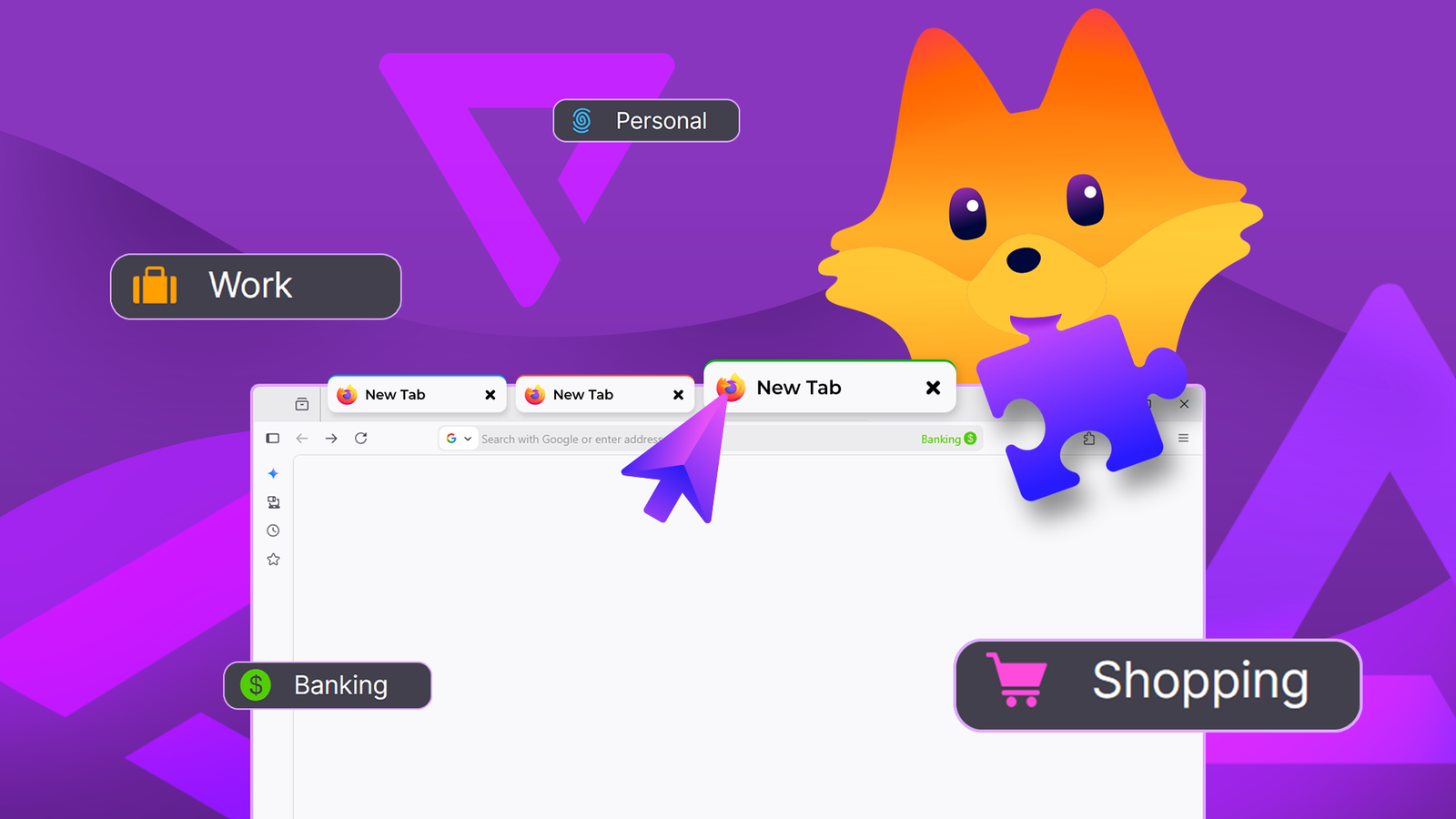
Published Jul 19, 2026, 6:00 AM EDT I cover Android with a focus on productivity, automation, and Google’s ecosystem, including Gemini and everyday apps. With a background in engineering and software development, I tend to go beyond surface-level tips and focus on how features fit into real workflows. Before joining AP, I wrote for tech publications such as Gizbot in 2023 and iJunkie (formerly known as iPhoneHacks) from 2021 to 2022. I've used Chrome for years because it does almost everything I need from a browser. It syncs across my devices, works with virtually every website, and rarely gives me a reason to look elsewhere. But no matter how I organize Chrome, separating my work, personal, and other online accounts has always been a hassle. I regularly find myself juggling personal and work accounts, opening Incognito windows to sign in with another account, or worrying that one website is tracking what I do on another. When I tried Firefox, I discovered it had a surprisingly elegant solution to all of those problems. It's such a simple idea that I couldn't help wondering why Chrome still doesn't offer anything similar, especially since it made my everyday browsing noticeably more organized. Multi-Account Containers solve one of the web's most annoying problems One of the biggest frustrations with Chrome is keeping different parts of your online life separate. I regularly switch between personal and work accounts, stay logged in to multiple services, and visit websites that I'd rather not have tracking everything else I do online. In Chrome, that usually means switching browser profiles, opening Incognito windows, or repeatedly signing in and out of the same account. Firefox's Multi-Account Containers extension offers a much cleaner solution. It lets you create separate, color-coded containers for different parts of your online life, such as Work, Personal, Banking, or Shopping. Each container has its own cookies and site storage, so websites opened in one container can't access the login sessions or cookies from another. That means I can stay signed in to multiple accounts on the same website at the same time without them interfering with each other. It only took a few clicks to organize my browsing Multi-Account Containers are easy to set up. After installing the extension from Firefox's Add-ons store, a Containers icon appears in the browser toolbar. Clicking it lets you create your first container, give it a name, and choose a color and icon so it's easy to distinguish from your other browsing sessions. Mozilla includes a few common presets, such as Work, Personal, Banking, and Shopping, but you can create as many custom containers as you need. Click the Containers icon and choose the one you want, or right-click the New Tab button to open a new tab in a specific container. Quiz 8 Questions · Test Your KnowledgeFirefox browserTrivia challenge Think you know Mozilla's legendary browser? Put your Firefox knowledge to the ultimate test. HistoryFeaturesPrivacyOpen SourceMilestones Begin What was the original name of Firefox when it was first released as a standalone browser in 2002? AMozilla LiteBPhoenixCFirebirdDNetscape Next Correct! Firefox started life as Phoenix in 2002, a lightweight offshoot of the Mozilla Application Suite. The name was later changed to Firebird, and then finally to Firefox in 2004 to avoid trademark conflicts. Not quite. The browser was originally called Phoenix in 2002. It went through two name changes — first to Firebird, then to Firefox in 2004 — before landing on the name we all know today. Continue In what year did Firefox 1.0 officially launch, marking its debut as a mainstream browser? A2002B2003C2004D2005 Correct! Firefox 1.0 launched on November 9, 2004, and it was a massive moment for the open web. The release was celebrated with a full-page ad in The New York Times funded by donations from the community. Not quite. Firefox 1.0 officially launched on November 9, 2004. To celebrate, the Mozilla community raised enough money through donations to take out a full-page advertisement in The New York Times. Continue Which non-profit organization develops and maintains Firefox? AApache Software FoundationBElectronic Frontier FoundationCMozilla FoundationDOpen Web Alliance Correct! The Mozilla Foundation is the non-profit organization behind Firefox. It was established in 2003 and operates Mozilla Corporation as a wholly owned subsidiary to handle commercial activities around Firefox. Not quite. Firefox is developed and maintained by the Mozilla Foundation, a non-profit created in 2003. Mozilla Corporation, a wholly owned subsidiary, handles the commercial and product side of things including Firefox's development. Continue What is the name of Firefox's JavaScript engine, introduced to dramatically improve browser performance? ABlinkBV8CNitroDSpiderMonkey Correct! SpiderMonkey is Firefox's JavaScript engine and is actually the world's first-ever JavaScript engine, originally written by Brendan Eich in 1995. Mozilla has continued to evolve it significantly over the decades. Not quite. Firefox uses SpiderMonkey as its JavaScript engine. It holds the distinction of being the very first JavaScript engine ever created, originally written by JavaScript's inventor Brendan Eich back in 1995. Continue What feature did Firefox introduce in 2019 to block third-party tracking cookies by default for all users? AStrict Mode browsingBEnhanced Tracking ProtectionCPrivate RelayDSecureBrowse Shield Correct! Firefox rolled out Enhanced Tracking Protection (ETP) by default in 2019, blocking thousands of known trackers automatically. It was a landmark move that put privacy front and center without requiring users to configure anything. Not quite. The feature is called Enhanced Tracking Protection, and Firefox made it the default for all users in 2019. It automatically blocks known third-party trackers, social media trackers, and cryptominers without any manual setup required. Continue Which rendering engine does Firefox use to display web pages? AWebKitBBlinkCTridentDGecko Correct! Firefox uses the Gecko rendering engine, which Mozilla has developed since 1997. Unlike most major browsers that have converged on Blink, Gecko remains one of the last independent rendering engines still in active development. Not quite. Firefox uses Gecko, its own rendering engine developed by Mozilla since 1997. This is significant because most other major browsers — including Chrome, Edge, and Opera — all use the Blink engine, making Gecko one of the last independent alternatives. Continue What record did Firefox set in 2008 that earned it a Guinness World Record? AMost browser extensions available in a single storeBMost downloaded software in a 24-hour periodCFirst browser to support tabbed browsing nativelyDFastest browser benchmark score ever recorded Correct! Firefox 3 set a Guinness World Record in June 2008 for the most software downloaded in 24 hours, with over 8 million downloads in a single day. Mozilla had organized a global 'Download Day' campaign to achieve the milestone. Not quite. Firefox 3 earned a Guinness World Record in June 2008 for the most software downloads in a 24-hour period, pulling in over 8 million downloads. Mozilla coordinated a 'Download Day' event to rally users around the world to make it happen. Continue What is the name of Firefox's built-in password manager and sync service that stores credentials securely across devices? AFirefox KeychainBMozilla VaultCFirefox LockwiseDSecure Sync Pro Correct! Firefox Lockwise was Mozilla's branded password manager, available as both a built-in Firefox feature and a standalone app. It allowed users to securely store, sync, and access their passwords across devices using end-to-end encryption. Not quite. The answer is Firefox Lockwise, Mozilla's built-in password manager. It offered end-to-end encrypted password storage and syncing across devices, and was also available as a standalone mobile app before Mozilla eventually discontinued the separate app in 2022. See My Score Challenge CompleteYour Score / 8 Thanks for playing! Try Again Site assignments are the feature that sold me Being able to keep multiple accounts separate is useful, but the feature that convinced me to stick with Multi-Account Containers was the site assignments feature. Instead of manually choosing a container every time I visited a website, Firefox learned where each site belonged. Setting it up is simple. Open a website in the container you want, click the Multi-Account Containers icon in the toolbar, and choose Always Open This Site In. Firefox automatically opens that website in the assigned container whenever you visit it. You can manage or remove these assignments at any time from the extension's settings. I assigned my work Gmail account to my Work container, my bank's website to Banking, Amazon to Shopping, and social media sites to a dedicated Social container. After that initial setup, I rarely had to think about containers again. Credit: Lucas Gouveia / Android Police Another benefit of Multi-Account Containers is that it helps keep my social media accounts separate from the rest of my browsing. By opening services like Facebook, X, or Instagram in their own dedicated container, their cookies and site data stay isolated from my Work, Shopping, and Personal containers. That makes it harder for those logged-in accounts to connect my activity across different parts of the web. It's worth noting that containers don't make me anonymous or block every form of tracking. Firefox's built-in Total Cookie Protection already provides strong cookie isolation by default, and more advanced tracking techniques can still exist beyond cookies. Chrome still doesn't have an equivalent Credit: Lucas Gouveia / Android Police Although Chrome offers browser profiles, which are great for keeping work and personal browsing completely separate, they require switching between entirely different browser windows. It isn't nearly as seamless when all you want is to stay signed in to two accounts on the same website or isolate certain sites while keeping everything in one window. Multi-Account Containers takes a different approach. Instead of separating your entire browser, it separates individual tabs into isolated containers with their own cookies and site data. I can have my personal Gmail open in one tab, my work Gmail in another, and my bank's website in a third, all within the same browser window and without any of them interfering with one another. That's a level of flexibility Chrome doesn't offer. There are third-party Chrome extensions that attempt to recreate this experience, but they're developed independently and don't integrate with the browser the way Mozilla's own extension does. It's the one Firefox feature I wish Chrome would copy Chrome still does plenty of things well, and I'm not giving it up anytime soon. But after experiencing how much simpler Multi-Account Containers made my daily browsing, it's one of the few Firefox features I genuinely miss whenever I switch back. Firefox's containers feel like a natural part of the browser, from automatic site assignments to cookie isolation, and that's why I think it's still one of Firefox's biggest advantages over Chrome.
I found the one Firefox feature Chrome desperately needs
Full Article
Original Source
Read the full article at Androidpolice →KhanList aggregates and links to publicly available news content. We do not host full articles from third-party sources. Always verify important information with original sources.