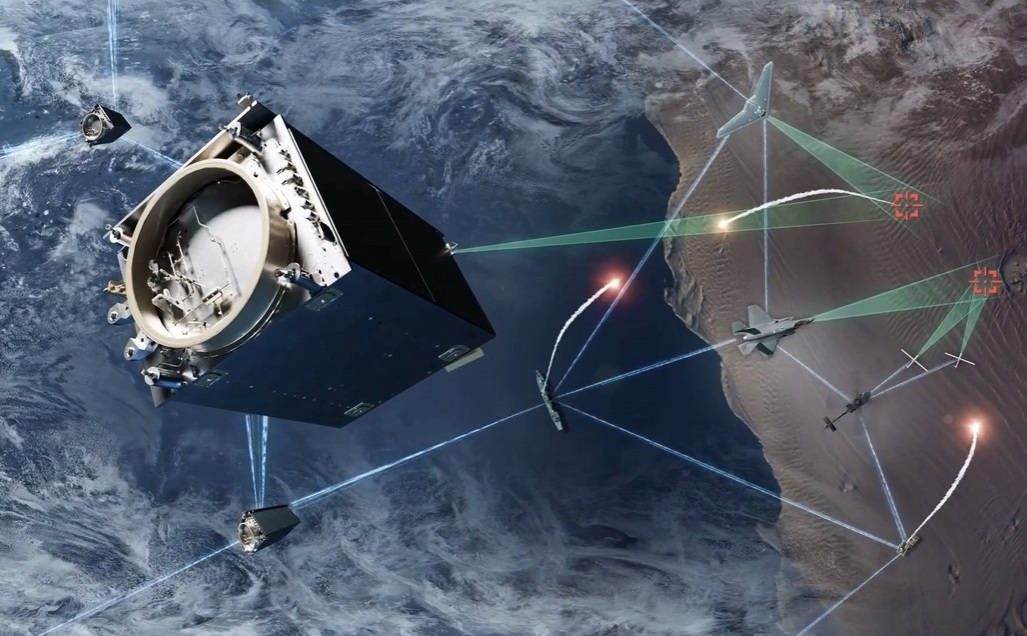
Dominance in future wars will likely depend more on data sharing than on capable weapons, Lockheed Martin has declared in a press release. In its view, the exchange of information should be quick so that commanders can understand and respond to an attack before the enemy gains the advantage. This concept is called a “sensor-to-shooter” network, and Lockheed Martin is working to make it a reality. Such a network effectively sees many different platforms from space to the sea acting as nodes in an enormous chain. According to Lockheed Martin, one of the most important “nodes” will be overhead persistent infrared (OPIR) satellites. Such satellites will act as continuous watchdogs, monitoring large areas for signs of missile engine activity. In the network, they could provide early warnings about potential threats. The Space Force describes OPIR as providing missile warning plus “tipping and cueing” to missile-defence forces. Other sensors like radar, ships, and aircraft (like the F-35) would also be used to contribute data to the network. For example, an F-35’s infrared and radar sensors might see the missile from another angle and help establish its location, trajectory, and probable target. The need for speed At the center of the network, a sort of “nervous system” called the Command and Control, Battle Management and Communications (C2BMC), would combine, analyze, and distribute information where needed. In the case of a missile launch, the system would help humans determine what was launched, where from, and where it is likely headed. It would also help commanders determine which “node” in the chain is best set to engage it, and what should be used to neutralize the threat. This could range from Terminal High Altitude Area Defense (THAAD) for short- to intermediate-range ballistic missiles to the in-development Next Generation Interceptor (NGI) for things like intercontinental ballistic missiles (ICBMs). Above all, Lockheed Martin stresses, speed of decision-making will be make-or-break. Ballistic missiles are problematic enough, but the rise of hypersonic missiles will leave commanders potentially just minutes to make a decision. If every system is isolated, people must manually pass information between separate networks. That wastes time and can produce contradictory tracks. Lockheed’s pitch is that an integrated architecture automates much of that movement and gives everyone the same information sooner. “Speed-to-decision” therefore doesn’t primarily mean faster missiles. It means reducing the delay between seeing something and taking the correct action. Lockheed Martin taking on more than it can chew? But to work effectively, every link in the chain needs to exchange usable data without unnecessary delays. For a system developed by Lockheed Martin, this should be simpler, but for third-party weapons systems, this could prove trickier. Add in the fact that different nodes could be in different services (Army, Navy, Air Force, Space Force) and different countries, and the problem becomes much clearer. Different systems tend to have different formats and security needs, especially if trying to network decades-old legacy hardware with cutting-edge systems. And that is before issues around rules of engagement and electronic warfare interference (e.g., jamming) are taken into account. Consequently, the real engineering challenge is not just connecting cables; it is ensuring that the information is fast, accurate, secure, and sufficiently trustworthy to support firing a weapon.Not a simple problem to overcome, but Lockheed Martin is confident it is up to the challenge of solving it. Recommended ArticlesGet the latest in engineering, tech, space & science - delivered daily to your inbox.Christopher graduated from Cardiff University in 2004 with a Masters Degree in Geology. Since then, he has worked exclusively within the Built Environment, Occupational Health and Safety and Environmental Consultancy industries. He is a qualified and accredited Energy Consultant, Green Deal Assessor and Practitioner member of IEMA. Chris’s main interests range from Science and Engineering, Military and Ancient History to Politics and Philosophy.
Lockheed Martin’s new defense vision connects satellites, F-35s and missiles
Full Article
Original Source
Read the full article at Interestingengineering →KhanList aggregates and links to publicly available news content. We do not host full articles from third-party sources. Always verify important information with original sources.