
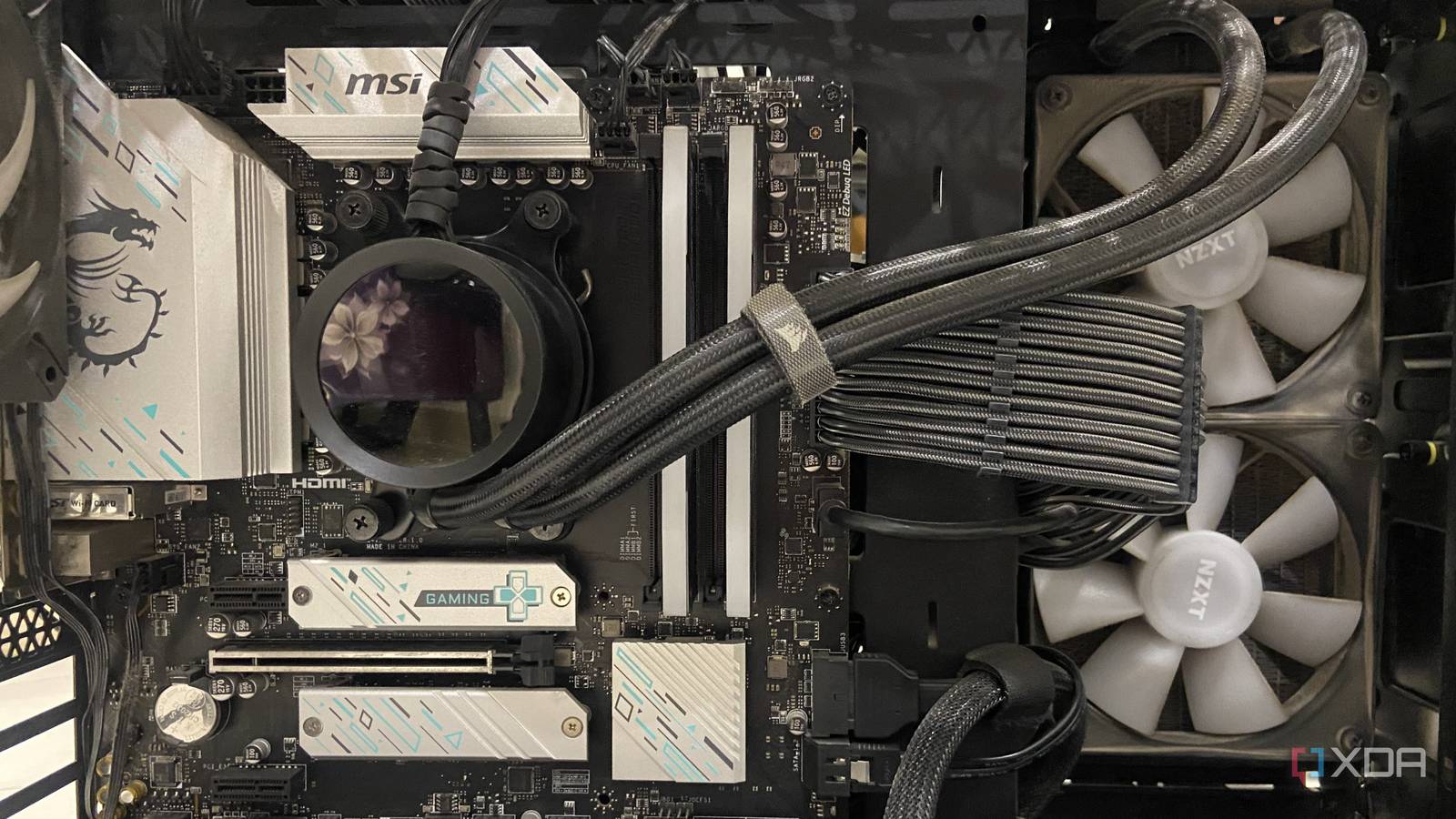
Published Sep 18, 2026, 4:30 PM EDT Abhinav pivoted from a career in banking to pursue his first love in writing. Even while working full-time, he continued contributing as an editor-at-large, a role he has held for more than 7 years. A lifelong tech enthusiast who has built three gaming and productivity powerhouse PCs since 2018, his passion for technology keeps him closely following the semiconductor industry, from NVIDIA and AMD to ARM. His MSc dissertation explored how artificial intelligence will reshape the future of work, reflecting his curiosity about the wider social impact of emerging technologies. Modern computing has come a long, long way. We went from AGP slots moving about 2GB/s and IDE ribbon cables wide enough to block half the airflow in case to a PCIe 5.0 x16 slot carrying roughly thirty times that bandwidth, storage wired straight into the CPU, and a single rear port that pushes 40Gbps of data and a display signal at once. And yet, the same boards carry remnants of a much older era. I went through the manual for my MSI B650 motherboard and found headers that I had never paid attention to, let alone thought about using, because these were designed for accessories that haven't been in use for a while. Here are four motherboard headers that'll remind you of a bygone age and serve little to no purpose on a modern PC. It detects if the computer case has been opened On my motherboard, the chassis intrusion connector is labeled JCI1, but it still ships with a variety of SKUs labeled as "chassis intrusion" (on ASUS boards) and simply CI on Gigabyte boards bundled with the F_PANEL headers. It consists of two pins, and as the name suggests, the purpose is to warn the user that the chassis has been opened. It's possible to enable it even on modern boards via the BIOS's Chassis Intrusion Configuration. The only issue is, I have neither owned nor seen a consumer case that shipped with a switch for it. The rationale is that it can serve a case for business and enterprise customers where IT professionals would want to be notified if the components inside a PC case have been tampered with. Tom's Hardware reported a case where this exact feature would've been useful back in August, where some thieves in Wuhan esports hotels swapped RTX 5080s for RTX 3060s, closed the cases back up, and went unnoticed for days. For most consumers with a personal computer, this one's going to sit unoccupied. Credit: MicroStar International. The oldest diagnostic tool on the PC, replaced by debug LEDs If you've built or used a PC in the 2000s, you'll probably remember the beep when you hit the power button that confirmed a PC was booting. That sound came from a tiny plastic speaker wired to the motherboard, and JFP2 is the header it used to plug into. My manual lists it as a connector for the buzzer and speaker. The speaker mattered because it woke up before the GPU did. If something was badly wrong with the PC, the monitor stayed black, and the beeps were the only way the board could report errors. Two beeps corresponded to one error, three meant another, and you could look the pattern up in the manual. Cases stopped bundling that speaker many years ago, and boards found a clearer way to convey the same message. My B650M comes with EZ Debug LEDs sitting near the edge, and each covers a specific error that can stop a PC from booting. Red is the processor, yellow is the memory, white is the GPU, and green is the boot drive. Credit: MicroStar International. JTPM1 asks for a chip most CPUs already contain Twelve pins for a security module that AM5 made redundant JTPM1 is a 12-pin SPI header for a discrete TPM (Trusted Platform Module), of which three are simply marked as "Reserved." Every AM5 Ryzen already provides firmware TPM 2.0 inside the processor, so Windows 11 has no reason to look for a separate chip on the board. The header exists for buyers with policies requiring a physical module, and there's a market for it, though not one that overlaps with the people buying a micro-ATX gaming board. That being said, it did have a brief moment of relevance. In March 2022, AMD confirmed that Ryzen systems could stutter intermittently with fTPM enabled, and advised users to fit a discrete TPM module instead while a BIOS fix was prepared. The fix came with AGESA version 1.2.0.7, and vendors shipped it from around May 2022. Credit: MicroStar International. JDASH1 gets you a Tuning Controller that no one's selling JDASH1 is labeled the Tuning Controller connector on the motherboard manual for my MSI B650M, which sounds useful until you look at what MSI puts on modern B650 boards. The manual says it connects to an optional Tuning Controller module, and sure enough, MSI does ship one with SKUs like the MEG Z890 Unify-X. It's a tiny module with a POST code display, power and reset buttons, OC retry and fail-safe buttons, and a clear CMOS button. It's essentially an external BIOS control panel of sorts for overclockers. The problem, however, is that my B650M can't support the whole thing. JDASH1 on my SKU has six pins, and two of them do nothing. Pin 1 is blanked for keying and pin 2 is marked NC, which leaves an SMBus clock line, an SMBus data line, 5V and ground. On the motherboards that actually support this, the same header has fourteen pins that add the functionality to use OC retry and clear CMOS features. It is less than useless in this SKU. Credit: MicroStar International. The modern motherboard has some artefacts from the past While most of these headers have no use for the average user who has built a PC around a modern chip for personal use, it costs manufacturers nothing to not remove them and some of them serve edge cases in other workloads, so I wouldn't be totally surprised if the next board I buy carries the same four. Standards are advancing everywhere else at the speed of light, but some headers inside the case remain, possibly for a trip down the nostalgia lane.
I found four obscure motherboard headers that serve almost no purpose, but manufacturers keep shipping them anyway
Full Article
Original Source
Read the full article at Xda-developers →KhanList aggregates and links to publicly available news content. We do not host full articles from third-party sources. Always verify important information with original sources.