
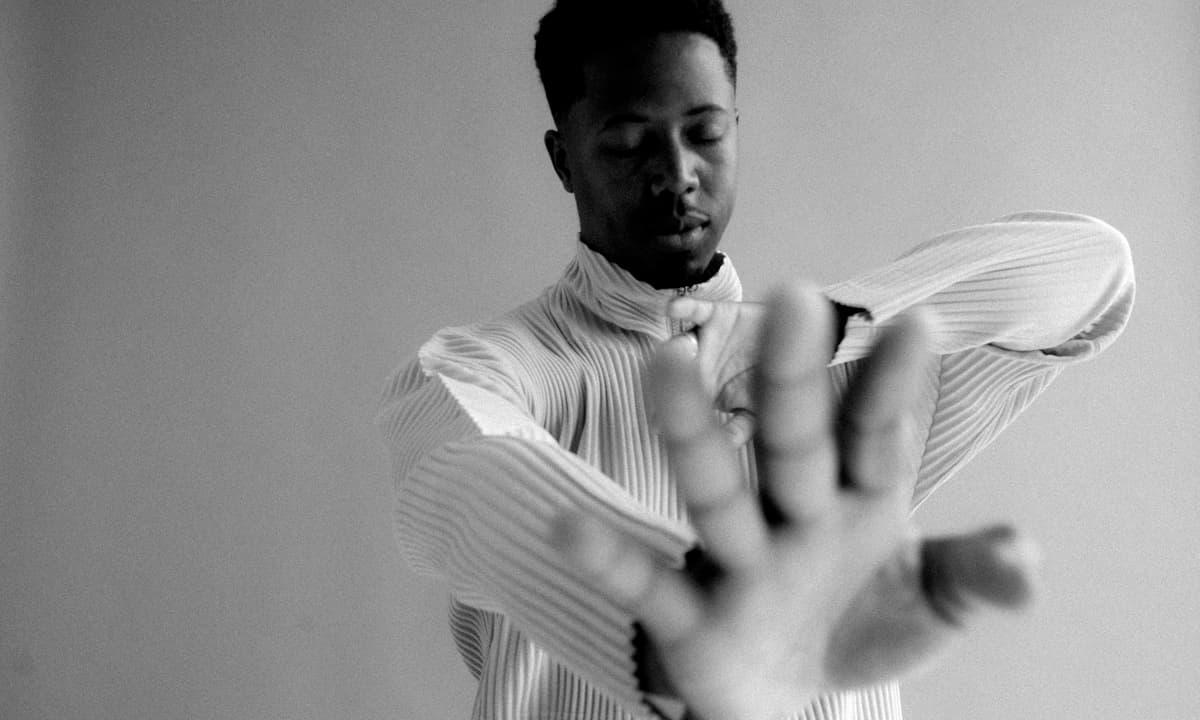
It’s raining outside St Barnabas in Dalston, where Moses Boyd is due to play a few songs from his new sophomore album, Songs for Sinners, for friends and family later this evening. Because the interior of the church — with its bare brick-and concrete walls and brightly painted crucifix — has a distinctly hollow chill, we’ve retreated to his wife’s black Polo hatchback for our interview. We run the heater to keep warm, while watching out for traffic wardens. “I think I’m OK here,” says Boyd, a boyish 35, looking out at his parking spot. “But you never know.” A few mementos dangle from the rearview mirror, including a feather and two tiny souvenir boxing gloves — one for St Lucia, and one from Jamaica, where his mother’s family is from. He has already taken his drum kit, with “Moses Boyd” emblazoned across the front bass drumhead, into the church for soundcheck. He expects a band of friends and fellow musicians, including alt-gospel chanteuse Shantéh and bass guitarist Ezekiel Ajie, to arrive within the hour.With a dimpled grin, Boyd tells me he’s set up a sound installation to play on a loop as people walk in: pre-recorded sounds of his own family singing, harmonising and cracking up around a table at his south-east London home. This “kitchen choir” is a central feature of Songs for Sinners. Their voices are rawer but no less impassioned than those of the professional jazz and gospel singers who also grace the record. Here, woven with Niji Adeleye’s vital contributions on organ and synth, these vocal layers jostle and vibe alongside jazz forms, dance grooves, glitchy electronics and Caribbean rhythms.Moses Boyd wants his latest album to be “universal”Photo by Adama JallohIt’s a project that questions faith but also restores it — in community, humanity, a future. Long celebrated as a virtuosic drummer and producer, Boyd is the man whose 2016 single Rye Lane Shuffle, a propulsive slice of London Afrojazz, is widely considered a blueprint for the London jazz renaissance — a legacy cemented when his 2020 album Dark Matter was shortlisted for the Mercury Prize. While that debut relied strictly on guest singers, Boyd now contributes vocals and wrote the lyrics himself — aside from guest spots by US rapper Chuck Strangers and spoken word artist Rarely Always on I Surrender. On some tracks, he steps away from the drum kit entirely. “I wanted these songs to be about all of us and for all of us,” Boyd says. “They’re about our relationships and our ideas. The title is a nod to this theological notion that we’re all sinners. It’s a bit of rage bait.” He smiles, shrugs. “I wanted this music to be universal.”The cast of singers and musicians on Songs for Sinners is nearly 30 strong, as befits a project created “in chunks” over three years, during which he variously travelled, moved house, had his first child, made music for film and TV, and played live with friends including saxophonist Binker Golding. The two co-founded the acclaimed jazz duo Binker & Moses in 2014, forming the project while touring as part of the rhythm section for vocalist Zara McFarlane. “Come together, give thanks just like we should,” belts McFarlane on Say Yeah, a soaring liturgical wig-out that features a children’s choir from Earlham Primary School and is the album’s first single. “Oh, you cannot measure just how I feel so good.”“My earliest memories are going to services and prayer meetings there with my brothers and sisters”This celebration of togetherness is hard-wired into Boyd’s history. His musical identity was forged across several deeply collective London spaces. Early on, there was the high-energy participatory environment of the West Indian church. In the 1980s, his paternal grandparents, who were from Dominica, ran a Pentecostal congregation from their house in Brockley — a hub for newly arrived Caribbean families.“My earliest memories are going to services and prayer meetings there with my brothers and sisters,” Boyd says. He is number four of six siblings. “That was my life for a long time.” Moses Boyd says Songs for Sinners is the album he always wanted to make.He was 13 when he started on drums, the same year his older brother gave him NERD’s 2004 masterpiece Fly or Die, embedding a genre-blurring clash of rock, punk and hip-hop into his sonic DNA. His teacher, a jazz drummer, turned him on to greats such as Elvin Jones and Max Roach. From there, he went on to join Tomorrow’s Warriors — the legendary jazz incubator where shared musical conversations and an “each one, teach one” philosophy dovetailed with that of the church.Read More“I loved the freedom of jazz, which wasn’t there for me in gospel music. I started going at 100 miles per hour. I played in rock, funk and reggae bands. Afro-Cuban ensembles. Sun Ra cover bands. I did functions. Weddings. I had enough tools under my belt,” he continues. “By the time of Rye Lane Shuffle I’d realised what ingredients were lacking for me in UK jazz and so I put them together.”Alongside friends and fellow Warriors graduates including tuba player Theon Cross, saxophonist Nubya Garcia and drummer Femi Koleoso (later of Ezra Collective), he became part of a diverse community who jammed in pop-up clubs and back rooms of pubs. They heightened the energy with bouts of fierce improvisation and dancefloor-style drops, bringing in the likes of Afrobeat, highlife and grime, breaking the fourth wall, making jazz something people could dance to again. Bringing it back to life.With his impassioned second album, the drummer spearheading London’s collective jazz renaissance is helping restore the city’s faith in community, humanity and the future. “Something about this feels very euphoric and dreamy to me.“It wasn’t new, but for a long time we’d lost that. There were jazz clubs, and there were clubs for clubbing. By bridging the gap, London created a different relationship with the music that no one else had at the time.”“I had the desire to mix the two worlds, but I didn’t know how”When the media hype came, positioning him at the vanguard of the young London jazz boom, he didn’t feel overburdened. “I knew what I was trying to do was bigger, that there were other avenues and places to get to, ones that didn’t fit the sound being talked about. I was like, ‘If you expect me to keep doing this, that is not going to happen’.”Songs for Sinners is the album Boyd always wanted to make. But he couldn’t have made it until now. “I had the desire to mix the two worlds, but I didn’t know how,” he says. “With this album, like much of my life, there’s no roadmap, no easy answer to, ‘How does a drummer from south-east London start his own band and mix sound system music with jazz and gospel?’ Who do you even ask?”By way of suggestion, I point heavenwards, and he smiles. “I didn’t have enough life lived to do it. Now I’m 35. I’ve loved, lost, married, had a child, been down, had success, whatever. My relationship with faith has changed. Why? What am I critical of? What do I love? What do I let go of? Lyrically, I wanted to ask the questions that I have asked myself. That millions of people have asked themselves. If you listen to a lot of the songs, they’re from the perspective of someone running away from faith and someone running to faith, which is important because both things happen on a daily basis.”Later, inside a church warmed by a small, rapt crowd seated elbow-to-elbow in rows, and by the steaming cups of tea, coffee and biscuits on offer from a table at the back, Boyd takes to his drum kit, flanked by two musicians and four gospel singers. Shantéh begins, a cappella. “Maybe you’re by yourself, the weight of the world heavy on your health, still tryna figure out, but deep inside you know,” she sings, her voice soaring. Boyd weighs in, his playing driving and restless, then fluid and open. “There’s more to life than this.”Back in the car, we’d tried to find a label for Boyd’s new gospel-jazz hybrid, for this boundarypushing record with its existential themes andepic sweep. I tell him Songs for Sinners is the album we need right now. Boyd grins again. “I’ll take that,” he says. “Yeah, I’ll take that.” Songs for Sinners is out now; Moses Boyd plays Koko on April 1, 2027
‘I didn’t have enough life lived’: Moses Boyd on his most personal album yet
Full Article
Original Source
Read the full article at Standard →KhanList aggregates and links to publicly available news content. We do not host full articles from third-party sources. Always verify important information with original sources.