
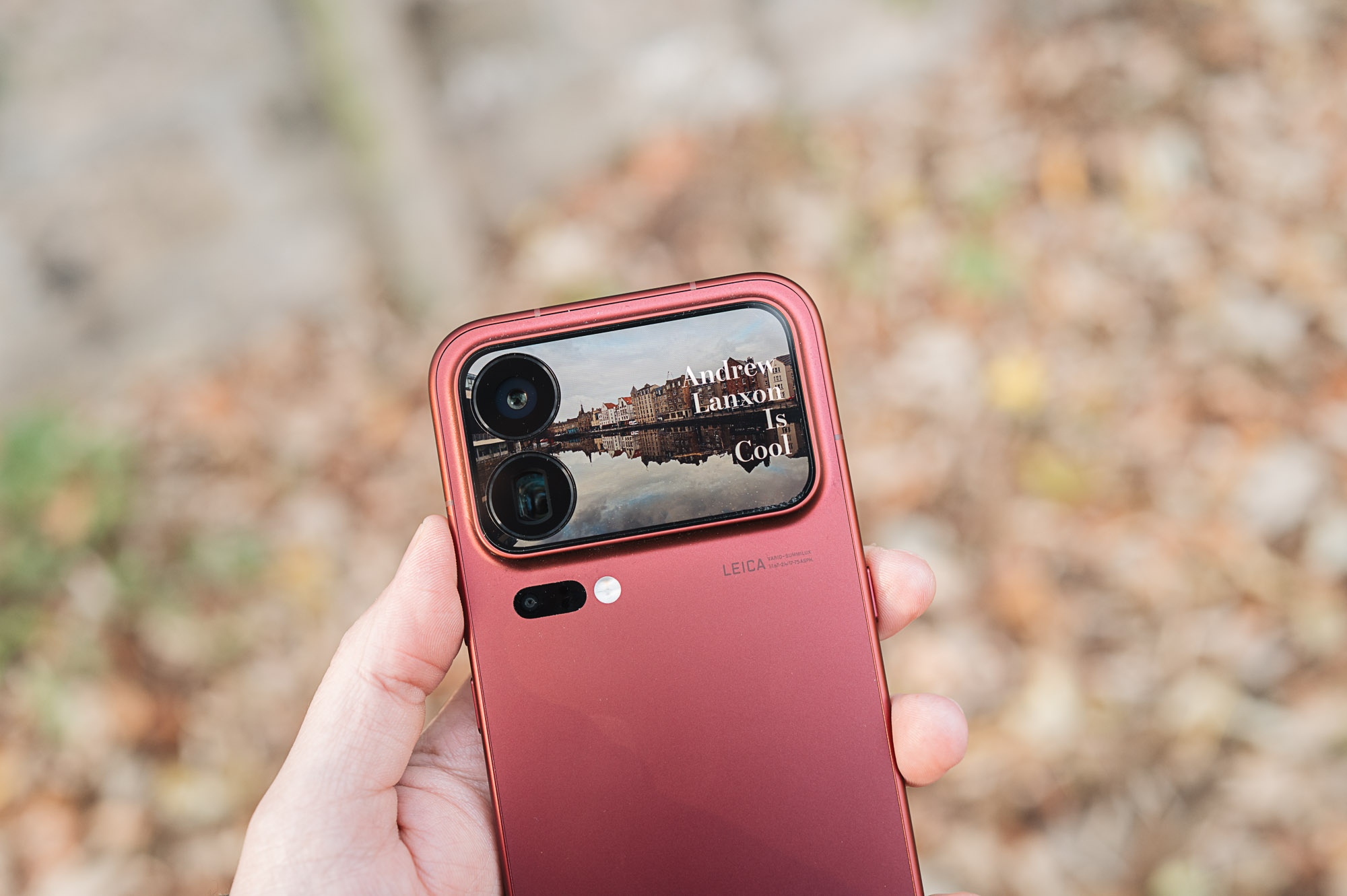
Xiaomi teased me with the 17 Pro, its bizarre dual-screen Android phone, last year. But it was sold only in China. Being from the UK, I went back to my regular boring phone with its boring single screen. Big sigh. So imagine my excitement when Xiaomi announced that its new flagship 18 Pro and Pro Max — complete with a second rear screen — would launch internationally, with a rollout including the UK and wider Europe. As with the rest of Xiaomi’s handsets, people in the US are flat out of luck. That sucks for Americans because this phone is actually damn good. I worried that the rear screen would just be a dumb gimmick — something that tries to separate the phone from competitors but doesn’t actually add anything useful. But I actually like it. Need it? No. But it’s fun and has some genuine uses. Beyond the screen, though, the 18 Pro Max packs the latest Qualcomm Elite Extreme Gen 6 processor, a fast-charging silicon-carbon battery and a potent camera setup that utilizes the same LOFIC sensor technology that impressed me so much in Xiaomi and Leica’s Leitzphone earlier this year. From the front you wouldn’t know there’s anything unusual about this phone.Andrew Lanxon/CNET The 18 Pro isn’t just smaller (6.4 inches vs. the Pro Max’s 6.9 inches) it misses some of the Max’s top tech as well. The processor is a lesser model, the main camera doesn’t use LOFIC tech and the smaller battery isn’t as capable. Shame. But the 18 Pro Max is an all-round Android powerhouse, and I’ve really enjoyed getting to grips with it over the past couple of weeks. Here’s what I’ve found and what you need to know about this phone. Xiaomi 18 Pro Max: What’s with that second screen? The extra display on the back is certainly this phone’s standout feature. It’s basically in the same place as the iPhone 18 Pro’s camera island, but instead of just being a piece of metal, it’s an actual functioning screen. If you’ve ever seen the cover display on a clamshell flip phone like Samsung’s Galaxy Z Flip 8, then it’ll seem quite familiar. Like the Flip 8, the second display shows incoming notifications, acting as a camera viewfinder and offering a variety of basic built-in functions like calendar reminders. What really hooked me, though, was the ability to create Gen AI apps just by typing in a prompt. For example, I asked for “a game where you just pop bubbles,” which the “Polish” tool elaborated on with deeper functions and visual styles before generating a finished game that was fully playable on the back screen, complete with a scoring system and, for some reason, a jellyfish mascot. It takes about 5 minutes for the app to be created each time, and its functions are limited. It’s not able to access any app data, so don’t expect to create a new email reader, and anything too technical will result in failure. Screenshot by Andrew Lanxon/CNET I asked it to create a camera overlay that showed exposure settings (shutter speed, ISO and so on) to serve as a light meter for an analog camera. I’m not sure whether the issue was my explanation or a technical limitation, but it took the phone two tries to get something close. It created an interface with dials and exposure information, but it didn’t open the camera to calculate exposure as I’d hoped. As a result, it looked nice but it was functionally redundant. Another time, I asked it to create an app that showed real-time charging speeds. The resulting app showed current battery level but not charging speed. It did have a baffling “charging milestones completed” button that simply increased by one each time I tapped it. I also had no luck with my “rude word generator,” which just repeatedly came back with “Couldn’t generate.” Frustratingly, each time it fails to create an app, it doesn’t tell you why — like if you’re asking for information it’s unable to access — but just says to try again “in a minute or two,” which rarely resulted in success in my testing time. If I’m asking for something it can’t achieve, it’d be helpful to know that. Even so, I’m impressed with this app creation tool and, like many of the AI tools that only mildly excite me right now, I can only assume it will improve over time. One of my favorite uses of the rear screen, though, is for vlogging. Firstly, seeing yourself from the back of the phone means you’re able to accurately film yourself using the best quality camera, rather than limiting yourself to the front-facing camera, which won’t look as good. But there’s also an autocue function where you can input a script and have it overlaid as text, allowing you to read out your words as you present to camera. If you use the rear screen for your selfies, the image quality will be far better than using the front-facing camera. It’s a powerful tool for vloggers and other video creators who rely on longer prewritten scripts for their videos. But it’s quite basic: the text simply auto-scrolls at a speed you set in advance. I’d love to see Xiaomi use voice recognition here to automatically progress the text as you read out the words, slowing down or speeding up as you naturally read aloud. This tech already exists, so I don’t think I’m asking for literal magic here. Xiaomi 18 Pro Max: Great cameras for creative photographers Tucked into that second display is a 200-megapixel main camera and a 200-megapixel telephoto camera offering 3.2x optical zoom or 6.4x hybrid zoom. There’s also a really tiny 50-megapixel ultrawide camera by itself below the camera island, which makes it feel like an afterthought — something that I’ll come back to later. The main sensor is physically slightly smaller than the one in Xiaomi’s Leitzphone, but it uses the same LOFIC sensor tech for better dynamic range in a single image. I’ve taken a lot of photos with it so far and I’m really impressed with what I’ve seen. The smaller 18 Pro has an almost identical camera setup but its main sensor doesn’t use LOFIC, which is a shame as it forces you to go for the larger phone if you want the best possible image quality. There are loads of ways to customise the look of your images and I love the warm tones and superb dynamic range of this shot. Andrew Lanxon/CNET Pin sharp focusing on the flower, great colors and perfect exposure. No notes.Andrew Lanxon/CNET It’s a relatively low-light shot, but this image is sharp, noise-free and has great colors.Andrew Lanxon/CNET Shots are well-exposed, with accurate colors and fine details that manage to look sharp but without the harsh over-sharpened look that’s all too often seen from phone cameras. Images look more natural as a result. I like the standard look (left) and while the oranges are a bit much in the filmic look version (right) I do like how much it leans into those fall vibes. There are a lot of ways to tune your images in-camera — almost too many, in fact. There’s a whole host of built-in color presets, including a Leica-branded high-contrast black-and-white mode that I like, all of which you can customize further by adjusting the tones, colors, grain and white balance. Then there’s the option to shoot using the phone’s default color processing, going with “Leica Vibrant” for more popping colors or “Leica Authentic” for more natural tones. Each of these applies no matter what filter you then apply over the top. I will never get bored of the phone’s black and white mode.Andrew Lanxon/CNET Don’t want black and white? No problem, the phone has plenty of color options for you.Andrew Lanxon/CNET Confused? Yeah, I’m not entirely surprised, there are a lot of variables at play when taking an image with this thing but it didn’t take me long to figure out how to get the look that I wanted. And let’s be honest, there aren’t many photographers who want fewer options in how to take a photo. Then there’s Essential Moment, which is its own standalone mode where you can select from three distinct styles: a black and white mode, “modern vintage,” or “Iconic CCD.” Each of these is designed to replicate specific looks from cameras of the past, and Xiaomi says it uses AI to analyze the scene to authentically reproduce color tones, vintage lens effects and film grain (though crucially not generative AI to actually alter anything in the scene). I used the Essential Moment mode here and I love the colors it’s produced.Andrew Lanxon/CNET And the Essential Moment’s black and white mode has captured this curious pigeon magnificently.Andrew Lanxon/CNET I actually love this, especially the black and white option, which produces monochrome images with beautiful contrast and genuinely authentic-looking film grain. It’s the mode I’d end up using most often, I’m sure, and I’ve taken a bunch of photos with it that I really like. Oh, and that tiny ultrawide camera, weirdly separated from its friends? It’s not great, with nighttime shots being particularly disappointing here. On the upside, the main camera’s standard focal length is 23mm, which is already pretty wide, so you probably won’t miss the ultrawide much. Xiaomi 18 Pro Max: Processor, software and privacy display While the base 18 Pro uses Qualcomm’s latest Snapdragon 8 Elite Gen 6, the Pro Max ups the ante with the Snapdragon 8 Elite Extreme Gen 6. It’s no surprise that the Pro Max is a seriously powerful bit of kit, returning benchmark scores up there with the powerhouse Samsung Galaxy Z Fold 8 Ultra. Everything ran exceptionally smoothly, from playing demanding 3D games like Genshin Impact to editing photos or navigating the Android 17 interface. I found much the same with the 18 Pro, too — I didn’t see a noticeable difference in performance. I don’t mind Xiaomi’s software skin, as it’s easy enough for anyone familiar with Android to get to grips with. What I don’t like, though, is the company’s insistence on preloading it with an armada of apps including AliExpress, Netflix, WPS Office, TikTok and others. Together with the variety of Xiaomi apps also on board, the phone feels somewhat cluttered before you’ve even had a chance to add anything of your own. I’ve seen worse examples (Oppo has been bad with this), but it still irks me that the phone ends up feeling almost like it’s ad-supported. And if it is, surely it should be cheaper? The rear screen has various useful features but it can also just show the clock and a cute cartoon animal. So that’s nice.Andrew Lanxon/CNET The display has a “privacy mode” that uses hardware dimming to limit how much of the screen can be seen by people peeping over your shoulder. It’s similar to the tech we saw earlier this year on the Galaxy S26 Ultra, although having seen them both side by side, Samsung’s seems better. On the S26 Ultra, the privacy boost means that, when viewed off angle, content becomes essentially invisible. On the Xiaomi, while it looked much dimmer from the sides, I could still make out words on screen. It helps a bit, sure, but it won’t block those creeps entirely. My advice is: if you’ve got information so sensitive that even a glimpse would be career-ending, maybe wait until you’re alone before you put it on screen. Xiaomi 18 Pro Max: Battery life and charging The 7,050-mAh silicon-carbon battery in the larger Pro Max packs a punch, putting in some solid scores on our demanding battery rundown tests. After one hour of YouTube streaming, it dropped to 97%, then to 89% after the third hour. That puts it above the Galaxy S26 Ultra and Google Pixel 11 Pro XL, although still below the current champion, the iPhone 18 Pro Max. The deep red color of the phone looks great and the all-metal construction feels very premium to hold.Andrew Lanxon/CNET In everyday use, you won’t struggle to get through a full day of mixed use and you can likely be quite demanding with it and still not worry about it conking out mid-afternoon. Take photos, watch videos, listen to music – don’t stress over it; this thing should hold out fine. The phone supports up to 100-watt wired fast charging, though you’ll need a Xiaomi fast charger to achieve the fastest speeds. I don’t have a Xiaomi charger (and the fastest it sells in the UK is 90W for £25), but I tried it with multiple third-party 100-watt chargers and the maximum I could get was around 65 watts. Even so, it went from 1% to 65% in 30 minutes of charging, which is still pretty quick — on par with the iPhone 18 Pro Max, in fact. Still, it should be able to go faster; you’ll just need to source a charger that will allow it. With its smaller 6,000-mAh battery the Xiaomi 18 Pro didn’t fare as well on our battery drain tests (it dropped to 93% after an hour of YouTube streaming) but in general use you’ll still comfortably get through most of a day on a single charge. It’s a great all-round Android phone.Andrew Lanxon/CNET Xiaomi 18 Pro Max: Should you buy it? If you’re in the US, it’s something of a moot point. You can’t buy it. Sorry. Sure, you can probably import it from some third-party resellers, but it’s not officially on sale. If you’re somewhere where you can buy it, then lucky you — this phone is a blast. It ticks many of the boxes I’d expect from a flagship phone right now (camera quality in particular), and that second rear screen is the cherry on top. I expected it to feel like a pointless gimmick, and maybe it is a bit of a novelty, but it’s fun and I’ve already found it genuinely useful. I don’t like that there are so many hardware differences between the two phone sizes, as it forces you to have a much bigger model if you want the best performance. I prefer Apple’s approach: With the iPhone 18 Pro, I can have the same exact potent camera setup and processor performance, no matter which size I choose. With Xiaomi’s phones I’m forced to compromise between performance and pocketability. If you want the best camera, then go for the bigger model. Battery life is better, too. When he's not testing the latest phones or phone cameras, Andrew can normally be found with his own camera in hand or behind his drums or eating his stash of home-cooked food -- sometimes all at once. See full bio
I Didn’t Expect to Like Xiaomi’s Bizarre Dual-Screen Phone So Much
Full Article
Original Source
Read the full article at Cnet →KhanList aggregates and links to publicly available news content. We do not host full articles from third-party sources. Always verify important information with original sources.