
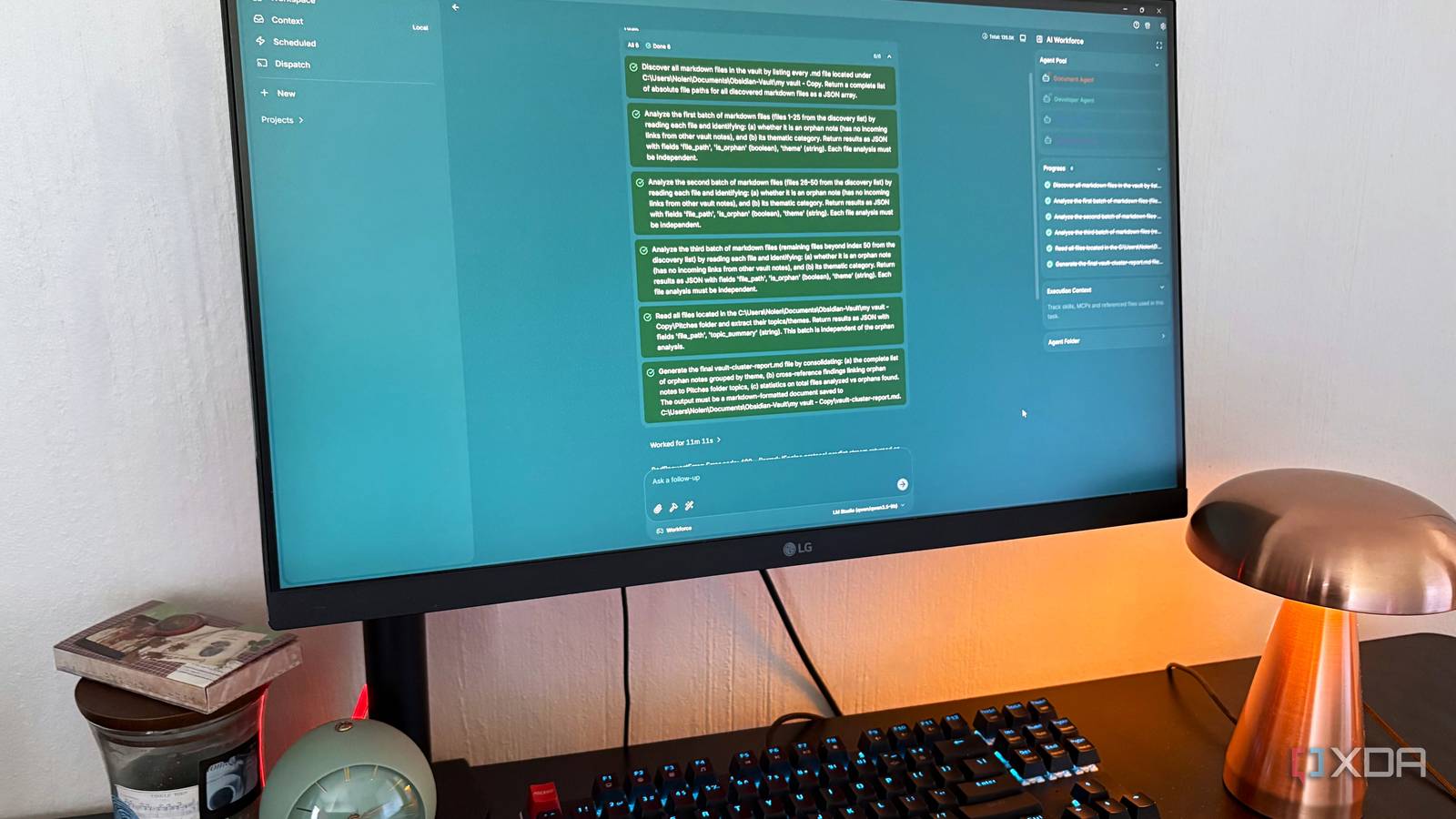
Published Aug 25, 2026, 7:30 AM EDT Nolen began their writing career in 2019, with three years dedicated to editing the Creative section at MakeUseOf. Their expertise lies at the crossroads of technology and creativity, covering areas like photography, video editing, and graphic design. Outside of work, you'll often find Nolen diving into a good book, writing their own stories, or playing video games. Handing an app permission to browse, write files, and execute on your behalf is powerful, but there's a whole category of work that I think you shouldn't give to a cloud-based agent. Basically, I feel like if you wouldn't send it in a DM or post it on social media, then it's probably best left on your machine, such as bank statements, contracts, or health info. Every big agentic cowork tool right now, Claude Code, Antigravity, Codex, etc. ships all that context off to servers out of your control. Eigent is an open-source, local-first alternative to those. I've been testing it for a while, and it does actually accept cloud APIs, but the version that matters for this is Eigent paired with a local model. That's the setup that's going to keep your workflow fully local. Want to stay in the loop with the latest in AI? The XDA AI Insider newsletter drops weekly with deep dives, tool recommendations, and hands-on coverage you won't find anywhere else on the site. Subscribe by modifying your newsletter preferences! Some folders need to be kept off-limits And I finally found a place for them to go I have been running Claude Code, Codex, and Antigravity for months, and I have never once pointed any of them at something on my machine that would bother me if it were published publicly. For example, I use these tools for my UI experiments and vibe-coding projects, as well as my Obsidian vault admin and interactive layer. The vault has meeting notes, pitch ideas, a database of my DVD collection, and so on - so yes, private information, but it wouldn't be the end of the world if those contents got more eyeballs. I deliberately keep my health and finance docs out of it because I want to keep Claude Code in it. I've primarily been using my local LLM with the filesystem access plugin to work on those private documents. It's a dead simple setup and gives you an interactive layer on documents you might not have otherwise understood. Until I found Eigent, a cowork app that lets you run the entire pipeline locally and gives you more workspace features than a local LLM engine. I run this with my tried-and-true Qwen 3.5 9B because it's powerful enough for tool calling but small enough to work within the constraints of my hardware. One app running a whole team of agents This agent splits up and runs the pieces at the same time Eigent is an open-source desktop app built on the CAMEL-AI multi-agent framework. It doesn't care what model you pick, but I've been running it locally, hooked up to LM Studio's OpenAI-compatible local server so every call runs on my GPU. Ollama, vLLM, SGLang, and llama.cpp all work the same if you prefer one of those. It ships specialized agents - Developer for terminal and code, Search for browsing, Document for file work, Multi-Modal for images and audio. And then there's the parallel workforce. When I hand it a prompt, a Coordinator agent decomposes it into subtasks and dispatches them across the specialized agents, and these independent branches run concurrently. Each agent keeps its own memory window so context does not bleed between them. The Document agent handles the usual suspects: PDFs, Word, Excel, PowerPoint, HTML, EPUBs, plain text, even images via OCR and audio. So bank statements, contracts, and scanned docs are all fair game. I'm not demonstrating this with my actual private documents, of course, so I set it up with my Obsidian vault. A prompt like "cluster my orphan notes by theme and cross-reference them against my open pitches" spins up multiple agents that all work the vault at the same time. My DVD hunts pull the same trick - Document agent reads my wishlist while the Browser agent hits retailers in an isolated Chromium session, both running in parallel while I watch the task tree fill in. It finishes fast enough, though this will come down to your hardware if you're running the full pipeline locally. Don't expect miracles if you have a smaller GPU like me. The agent clocks in without me It runs itself Eigent has a Triggers system that lets you schedule your work, and there are three types. Schedule Triggers for recurring runs, Webhook Triggers for external systems firing agents in real time, and Agentic Triggers where one agent can wake another based on the outcome of its own task. My DVD hunt Skill was the obvious first candidate. I had been running it manually every couple of weeks. Now it runs every Sunday morning on a Schedule Trigger and drops a dated report into my collection folder before I even start my day. Setting it up was pretty easy - I opened Scheduled in the sidebar, gave it a plain prompt of "run dvd-hunt every Sunday at 8 am and save the report to my collection folder", and it parsed the cadence and wired the Skill up itself. Every scheduled run uses the same local model my manual runs do, so unattended does not mean it reaches for the cloud when I am not looking. Eigent also runs a local Postgres instance in the background and logs every agent message and tool call and file write into it. When I check on the Sunday run, I can pull up exactly what happened - which agent did the reading, which page the browser hit, what ended up in my collection folder, and so on. All of this with no cloud-based dashboard behind it, the entire database is still on my machine. Finally, a local agent stack I can use for the folders I would never hand to a cloud one Local agents used to be a massive compromise, they were way slower and less capable, but at least private. Now, if you're in the same boat as me with 8GB VRAM, you might still be dealing with some slowness, but the "incapable" framing overall is outdated now. Eigent with a local model gave me a workforce that runs in parallel on my GPU, a scheduler that wakes it up without me, and a Postgres instance that keeps the receipts. The folders I wouldn't let a cloud agent near finally have something to work with them. Eigent
I built a fully local agentic AI setup with one open-source app, and it never touches the cloud
Full Article
Original Source
Read the full article at Xda-developers →KhanList aggregates and links to publicly available news content. We do not host full articles from third-party sources. Always verify important information with original sources.