
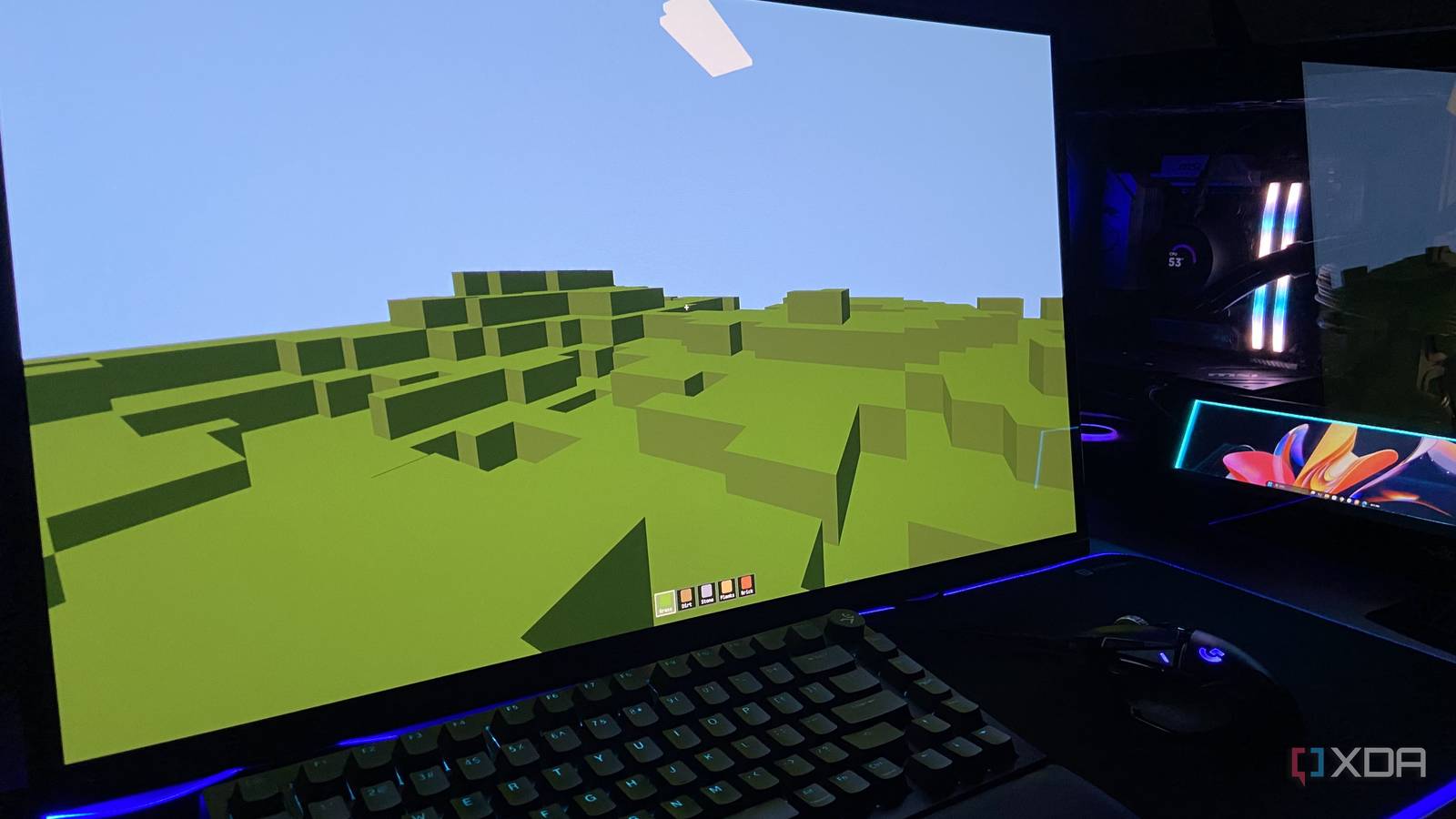
Published Nov 25, 2026, 2:01 PM EST Abhinav pivoted from a career in banking to pursue his first love in writing. Even while working full-time, he continued contributing as an editor-at-large, a role he has held for more than 7 years. A lifelong tech enthusiast who has built three gaming and productivity powerhouse PCs since 2018, his passion for technology keeps him closely following the semiconductor industry, from NVIDIA and AMD to ARM. His MSc dissertation explored how artificial intelligence will reshape the future of work, reflecting his curiosity about the wider social impact of emerging technologies. At this point, anyone who's remotely expressed their interest in AI models has seen their YouTube algorithms flood the feed with coding contests between the incumbents Gemini, Claude, and ChatGPT to create Minecraft, GTA, and various other games with an endless budget. The frontier models have always been able to create something workable as far as anyone can remember, and they often come up with something impressive now and then. However, what else is expected of data center-grade compute? To see how close three local models that could run on my 16GB gaming GPU could get in the same test, I ran Alibaba's Qwen3.6-35B-A3B, Google's Gemma 4 26B-A4B and Nvidia's Nemotron 3.5 Lightning 30B-A3B via llama.cpp as the runtime with a 128K context window. When each model got the same prompt for a small Minecraft-style sandbox and exactly one attempt, only one got reasonably close to what you'd call Minecraft. All three models received the same hastily written prompt This gamer wants Minecraft in HTML, and they want it now Not every prompt that goes to a local model comes from a developer, and that means that most prompts aren't well-engineered and well-thought-out. I wrote the prompt from the perspective of an impatient gamer with the surface-level expertise of someone who has watched a few too many YouTube coding contests. They know enough to ask for Three.js and an HTML file, but not enough to spell out how collisions or block placements should work: Make me a small Minecraft-style sandbox in a single HTML file using Three.js from a CDN. I want a small hilly world of grass, dirt and stone that I can walk around in first person with WASD and the mouse, jump in, and not fall through. Left-click breaks blocks, right-click places them, and number keys switch between a few block types. No mobs, crafting, or saving, just the sandbox. Give me the whole file in one go. All three models ran in llama.cpp on my RTX 4070 Ti Super with a Ryzen 5 7600X chip and 32GB of DDR5 memory, using Unsloth's UD-Q4_K_M quant, a 128K context window, reasoning enabled, and sampler settings from each respective model's Hugging Face card. I left llama.cpp's --fit option at default to let the automatic fitting decide how much spilled into system memory. As for the evaluation, I set five yes/no checks from the prompt the way a player would evaluate them, and a model had to pass all five. Check Passes if World Loads into a hilly world with grass on top and dirt and stone below Movement WASD walks, mouse looks around in first person Ground Space jumps, and you land on blocks without phasing through Break and place Left-click removes the block you're aiming at, and right-click places one on the face you're aiming at Block switching The number keys change the block type Nemotron built exactly one block, and it was black The game has no flaws if there's no game Nvidia's model card compares Nemotron 3.5 Lightning directly against Qwen3.6 and Gemma 4, so my expectations were quite high. After delivering the prompt, Nemotron produced 5,677 tokens in just under two minutes at 47.74 tokens per second, which was the slowest of the three, despite the "Lightning" in its name. However, partway through its reasoning, it talked itself into a mistake. It decided that the pointer-lock control in Three.js already reads WASD and handles jumping. Well, it does neither. It then loaded Three.js twice, once as a classic script and once as a module under the same name, so the module could not find the controls it needed. When I opened the HTML, I was greeted by a black screen, with a block indicator reading Grass, and an FPS counter counting... nothing at all. Nemotron's response ended with "Enjoy your tiny Minecraft-style sandbox!", for which it gets 5/5 in the cruel joke contest, but 0/5 on my checks. Qwen3.6 built the most ambitious world And then launched me out of it Qwen3.6 had a reputation that preceded its entry into this test. I've used it extensively for local coding before, so it was my favorite going in. It was also the fastest, jotting down 8,495 tokens in just two minutes and 19 seconds at 60.74 tokens per second. It's game was the most ambitious, with noise-generated hills on a 48x48 map, five block types, clouds, and a block outline. As I watched its reasoning traces, I found myself getting rather excited. Well, I got too excited. I clicked in, saw a brief glimpse of the world it had created, and then it launched me into the orbit, on all three reloads. Turns out Qwen picked my spawn point before the world existed, which left me in mid-air. Worse still, Qwen rewrote its collision code halfway through, under a comment that said, "Actually let me redo collision more cleanly," but never deleted the first version, so both ran at once. The older of the two had a math error that turned falling into an upward push, and once I'd fallen about five blocks, that push overpowered gravity and only got stronger from that point. Curiosity got the better of me, so I had Claude fix the bugs behind the launch and dropped back into Qwen's world. The screenshots here detail what Qwen3.6's sandbox would have looked like if it hadn't sent me to the moon, though they don't do any favors for its 2/5 score. Gemma 4 kept it simple, and it was the only one that worked This was unexpected, but very welcome Gemma 4 wrote the least code of all three, and finished in one minute and 25 seconds with 4,762 tokens at 55.43 tokens per second, so before I even ran the HTML file, I had low expectations to begin with. Its game also happened to be the plainest of the three featuring a 32x32 world of hills built from sine waves, three block types, and what Gemma called a "mini-physics engine" that checks the block under your feet. To my absolute surprise, it was the only one that passed all five checks. I could walk, look around, jump, break blocks, and build with dirt without falling through anything. While the clear winner out of the three, it wasn't exactly perfect. Gemma tied the movement speed to the frame rate, so the faster my monitor refreshed, the faster I moved. On my 240Hz monitor, even the lightest tap of W flung me across the map. Regardless, it was the only one of the three that was remotely playable. I'd leave Minecraft to Microsoft for now There are certainly better ways to run this test, and as I've experienced, a lot of the outcome depends upon the prompt. An overly-engineered prompt could yield better results, but the test was to demonstrate how far each model could get with as little context from a gamer as possible. Astonishingly enough, the winner was the one I least expected, but given how fast the local AI landscape is moving, I'd give it only a week before that could all change. llama.cpp Llama.cpp is an open-source framework that runs large language models locally on your computer.
I asked Qwen3.6, Gemma 4, and Nemotron 3.5 to build Minecraft on my 16GB GPU, and only one pulled it off
Full Article
Original Source
Read the full article at Xda-developers →KhanList aggregates and links to publicly available news content. We do not host full articles from third-party sources. Always verify important information with original sources.