
Published Nov 15, 2026, 5:30 PM EST Abhinav pivoted from a career in banking to pursue his first love in writing. Even while working full-time, he continued contributing as an editor-at-large, a role he has held for more than 7 years. A lifelong tech enthusiast who has built three gaming and productivity powerhouse PCs since 2018, his passion for technology keeps him closely following the semiconductor industry, from NVIDIA and AMD to ARM. His MSc dissertation explored how artificial intelligence will reshape the future of work, reflecting his curiosity about the wider social impact of emerging technologies. Sign in to your XDA account I have spent an unbelievable amount of time playing .io games in my browser, and what keeps me coming back to them is the sheer simplicity of these games that also makes them so addictive. They're noncommittal, instantly rewarding, and involve zero setup hassles. I've also put the agentic capabilities of Claude Code, OpenAI's Codex, and Google Antigravity against one another on several occasions, almost enough times to start believing that there are no surprises left. This time, I asked all three for exactly the kind of browser games that I keep coming back to. I went asking for a 3D time-trial racer that runs in my browser with nothing to install, three tracks with medals to chase, and a ghost of my best lap to compete against. Then, I played each on my DualSense, and one of them kept me hooked for over an hour. I wrote the brief like a player, not a developer Every agent got the same prompt, and one shot at it While writing out a prompt for this test, what I deliberately wanted to avoid doing this time is handing out a feature checklist and evaluating models against a set of fixed deliverables, mainly for two reasons. The first of which is the fact that game design is an inherently creative process, and handing out fixed success and failure conditions would be tantamount to testing prompt adherence, which is not something that makes a game worth replaying. The second is that a checklist rewards whichever agent builds the most, and a game can tick every box on the list and still be the one I close after one lap. With that in mind, I wrote the prompt in a way that a player would describe the game they want, and left every other design decision to the agent: Build a 3D time-trial racing game that runs in my browser from this folder, with nothing for me to install. One car, three short tracks, and bronze, silver, and gold target times for each track. Show a ghost of my best lap. It should play well on a PlayStation controller as well as a keyboard. Make it the kind of game I'd want to keep replaying. I sent each agent the prompt, verbatim, with one attempt and no follow-up messages. All three ran on high effort, and all of them used a model its developer offers to free users, which meant using Sonnet 5.5 in Claude Code, GPT-5.6 Terra in Codex, and Gemini 3.8 Flash in Antigravity. Agent Model Effort Claude Code Sonnet 5.5 High Codex GPT-5.6 Terra High Antigravity Gemini 3.8 Flash High Codex built a racing game with the road in the sky It felt like GPT-5.6 wasn't done writing the code, and yet, it was After 3 minutes and 16 seconds of generation, I was taken aback to find that ChatGPT Codex quite literally didn't give enough to write about. It handed over a single HTML file, and it seemed like it tried to satisfy the bare minimum of the conditions, including the three tracks, gold, silver and bronze times for each, and a best lap that saves between visits. When I hit Start Run, the track was hanging in the sky while my "car", which, by the way, was a dashboard-shaped wedge with a thin red stripe across the top, sat on what was supposed to be grass below it. The DualSense couldn't start or restart a run either, so every attempt meant reaching for the mouse. As far as the question goes about wanting to "keep replaying" it, the only thing I wanted to replay was the prompt, in a different agent. Antigravity built a functional car, but not a game Gemini 3.8 Flash delivered on the features, but not the fun Antigravity took about 12 minutes, nearly four times as long as ChatGPT Codex, so I half-expected it to have a four times better-looking game than whatever GPT-5.6 envisioned. It handed me a whole folder of files this time, with a feature list that looked quite promising on the chat window. It had three tracks, a ghost with a live gap to my best lap, sector splits, a minimap, drift, camera switching, and six paint colors. I then picked up the DualSense and decided to give it a go, only to find in the first few seconds that the controls were inverted. My best lap on its initial map, named "Coastal Sprint", was 55.9 seconds, nearly 20 seconds off bronze, except the problem was I never ran the game before, and Antigravity didn't explain how it set it. It also said that the game runs from the folder I set, but loaded its 3D library from the internet. The only verdict that matters, of course, is whether the game was fun. Well, it was about as fun as driving with crossed arms, which, thanks to the inverted controls, is exactly what it felt like. It was, however, orders of magnitude better than Codex. Claude Code took 35 minutes, and dropped a Steam-ready game It wrote its own 3D renderer, and faked a DualSense to test it Claude Code took the longest to develop its game, and at 35 minutes and 46 seconds, it was the last entry to cross the finish line by a long way. A quick glance into its folder showed me where the time went, though, and to be fair, every second spent was worth it. Instead of pulling in a library like three.js, Sonnet 5.5 wrote its own 3D renderer, built the car and sky out of code, and synthesized the engine and tire sounds without a single audio file. And yet, somehow, that isn't even the most impressive aspect about the game. It wasn't implied in the prompt that the game needs to be tested, but it meticulously played and replayed its own game before I did. It loaded the game in its own browser, drove laps to check the ghost and the finish screen, and even faked a DualSense in code to press the buttons it had mapped by injecting a mock gamepad into the page and scripting every press: // Press a button on the fake pad, hold it, then release it const tap = async (i, ms) => { pad.buttons[i].pressed = true; pad.buttons[i].value = 1; await sleep(ms || 90); pad.buttons[i].pressed = false; pad.buttons[i].value = 0; await sleep(90); }; // Press Options, then log whether the game paused await tap(9); log.push('options->' + S.state); Further, it designed the tracks by looking at them too, drawing all three as a map and redrawing them three times, first because one crossed over itself, then again, because the corners were too tight, and finally one more time when they were too gentle. As for the game itself, it reflects the effort. It handles like a dream, the steering agrees with the degree the analog stick is turned so that a sharp corner is a yank and a gentle sway along a long curve is a much smaller shift. The DualSense rumbles softly on curbs and drifts as well. Holding the L1 or R1 buttons through a long corner charges a mini-turbo reminiscent of Mario Kart, but drifting sacrifices speed and only pays off in the right corners, which means a player must adapt and use it sparingly. There are multiple camera views to cycle between, including hood, chase, and far chase, all of which can be cycled through the square button. Everything else in the game is centered around beating yourself. The triangle key restarts a run instantly, the ghost shows a live gap to my best lap, and the finish screen stitches an ideal lap together from my best sectors. There's no better way to praise this game except by admitting here that I could simply not stop playing it for over 40 minutes, and so couldn't fellow XDA author Samarveer Singh, with whom I shared the file with, out of pure awe. Claude Code built a game with the instincts of a gamer While all three agents managed to turn the three lines of my prompt into something that ran, only Claude Code built a game that I would want to open again. Perhaps the most beautiful aspect of what it managed to emulate was something that I had in mind, but didn't detail in the prompt, which is the simplicity and allure of .io games. It takes no setup, restarts instantly, is greatly enjoyable, and gives me a reason to come back and beat myself in a race. Claude is an AI assistant and LLM developed by Anthropic.
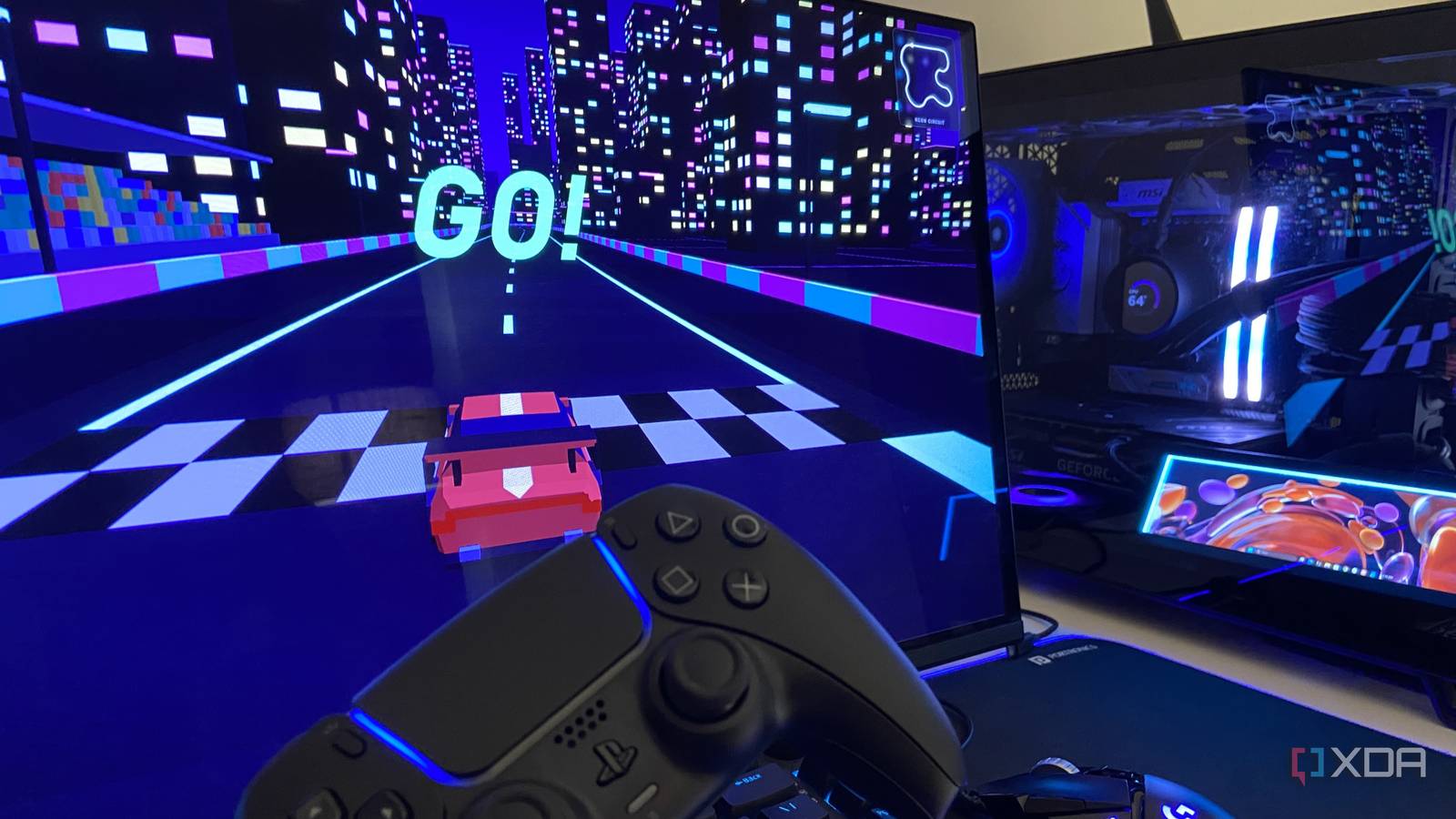
I asked Claude Code, Google Antigravity, and ChatGPT Codex to build the same game, and only one made something I wanted to keep playing
Full Article
Original Source
Read the full article at Xda-developers →KhanList aggregates and links to publicly available news content. We do not host full articles from third-party sources. Always verify important information with original sources.