
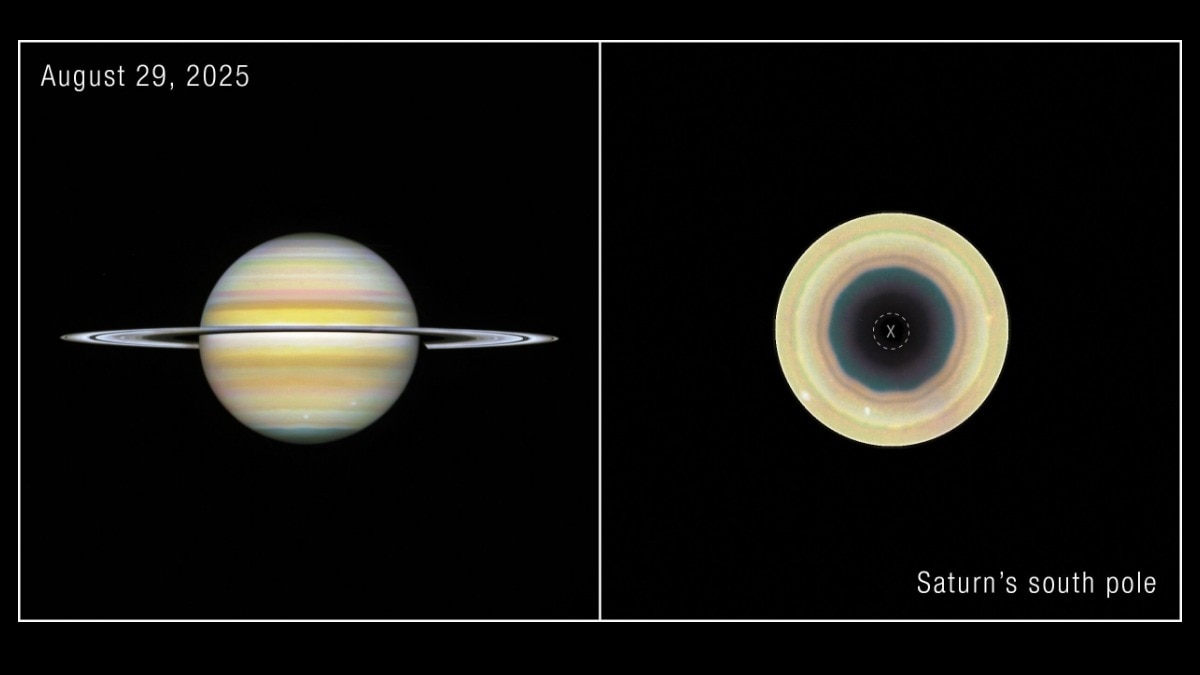
Hubble has detected a giant 10-sided wave around Saturn's south pole. Scientists say the emerging decagon may reveal a new atmospheric pattern on the gas giant.Two views of Saturn from NASA’s Hubble Space Telescope reveal a giant, evolving 10-sided atmospheric wave encircling the planet’s south pole. (Photo: Nasa)Nasa’s Hubble Space Telescope has spotted a remarkable new atmospheric feature swirling around Saturn’s south pole: a giant, evolving 10-sided wave, marking the first time scientists have observed a large, regular-sided jet pattern in the planet’s Southern Hemisphere.The newly discovered structure, described as a decagon, bears an uncanny resemblance to Saturn’s famous six-sided hexagon at its north pole.But scientists say the newly emerging southern feature is distinctly different and could represent an entirely new atmospheric phenomenon developing on the gas giant.The findings were published Wednesday in the journal Science Advances. Researchers pieced together several years of Hubble observations dating back to 2023 and found subtle signs that the structure was beginning to emerge before becoming a clearly defined 10-sided pattern. The observations were collected under Hubble’s Outer Planet Atmospheres Legacy, or OPAL, programme, which has been photographing the Solar System’s outer planets annually for more than a decade.“We've never seen anything quite like this in Saturn's southern hemisphere,” said Amy Simon, a study co-author and OPAL principal investigator at Nasa’s Goddard Space Flight Center.“The northern hexagon has been there every time we've looked for more than 40 years. This feature is different, it appears to be strengthening, giving us the rare opportunity to watch a giant atmospheric pattern develop,” Simon said.The discovery became possible as Saturn’s changing seasons gradually brought its south pole back into view from Earth.Astronomers analysing images collected by ground-based observatories first noticed an unusual undulating atmospheric band around the southern pole in 2024.Additional observations in 2025 strengthened evidence that the feature was developing into a decagon.Hubble’s observations provided the clearest confirmation. From its vantage point above Earth’s atmosphere, the space telescope can capture sharp, high-resolution images of Saturn over complete rotations without atmospheric distortion.Scientists found that the wave is embedded within one of Saturn’s powerful jet streams and extends through multiple layers of the planet’s atmosphere. This suggests that the decagon is not simply a cloud-level formation but a vertically extended atmospheric structure.The discovery has also raised a major question: why has the feature appeared now?Researchers have searched for a southern counterpart to Saturn’s northern hexagon for decades. Images from Nasa’s Cassini spacecraft, which orbited Saturn between 2004 and 2017, showed no evidence of a similar long-lived structure.“The most intriguing part to me is that this seems to have just formed recently,” Simon said. “The question is, why did it suddenly form now when we haven't seen one before?”Scientists will now use continued observations from Hubble and Nasa’s James Webb Space Telescope, alongside computer simulations, to understand how the decagon formed and whether it will stabilise into a long-lived atmospheric pattern like Saturn’s famous northern hexagon.For now, the mysterious 10-sided wave offers scientists something exceptionally rare: the opportunity to watch a gigantic planetary weather pattern being born.- EndsPublished By: Sibu Kumar TripathiPublished On: Sep 3, 2026 12:48 IST
Hubble telescope captures giant wave with 10 sides on Saturn's South Pole
Full Article
Original Source
Read the full article at Indiatoday →KhanList aggregates and links to publicly available news content. We do not host full articles from third-party sources. Always verify important information with original sources.