
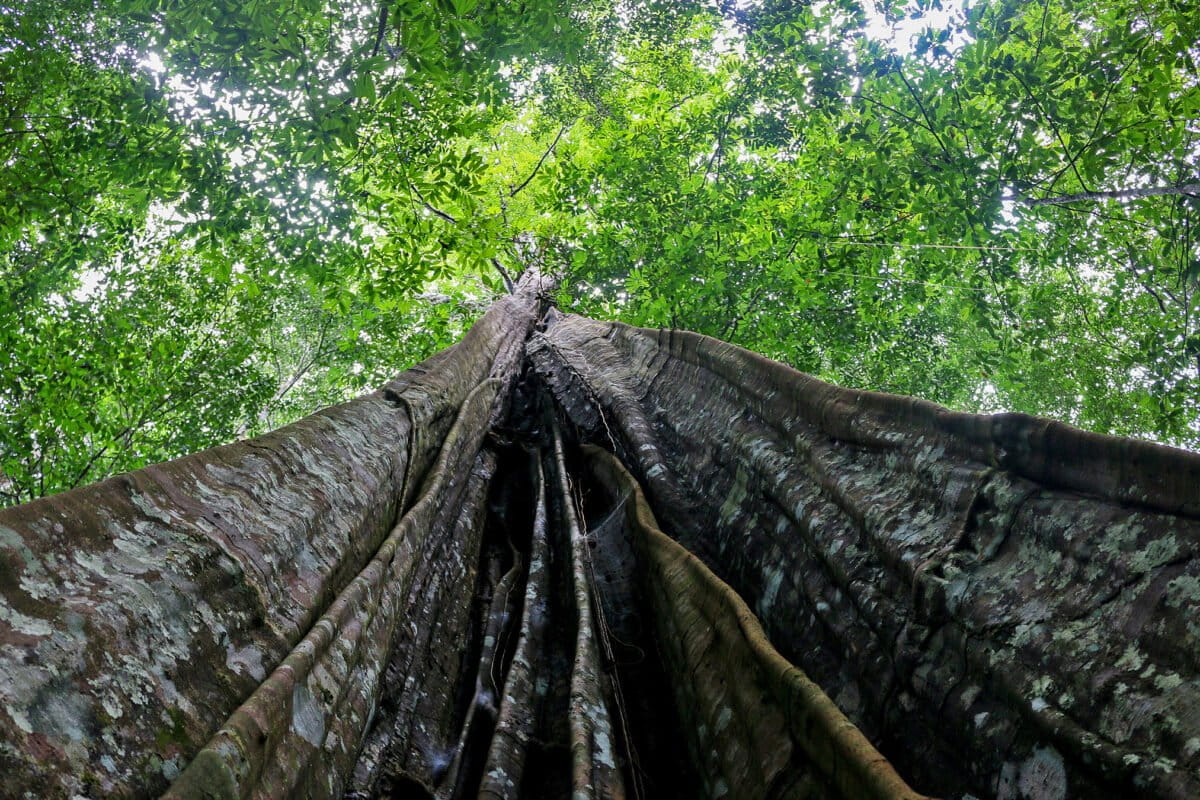
For 25 years, a pioneering experiment in Pará has subjected an area of Amazon rainforest to artificial drought to project what could happen to the biome under climate change.After two decades receiving only half the normal rainfall, the forest lost its largest trees while others survived, revealing that it had reached a new equilibrium.Project scientists reject the idea that the Amazon rainforest subjected to water stress could become a savanna. Instead, they argue, it could turn into a novel ecosystem more closely resembling a heavily degraded forest.The structure that diverted rainwater was removed two years ago, and researchers now want to find out whether large trees can grow back. A question hangs in the air while the soil of the planet’s largest tropical rainforest grows increasingly dry: What is the Amazon’s future facing extreme droughts in a warming world? To try to predict the fate of the biome, an ambitious experiment subjected an area of Amazon vegetation in Pará in northern Brazil to severe water stress for two decades. The findings reveal a surprising reshuffle of how the forest survives. The Esecaflor Project (Forest Drought Study Project) is the longest-running and most extensive scientific investigation of its kind ever conducted in a tropical forest. It has been underway for 25 years, during which its creators have sought to understand how the Amazon might respond to a prolonged lack of water in the soil. The experimental drought began in 2001. Covering a one-hectare (2.5-acre) area within the roughly 318,000 hectares (786,000 acres) of Caxiuanã National Forest in Pará, the project installed 6,000 transparent, rectangular plastic panels beneath the tree canopy, between 1 and 4 meters (3.3 and 13 feet) above the ground, to divert about 50% of rainwater away through gutters and channels. An undisturbed plot of equal size serves as a comparison area. In both forest plots, researchers monitor soil moisture, air temperature, tree growth, sap flow and root development, while two 40-m-(131-ft-)tall towers equipped with NASA radar transmit data to the agency’s Jet Propulsion Laboratory in the U.S. state of California for processing. Plastic panels installed beneath the canopy in the Esecaflor Project study area divert rainwater to subject the forest to water stress. Image by Antonio Lôla da Costa. Testing the Amazon’s resilience British ecologist Patrick Meir, of the University of Edinburgh in Scotland, recalls a 1998 meeting in Belém with meteorologist Antonio Lôla da Costa of the Federal University of Pará (UFPA) and the late agronomist Samuel de Almeida of the Emílio Goeldi Paraense Museum. Together, they sketched out a plan to investigate how the forest’s carbon storage capacity might be affected by drought. “I knew there was a huge gap in the understanding of how this sensitivity worked, and we wondered whether there was a risk of a widespread increase in tree mortality with future climate change,” he says. According to Meir, computer models already pointed to widespread tree die-offs driven by climate change, but forecasts of how the Amazon would respond to prolonged drought remained uncertain. “We needed a new type of experiment that would explore the forest’s response to drought at the ecosystem scale, as well as at the level of leaves, branches and individual trees. That was the new science we developed over the past quarter of a century to help address the difficult question of the Amazon’s tipping point.” Over 25 years of intense competition for water, the Esecaflor plot transformed into a shorter, less dense forest with biomass loss across leaves, branches, trunks and roots, and a reduced capacity to store carbon dioxide. Yet the forest showed remarkable adaptability. By redistributing the limited water available in the soil, it reached a new eco-hydrological stability. An Esecaflor researcher analyzes a sample. Image by Antonio Lôla da Costa. “We had funding for three years,” says Antonio Lôla da Costa, national coordinator of the project. “But questions kept arising, and over the past 25 years we have published more than a hundred international papers, trained more than a hundred doctoral, postdoctoral and master’s students, and continued to answer questions along the way.” Authored by British and Brazilian researchers, the group’s latest paper was published in May 2025 in the journal Nature Ecology & Evolution. It details the timeline of dramatic changes in this small patch of Amazon rainforest. “During the first three years, nothing happened because of the forest’s moisture reserves,” Lôla da Costa says. “After five years, tree mortality began, especially among large trees with trunk diameters greater than 50 centimeters [20 inches], which need more water and are more affected by water shortages. After eight years, we had lost 40% of the total biomass.” When the experiment reached its 15th year, biomass loss peaked, raising a lingering question among scientists: Would the forest collapse, or did it still have a chance to respond and regenerate? Esecaflor pushed forward. “In 2024, we reached one of our most interesting conclusions,” Lôla da Costa says. “With the disappearance of the large trees, we lost nearly 50% of the biomass. But the small amount of water available was enough for the smaller trees to redistribute it, eventually reversing the trend in mortality. They were disappearing, but at a certain point they reached a balance and started growing again. It was a huge surprise!” A tower in the Esecaflor Project area is used to process collected data. Image by Antonio Lôla da Costa. Tropical ecosystem specialist Lucy Rowland of the University of Exeter in the U.K., one of Esecaflor’s lead researchers, points to a question that remains open: Why are trees more vulnerable? Unlike the experiment’s artificial drought, she notes, natural drought affects vegetation through both the soil and the atmosphere. “At first, we thought that the death of the larger trees was due to a hydraulic system inherently more vulnerable to drought, as their vessels are more prone to embolism,” she says. “But the most likely explanation is that they have taller crowns, stand out in the canopy and are therefore more exposed to a hotter, drier atmosphere.” Rowland says the experimental plot can still be considered tropical forest, albeit degraded. She also challenges the use of “savanna” to describe this potential new Amazon ecosystem subjected to years of drought. “The rainforest will never transform into a savanna, but rather into a novel and highly degraded ecosystem for which we have no natural references. We need to be very careful when using the term ‘savanna’ with a negative connotation,” Rowland says. “Brazil’s savannas, the Cerrado, are not a consequence of forest degradation. They are high-value, species-rich ecosystems, and the fact that the savanna is mistakenly seen as less valuable than the rainforest, almost like a ‘wasteland,’ has driven the mass destruction of this important biome.” The Esecaflor study area after the panels were removed: After more than 20 years of water stress, the vegetation had become a degraded forest. Image by Antonio Lôla da Costa. Current questions, future uncertainties Esecaflor has now entered a new phase. In November 2024, after 23 years of artificial drought, the canopy of plastic panels that diverted rainwater was removed, and rainfall has returned to normal conditions, just like in the control plot. The project now seeks to answer new questions. One question is whether large tree species can grow back in this new environment. These trees, including kapok, andiroba and angelim vermelho, remove carbon from the atmosphere and recycle rainwater through transpiration, helping to form flying rivers. “That is a very pertinent question, and one of the reasons why keeping the experiment running is crucial,” Rowland says. “The recovery of these large tree species will not be a quick process. Some of them may take decades or even centuries to regenerate, a period during which we expect these forest ecosystems will continue to be hit by more frequent natural droughts.” Meir, the British ecologist, agrees that understanding the differences between sizes and species is one of the project’s current priorities: “Although there is more water available per tree at the moment, the recovery of these trees could be slower than that of more drought-resistant species. The forest affected by experimental drought appears stable for now, but it has lower biomass and stature than before and is more open, which may make it more vulnerable to future climate extremes.” Lôla da Costa, meanwhile, who for the past 30 years has traveled 18 hours by boat every month from Belém to Caxiuanã National Forest, south of Marajó Island, spending up to 10 days immersed in the forest, turns to other arguments to raise awareness. “Every day, when we travel out to our forest, we pass barges and barges loaded with wood logs,” he says. “Esecaflor is a controlled experiment involving soil drought, very different from the major fires and widespread deforestation that humans inflict on nature. The forest will not collapse if we know how to manage it. But if someone goes there with a machine and destroys 100, 200 or 300 hectares in a single day, then it will never recover.” “We measure tree growth with equipment every 15 minutes,” Lôla da Costa says. “So you can see the tree’s pulse. It’s like an electrocardiogram. It breathes and grows. When a tree starts getting sick, that pulse slows down, and when it dies, all that appears on the monitor screen is a flat line. It is a living being that breathes, that feels. The only thing is, it doesn’t know how to run; it can’t leave its place. If they disappear, all of us on planet Earth will go with them.” Banner image: A tree in Caxiuanã National Forest in Pará. Image by César Favacho, via Wikimedia Commons (CC BY-SA 4.0). This story was first published in Portuguese here on Oct. 20, 2026. Targeted conservation in Brazil could help protect the Amazon’s flying rivers Citation: Sanchez-Martinez, P., Martius, L. R., Bittencourt, P., Silva, M., Binks, O., Coughlin, I., … , & Meir, P. (2025). Amazon rainforest adjusts to long-term experimental drought. Nature Ecology & Evolution, 9(6), 970–979. doi:10.1038/s41559-025-02702-x Credits Topics
How would the Amazon react if it dried up? A 25-year-old field study has the answer
Full Article
Original Source
Read the full article at News →KhanList aggregates and links to publicly available news content. We do not host full articles from third-party sources. Always verify important information with original sources.