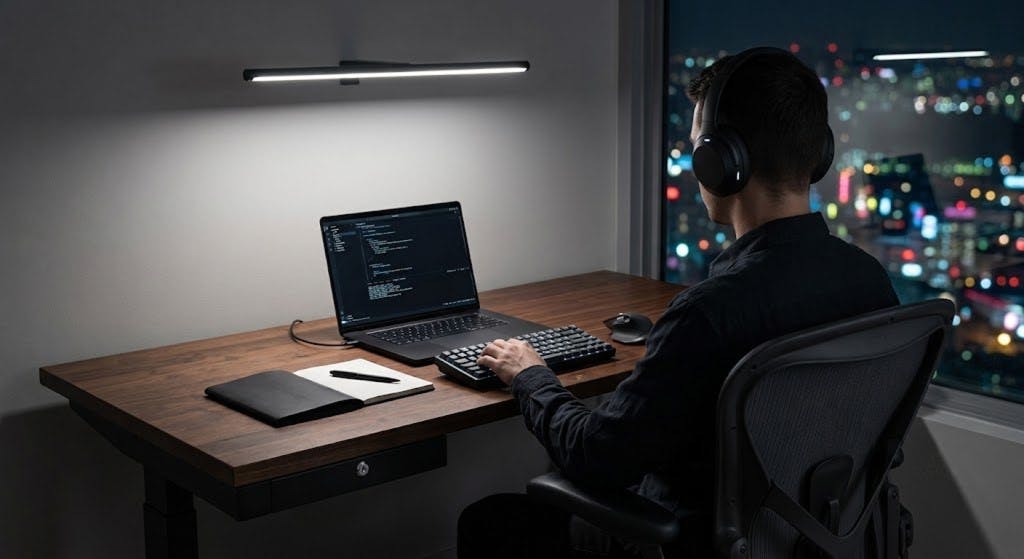
I. The Myth of the "Productive Mess" The modern workplace is a continuous tax on your brain. Most developers and engineers operate in environments that are cluttered, noisy, and visually chaotic. This dysfunction is often excused as "creative chaos". In reality, it is a system-level failure. Your physical environment is an external peripheral of your brain. If your desk is disorganized, your mind is forced to spend finite energy on background visual scanning and filtering distractions. You are burning through your limited attention budget before you even write your first line of code. We live in a landscape dominated by generative AI tools and algorithmic feeds engineered to exploit our attention. In this environment, your physical workspace cannot remain a passive backdrop. It must be designed as a defensive perimeter—a practical barrier against digital distraction. II. The Law of Geographic Isolation: The "Brain Drain" Verdict The most acute hazard on your desk is your smartphone. The standard compromise—placing the device face-down or switching it to silent—is a proven failure. Data from Adrian Ward’s research at the University of Texas, published in the Journal of the Association for Consumer Research, demonstrates that the mere physical presence of a smartphone reduces your available cognitive capacity, even when it is powered off. Figure 1. Effect of phone location on available Working Memory Capacity (OSpan Score, A) and Fluid Intelligence (Raven’s Matrices, B). Error bars represent standard errors of the means. Asterisks indicate significant differences: * p < .05, ** p < .01. The data is clear: keeping your phone in another room yields the highest available working memory and fluid intelligence. When your phone is within sight or reach, your brain must constantly exert non-conscious effort to resist checking it. This passive process acts as a background cognitive drain. Figure 2. Experiment 2: The effect of phone location on available cognitive capacity (OSpan Score) at low (−1 SD), mean, and high (+1 SD) levels of smartphone dependence. Asterisks indicate significant differences: * p < .05, ** p < .01. If you have a high dependency on your phone, this mental tax increases significantly. Proximity acts as a drag on your focus. The device on your desk is a direct pipeline to servers running attention-extraction algorithms. You cannot out-willpower an adversary engineered to exploit your dopamine pathways. Deep concentration requires structural exclusion, not willpower. The hardware must be physically isolated. If it is within reach, you are already operating at a biological deficit. III. Visual Sterility: The Princeton Protocol A clean desk is a cognitive necessity. Neuroscientists at Princeton University demonstrated that the human visual system has a limited capacity for processing concurrent data. According to their study on competitive interactions in the visual cortex, published in the Journal of Neuroscience, when multiple objects are present in your visual field, they compete for neural representation. They physically suppress each other's activity in your visual cortex. This competition means that every stray document, unnecessary cable, or coffee cup acts as a micro-DDoS attack on your cognitive throughput. When your digital workspace is already dense with real-time logs and live terminal feeds, forcing your brain to waste processing power on physical clutter is an operational error. IV. The Ghost of Tasks Past: Attention Residue Physical clutter does more than distract your eyes; it fragments your processing power by triggering what Professor Sophie Leroy defines as "Attention Residue". Leroy’s research on task-switching, published in Organizational Behavior and Human Decision Processes, shows that when you transition from an uncompleted Task A to a subsequent Task B, your brain fails to execute a clean context switch. A cognitive tax remains stuck on the prior objective, degrading your performance on the current task. In physical workspace architecture, every half-finished report, unresolved invoice, or stray document on your desk acts as a material anchor for this residue. When your visual field catches these objects, your brain is abruptly yanked back into the open loop of an incomplete obligation. This depletes the energy you need for deep, analytical problem-solving. V. The Cognitive Void: Why We Clutter There is a distinct psychological resistance to a sterile workspace. Sterility is demanding. A clean desk offers no excuses; when you sit down, there is nothing left to do but work. For many, this absolute clarity is uncomfortable. Physical clutter serves as a buffer—it provides a false sense of busyness that protects the ego from the friction of deep thought. This physical buffer has a direct digital twin in how we interact with modern technology. Just as we pile papers on our desks to avoid facing the blank canvas of a complex task, we abuse generative AI tools to bypass the discomfort of mental resistance. Developers often prompt a model the exact second they face a logical bottleneck, outsourcing their thinking before their own cognitive synthesis even begins. This is not an argument against generative AI as an automation tool for routine syntax; it is a warning against using it to escape the productive friction of architectural design and raw problem-solving. This behavior has a rampant digital twin in your browser. Operating with dozens of open tabs—social feeds, instant messengers, and unread articles competing for your screen space—is the digital equivalent of a trashed desk. Clutter on your desk and instant digital shortcuts in your browser serve the identical function: they are safety nets engineered to escape the friction of raw, unassisted thought. The moment you hit a logical bottleneck in your code, an open browser tab acts as an immediate escape path. To survive, your physical perimeter must be mirrored by digital boundary enforcement. Relying on passive willpower is a proven design flaw. Instead, you must utilize system-level website blockers and strict browser whitelists to hard-lock your digital environment, forcing your brain into a state of absolute accountability. VI. Acoustic Integrity: Building the Sound Barrier Silence is the presence of clarity. The human brain is hardwired to scan the environment for sudden auditory changes—an evolutionary survival mechanism that is now constantly triggered by office background noise and notification pings. Data compiled by the World Green Building Council indicates that acoustic distraction and ambient speech can degrade cognitive performance by up to 66% for complex, text-processing tasks. To stabilize your focus, use specific acoustic masking: brown noise (a deep, low-frequency rumble resembling a heavy waterfall) or targeted binaural beats engineered to induce Alpha (8–12 Hz) or low-Beta/SMR (12–15 Hz) brainwave states. Crucially, binaural beats require stereo headphones to allow the brain to physically synthesize the phase difference between two slightly different carrier frequencies in the left and right channels. They must be accessed via real-time software frequency generators or played using high-fidelity, lossless audio files (FLAC/WAV). Standard streaming platforms often apply lossy compression algorithms that collapse or distort the phase differences between channels, rendering the physical synthesis impossible. From an engineering perspective, brown noise acts as an acoustic low-pass filter, shifting environmental energy toward lower frequencies. This masks high-frequency auditory spikes, preventing them from triggering your brain's involuntary orienting reflex. However, music with lyrics remains a hard restriction. Lyrics engage the language-processing centers of your brain, creating an immediate resource conflict in the neural hardware needed for high-level writing or coding. VII. The Chronometry of Focus: Time-Boxing Reality High-performance execution operates in structured intervals, not continuous erosion. Amateurs work until they are exhausted; architects of focus utilize high-intensity interval thinking. Crucially, this interval does not begin when you open your laptop. To prevent the mental fog caused by sudden task-switching, you must build a strict 10-minute transition buffer before the timer even starts. The very first act of this window—at Minute 0—is the manual activation of your digital boundary enforcement. During this window, you execute physical exile of your devices, clear your desk, and perform a brief "brain dump" in your notebook to unload lingering thoughts. Only when your visual and mental field is completely clear do you initiate the countdown. By establishing a rigid 90-minute time-box of total isolation—aligned with the brain's natural ultradian rhythms—you create a high-focus environment. All physiological needs must be fully addressed prior to initiating the timer; once the sprint begins, the protocol permits zero escape routes or physical interruptions. When a sprint is strictly finite, the brain stops looking for micro-escapes and focuses entirely on execution. Capping the sprint at this threshold prevents cognitive burnout, protecting your finite mental resources before fatigue causes errors. Crucially, the sprint does not end when you close your laptop. Transitioning instantly from deep focus to scrolling social media creates a sensory shock that erases your mental gains. To cement your output, the exit requires a strict 15-minute period of sensory depriming—complete digital silence—allowing the brain to consolidate synthesized data before algorithmic noise hijacks the newly formed synaptic pathways. This is followed by an additional 15-minute phase of active physical recovery (stretching, hydration, and visual reset) without screens, bringing the total inter-sprint rest to a rigid 30 minutes to match the natural trough of your ultradian cycle before the next wave begins. VIII. The Sanctuary Protocol This environmental framework is the foundational physical layer of our attention-engineering protocol. High-performance cognition is not an accident; it is an engineered state initiated by ritual. Out of Sight, Out of Mind (Physical Exile): If your workflow allows, place your phone in another room. If you are bound by mandatory 2FA or on-call duties, place the phone in a closed, opaque drawer under your desk. This blocks the visual draw of the device and prevents the automatic visual scanning that triggers cognitive drain, while still keeping it accessible for critical notifications. Crucially, your system-level digital blockers must be engaged immediately upon entering the 10-minute transition buffer, preventing any last-minute digital micro-escapes before the workspace is cleared. Furthermore, the device in the drawer must be treated strictly as an authentication tool, not a gateway to consumption; if 2FA is required mid-sprint, interact with it mechanically and banish it back to the opaque zone immediately to prevent the leakage of attention. Visual Flush: Remove everything from the desk except your primary machine and a single physical notebook. Crucially, the notebook must either remain closed or be flipped to an entirely blank page used exclusively to capture thoughts related to the active task. Keeping notes, plans, or scrap paper from previous tasks open in your visual field introduces immediate attention residue. The page containing your pre-sprint "brain dump" must be flipped over and completely hidden from view to prevent past tasks from triggering immediate attention residue and infiltrating your active workflow. Acoustic Shield: Trigger brown noise or your targeted binaural beats via local lossless files or standalone audio generator apps, put on stereo headphones, and boot up your terminal. Neural Consolidation: Immediately after the 90-minute sprint, execute 15 minutes of sensory depriming (such as NSDR — Non-Sleep Deep Rest, or dark room isolation) with zero digital inputs. Follow this with 15 minutes of physical movement and hydration away from your desk. Do not touch any digital devices until the full 30-minute recovery window closes. In the next breakdown, we will transition from environmental architecture to the internal code—how to program neuromodulatory states to prevent executive burnout.
How Workspace Design Affects Attention and Cognitive Performance
Full Article
Original Source
Read the full article at Hackernoon →KhanList aggregates and links to publicly available news content. We do not host full articles from third-party sources. Always verify important information with original sources.