
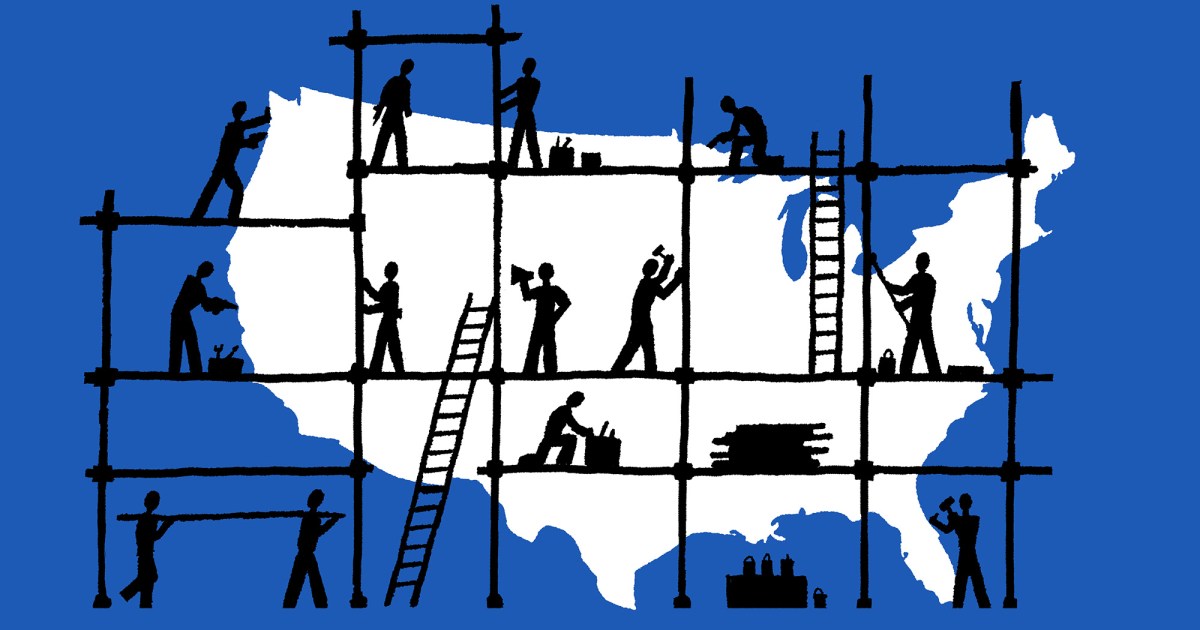
Get your news from a source that’s not owned and controlled by oligarchs. Sign up for the free Mother Jones Daily. When the 39th Congress convened on December 4, 1865, it was the first time the nation’s representatives had gathered since the Confederacy’s defeat and the assassination of President Abraham Lincoln. In the nine months Congress had been in recess, the Southern states had reconstituted their governments under the auspices of President Andrew Johnson, a Southerner whose commitment to the union was giving way to his virulent racism. From the sidelines, Lincoln’s fellow Republicans watched in horror as Southerners re-erected slavery’s scaffolding by restricting the freed population’s rights and condemning them to field labor. South Carolina and Mississippi elected Confederate generals as their governors. In Louisiana, former Confederate officers conducted state business in rebel uniforms. So when Congress came together, the Republican majority had to decide how to move the nation forward. Would they let the South return to its old ways over the bodies of more than 600,000 soldiers, or would they seize the chance to shape a society of equals? To the Radical Republicans, a minority faction dedicated to equal rights, the end of the war represented a momentous opportunity. “We are making a nation,” Rep. Thaddeus Stevens, a powerful Radical, told his colleagues. He believed the country to be in a revolution, and the job of the 39th Congress was to perfect “a true republic.” “The whole fabric of Southern society must be changed, and never can it be done if this opportunity is lost,” he said that September. But the 39th Congress faced a more immediate and existential threat: Abolition had undone the Constitution’s notorious three-fifths compromise, which had inflated white Southerners’ political power before the war. By not allowing the freed men the right to vote, abolition would now ironically hand white Southerners some 30 extra votes in the House and Electoral College—enough that they might win control of the federal government when combined with allied Northern Democrats. If that happened, ex-Confederates aimed to reinstate a form of slavery, compensate slaveholders for their lost property, and pay off Confederate war debts while blocking payments on the Union’s. The threat left two tasks for Republicans: democratize the nation and keep the former Confederacy out of power. These projects were inextricably linked. Now, 161 years later, the increasingly unhinged second presidency of Donald Trump is threatening to end American democracy, just as civil war and the threat of Confederates returning to power did. Trump’s movement violently stormed the US Capitol to overturn the 2020 election, and, back in office, he has challenged the country’s ability to conduct free elections. He defies the law, unilaterally dismantling agencies, conducting executions at sea, sending masked agents to terrorize immigrants and citizens, and starting an illegal war with Iran. Since winning reelection, Trump’s wealth expanded by at least $2.7 billion, as criminals spend big to secure pardons and corporations curry favor by funneling money to his ballroom. Aided by a Republican-appointed Supreme Court majority, Trump has sicced the Justice Department on political enemies and weaponized the Federal Communications Commission to silence the press. In keeping with the world’s most abusive regimes, Trump’s administration has normalized violence, from the torturous conditions in its detention centers to the revival of the military firing squad. Rather than submit this unpopular agenda to the people, the administration attempted to rig our elections by gerrymandering, manipulating the census, blocking mail ballots, purging voters, and mounting specious lawsuits aimed at election administrators. Despite these authoritarian tactics, the Democrats’ resounding midterm victories have forced Trump’s coalition out of power in Congress. If MAGA should lose the White House, the anti-Trump majority must decide whether it can proceed with mere tweaks to our democratic system—the path Democrats followed after Trump’s first term, when they failed to enact new voting rights legislation, only to see him return more dangerous than before—or make major reforms to vanquish Trumpism by creating a more small-d democratic government. Rep. Jamie Raskin (D-Md.) believes it will take “something at the scale and velocity” of Reconstruction or the civil rights movement “to extricate ourselves from the wreckage and to get democracy and freedom moving again…As with both of those periods, the imperative is democratization and the dismantling of structures of white supremacy and authoritarianism.” With a Democratic-controlled Congress in 2027, he continued, “the lawmaking branch needs to reassert its powers and its prerogatives against a runaway autocratic president.” As the presumptive next chair of the House Judiciary Committee, Raskin will be at the center of this fight. The former constitutional law professor believes the reason we have a federal government overrun by authoritarian tactics is that our political system allowed it. Our two-party system helped Trump consolidate Republicans, and he won his first term with a minority of the vote. Thanks to the Supreme Court, Congress is gerrymandered, awash in special interest money, and less accountable to voters. The justices, including three Trump appointees, helped the president return to power by bailing him out of prosecution for the January 6 insurrection—a plot to steal the Electoral College that was only possible because we don’t use the popular vote to begin with. After the Civil War, Republicans had to bring democracy to the Southern states, but they did it to save the federal government from a takeover by the forces of racism and minority rule that animated the Confederacy. If there is another moment for major change, reform must serve the same purpose of ensuring that authoritarianism and racial hierarchy do not reestablish themselves for good. Democrats’ historic midterm gains delivered the party a mandate to start this process. In exit polls, voters said the state of democracy was a top concern, just behind the economy; nearly three-quarters said Congress hadn’t done enough to check the president. The scale of their victory may lull some Democrats into thinking our democracy is healthy, leading them to turn their backs on an agenda of repairing it in favor of things pollsters say are more popular. They would be wrong. The midterms provide a critical reprieve, a limited time in which to secure our democracy before it’s swallowed by the forces bringing it down. Congress is a bit like Dorothy, waiting for the Wizard of Oz to send her back to Kansas, when all she needs to do is click her heels and get to work. Given Trump’s veto powers, advocates see this coming Congress—the 120th—as a time to build momentum for major reforms through investigations and agenda-setting votes to ban gerrymandering, enforce transparency in political donations, and install anti-corruption measures that would rein in Trump. Democratic lawmakers may vote, not for the first time, to make Washington, DC, a state and push multiple bills to check Chief Justice John Roberts’ unrestrained court. But beyond all that, some politicians and reformers hope the next two years are the beginning of something much bigger, with the fast-approaching 2028 Democratic presidential primary set to be a proving ground for a fundamental remaking of our democracy. As lawmakers wrestle, like the 39th Congress did, with how far to go and how to prepare the public to accept big changes, the task might be easier than it seems: Americans already know our system is broken, riddled by corruption, and ready for renewal. “The current administration has been able to destroy a lot very quickly. Our side should be prepared to build a lot very quickly,” Pete Buttigieg, the former transportation secretary and a possible 2028 presidential candidate, told me in late October. “This is just destined to be one of those times, if only because there’s so much rubble and ash around.” In 2020, Buttigieg put court expansion on the map as a Democratic presidential candidate. This past fall, as he campaigned alongside dozens of candidates during the midterms, Buttigieg aimed to show that reforming our political system isn’t only a good idea, but good politics, too. He urges fellow Democrats to seize the chance to “define what life is like in this country for the next 60, 70, 80 years. Seasons like that come around every now and then…We’re due for one right now.” In the 39th Congress, moderate Republicans urged smaller changes and a rapid restoration of Southern states’ status in Washington, while Stevens and the Radicals urged major reforms. Ultimately, many of the Radicals’ arguments won out as circumstances proved them right. With Southern whites perpetrating massacres on freed Black people and threatening a ruinous return to power, moderates begrudgingly concluded that the slave states’ power must be subdued not only on the battlefield, but also through heavy federal enforcement of civil rights in the South. The lawmakers were contending with many of the same questions we face today: Who is a citizen, and what rights do immigrants and other minorities have? Should one person’s vote count more than another’s? What is the right balance of power among Congress, the president, and the Supreme Court? And what power does Congress have to decide these questions? The 39th Congress answered the call with decisive and unprecedented measures to protect democracy against post-bellum backsliding. It seized from the president the power to determine how Southern states would be governed and readmitted to Congress. It passed the 1866 Civil Rights Act, extended the life of the Freedmen’s Bureau, required Southern states to create multiracial governments under US military supervision, and enfranchised Black men in the District of Columbia, all by overriding the veto of the president. It changed the size of the Supreme Court to stop it from interfering with Reconstruction. It crafted the 14th Amendment seeking to ensure equality and entrench their party in power, and legislated over another Johnson veto to see that it was ratified. If our current crisis presents Congress a moment of possibility, as it did in 1865, the best defense against Trumpism and the only shot at enacting lasting policy is first to recommit the country to a multiracial democracy, run by a Congress that better represents the people. Weak as it may appear, Congress’ powers remain vast. Today’s Congress is a bit like Dorothy, waiting for the Wizard of Oz to send her back to Kansas, when all she needs to do is click her heels and get to work. Ben Hickey Thaddeus Stevens—“practical about accomplishing ideals,” according to biographer Bruce Levine—understood that his quest to remake the nation depended on his party staying in power. On the first day of the 39th Congress, Stevens and the Republican caucus refused to seat the South’s representatives, which included, according to Levine, “the Confederacy’s vice president, six cabinet officers, 58 members of the Confederate congress, four Confederate generals, and five colonels.” Then they withheld their Washington stipends, forcing them home. The gambit opened the door to the 39th Congress’ achievements, including, most famously, the 14th Amendment. Stevens’ famous speech on Reconstruction laid out its bare-knuckled purpose: “to secure perpetual ascendancy to the party of the Union; and so as to render our republican Government firm and stable forever.” “Doing good things requires politics, and Stevens understood that,” says Mark Graber, a University of Maryland constitutional law professor. “He was saying, ‘It turns out there’s a move we can make that will make this system both democratic and more racially egalitarian, and we should.’” The 14th Amendment’s first section guarantees equality under the law for all. But according to Graber, whose book Punish Treason, Reward Loyalty details the motivations of the amendment’s framers, Republicans were most concerned with its largely forgotten latter sections, including its frontal attack on the South’s ill-gotten political power based on its newly freed Black population. To make sure their freedom didn’t buttress the political power of the Southern elite, Radical Republicans supported ensuring freed men could vote. But to the party’s moderates, Black voting rights weren’t yet feasible. The amendment put forward a compromise to reduce each state’s congressional representation by the share of eligible voters whose vote was “denied…or in any way abridged.” With the formerly enslaved making up about 40 percent of the South’s population, Stevens and his allies believed the threat would induce ex-Confederate states to let Black men vote. While the provision was never enforced—the next Congress attempted to directly enfranchise Black people via the 15th Amendment—Stevens’ insistence on its inclusion showed his understanding that promises of equality mean little if the government falls to people committed to enslavement and domination. It’s a lesson later generations would see borne out: The 14th Amendment’s promise of equal protection didn’t stop the South from imposing segregation, because Congress, presidents, and the Supreme Court allowed it; the 15th Amendment’s prohibition on voting discrimination didn’t stop the former Confederacy from disenfranchising nearly every Black person until Congress finally reasserted its authority with the 1965 Voting Rights Act. After Reconstruction, “even as things got worse for African Americans in the South, the Constitution never changed,” says Franita Tolson, dean of the University of Southern California’s law school. “It’s the political will that changed, the willingness for Congress to be overseer that changed.” In April 2026, the Supreme Court gutted the VRA, threatening to obliterate the 15th Amendment’s protections once again. Two months later, the court upheld the 14th Amendment’s birthright citizenship guarantee by a single vote—another demonstration that constitutional gains are only as secure as the people in power. “Constitutions do not enforce themselves,” says Nikolas Bowie, a Harvard law professor. “Hoping that with a new amendment we will have a different political reality, and one that will respect the work that they were doing, turned out just not to be true.” Progress could be protected only by strengthening democracy such that a minority faction could not take control. How to accomplish the same thing today is a topic of much discussion in Congress and in advocacy circles, among voting rights groups and academics. Much as events in the South pushed moderates in the 39th Congress toward aggressive reforms, Trump’s wreckage has major players sizing up ideas dismissed as pipe dreams just a few years or even months ago. I wanted to find out what big ideas were percolating and how their backers view the odds of success. “There are political windows that open up that we cannot control,” says former Obama administration official Spencer Overton, who, as founder of George Washington University’s Multiracial Democracy Project, is convening civil rights groups and lawmakers in reform conversations. “We have to be ready.” Our political system was designed 250 years ago for a small country dominated by white, landowning farmers. To become a successful, large, multiracial democracy, Overton argues, the US must overcome three interconnected “failure modes”: the Supreme Court, policy capture by special interests, and a Congress that doesn’t represent the people. If these three problems are not solved, he fears, the country will lose its democratic character and fail. The Supreme Court, in Overton’s view, has become an instrument of white backlash rather than a fair legal arbiter. By encouraging partisan gerrymandering and destroying the VRA’s guarantee of minority representation, the court has effectively disenfranchised millions while insulating lawmakers from the will of their voters. By letting the wealthy drown politics with corrupting cash, the court made rich individuals and corporations the favorites of our political system. Cut off from those they are supposed to represent, lawmakers are more beholden to the powerful who help buy their seats. The court, Overton says, has not only weakened democracy’s connective tissue, but it has enfeebled our government’s ability to rise to modern challenges, such as artificial intelligence and job displacement. “Our representative republic is not very representative right now.” Buttigieg supports major changes to address all three failure modes: reshaping the Supreme Court, overturning the Citizens United decision that flooded politics with corporate and billionaire money, and changing House elections so members better represent the people. “Our representative republic is not very representative right now,” Buttigieg told me. “The distortions of money in politics, of gerrymandering, and a number of other antidemocratic features that have crept into our system have brought our country to a kind of a breaking point.” “What I’m calling for looks like a lot of upheaval by the standards of the last 50 years,” he continued. “But it’s also deeply consistent with the last 250 years, where we used the tools that we had, from big political reforms to constitutional amendments, to make sure the system evolved with the times.” It’s 11 p.m. in Budapest when Kim Lane Scheppele, a Princeton University expert on the role of courts in democracies, appears for our video call. Scheppele studied Hungary’s new constitutional court after the fall of the Soviet Union, but mostly avoided the country when it was under the sway of Viktor Orbán’s authoritarian regime. After an overwhelming April electoral defeat toppled him, Scheppele finally went back and saw old colleagues. “I’m a friend of judges,” she says. “I do courts.” But when it comes to the US, our Supreme Court “has become a menace to democracy,” Scheppele explains. “Congress has to cut the knees out from under it.” Reconstruction-era legislators could have used this advice. While the 39th Congress did reduce the size of the court and kept Johnson from making any appointments who might undo Reconstruction, it ultimately failed to take more drastic action, leaving the court to later cripple the Reconstruction Amendments so that they no longer protected Black people’s rights and to invalidate most of Congress’ major laws to enforce them. Once again, Scheppele says, “the Supreme Court is the villain in the story.” The Roberts court has created an imperial presidency. By giving Trump criminal immunity, the GOP-appointed majority has handed the executive branch a roadmap to break the law. The justices have repeatedly stepped in to trample Congress’ laws, and by placing agency control in Trump’s hands, further cleaved them from Congress’ will. In addition to destroying the VRA, over the past 16 years the court has methodically gutted a raft of important pro-democracy legislation, including campaign finance laws that stemmed billionaire and industrial power. These statutory murders demonstrate the futility of reforming our political system without reforming the court; any major change would run into the Roberts majority’s buzz saw. While the justices stymie Congress, they’ve become the Trump administration’s fast pass to illegal action. In the past two years, Trump has pushed more than two dozen executive orders and policies that violate federal law, then rushed to the Supreme Court to ask the justices to let them take effect. And the court, often in unexplained emergency or “shadow” docket orders, usually does—on everything from defying congressional appropriations to dismantling the Department of Education. “It’s law school 101,” Scheppele says, that executive orders aren’t more powerful than federal law or constitutional safeguards. In what she calls a “constitutional revolution,” the “court is flipping the hierarchical relationship between” them. Once a third rail, Supreme Court reform is now something Democrats are expected to take up as soon as the opportunity arises. Some proposals—like term limits and an enforceable ethics code—are very popular. “Five years ago, it was never realistic to be talking about things like term limits,” says Scott Fay, a Democratic consultant who works with civil rights organizations. “That is absolutely on the table now.” Key Democrats like Hakeem Jeffries have endorsed term limits; Hillary Clinton recently called for adding four justices. “The lawmaking branch needs to reassert its powers and its prerogatives against a runaway autocratic president.” Scheppele is part of a group of constitutional law professors, now numbering some three dozen scholars, who have spent more than a year crafting Supreme Court reforms. Their proposal would cap the number of active justices and give each president four appointees per term, both expanding the court and effectively imposing term limits. When the opportunity for reform arises, Raskin has a similar vision of fixing appointments to presidential terms and limiting justices’ time on the court. It might seem surprising, but Congress has the power to do much or all of this simply by enacting a new law. Lawmakers can, as they have seven times before, change the Supreme Court’s size. They can decide which types of cases it hears, put restrictions on its emergency docket, create new courts to hear certain types of suits, or limit which laws are reviewable by the court. It simply hasn’t used these powers in a very long time. “What do we have to do to recover the power of Congress?” Scheppele asks. “The answer is kill off the power of the Supreme Court.” Ben Hickey By the time Thaddeus Stevens was helping lead the 39th Congress, the Pennsylvanian was an old man. While known for cutting rhetoric, his voice had grown so soft that his colleagues had to draw close to hear him. But Stevens’ place atop American politics, and the radical ideas he championed after the war, were a lifetime in the making. Early in his career, he joined the Anti-Masons, a short-lived political party that railed against an elite secretive order that pledged to support its members over the needs of everyone else. Such fealty sounds familiar. When the nation’s most powerful tech executives flanked Trump during his second inauguration, it was a visual demonstration of the links between Washington and the most wealthy. In 2024, Elon Musk, one of those guests, spent so much to reelect Trump that he essentially bought himself a White House job, which he used to enrich himself and destroy swaths of government; in the 2026 midterms, he spent about another half-billion to help Republicans. As an Anti-Mason, Levine explains, “Stevens was fighting against his version of that.” “It is impossible that any practical equality of rights can exist,” Stevens said in 1865, “where a few thousand men monopolize the whole landed property…How can republican institutions, free schools, free churches, free social intercourse exist in a mingled community of nabobs and serfs?” Today, another small cohort of ultrawealthy people works to create a political system in which their portfolios swell while funds for the public good run dry. To accomplish this wealth extraction on the backs of most Americans, they buy influence in Washington. In 1974, Congress passed bipartisan campaign finance reforms after discovering that President Richard Nixon promised milk producers $100 million in subsidies in exchange for $2 million in campaign donations, but the Supreme Court soon rolled them back. Under Roberts, the court has eviscerated campaign finance limits, with the infamous 2010 Citizens United decision allowing infinite independent election spending. Later rulings opened up avenues to bypass donation limits to politicians. An estimated $12 billion was spent on the 2026 midterm elections, a fourfold increase from before Citizens United. American democracy is buckling under this corrupt system. And because the Supreme Court cited the First Amendment to tear down these anti-corruption rules, it’s presumed that there’s little our representatives can do. Amending the Constitution to overrule Citizens United—a reviled decision in which five unelected judges undid the work of lawmakers representing 300 million people—is a near-impossible task, requiring two-thirds of Congress and three-quarters of the states. But here’s the rub: Congress is bound by the court’s constitutional decisions only because it chooses to be. It could work around Citizens United and clamp down on election spending with a new law. That’s the takeaway of a buzzy new book, Supremacy: How Rule by the Court Replaced Government by the People, by Bowie and his Harvard colleague Daphna Renan, which points out there is nothing in the Constitution that empowers the court to overrule Congress. “The primary court reform is that Congress needs to reassert its role as interpreting the Constitution and defend it from the court,” Bowie says. “Citizens United represents the Supreme Court’s interpretation of the First Amendment…If Congress wants to defend its own interpretation,” it has the power and tools to do so. For example, it could pass and protect new campaign finance rules by writing limits on how the court can review them—a version of what’s known as “jurisdiction stripping.” “Once Congress starts to do this,” Bowie says, it can begin to turn back “the restrictions on what kind of government we can have that have been imposed by the court.” Bowie’s plan to tackle Citizens United is one route to a destination many reformers want to reach. Overton envisions Congress enacting court reforms alongside new campaign finance reforms, so that by the time its money-in-politics legislation reaches the justices, a newly constituted court will uphold it. As Raskin puts it, overturning Citizens United “will require either a new constitutional amendment…or a new Supreme Court to overturn the decision the way that the Roberts court overturned Roe v. Wade. ” The varied proposals share a conclusion: Congress is not handcuffed by this court decision and must pick a path out of the mess it created. Like present-day anti-corruption reformers, the 39th Congress also faced criticism that its program was unconstitutional. In response, the 39th Congress found two critical sources of authority. One was the recently passed 13th Amendment, which the lawmakers interpreted not to just abolish slavery, but also to promote equality. (The court would soon sap it of this critical power.) The other was the Constitution’s guarantee clause, which abolitionist Sen. Charles Sumner dubbed a “sleeping giant.” It states concisely that “The United States shall guarantee to every State in this Union a Republican Form of Government.” The Supreme Court itself has ruled that defining a republican form of government is up to Congress, not the courts. Renan says “there’s a lot of inspiration to be drawn” from how the 39th Congress used the clause. For example, she believes today’s Congress could root new voting rights laws in its language, or legislate that it bars unlimited election spending. The professors’ lessons may seem academic, but Democrats in Congress have been thinking along similar lines. Raskin says Congress could use the clause to create anti-gerrymandering legislation. “It is not a truly republican, which is to say not a truly representative form of government, when the politicians choose the voters before the voters choose the politicians,” he explains. The For the People Act, a wide-ranging democracy reform proposed by Democrats in 2021, explicitly based its authority in the guarantee clause. It also would have routed challenges to the law away from conservative circuits overrun by Trump judges—a glimmer of recognition of Congress’ ability to control judicial review. There’s a chicken-and-egg quality to fixing our ailing democracy. On the one hand, Congress has all these latent powers lying about. On the other, it has been so hobbled by special interests, corruption, and hyperpartisanship that its muscles have atrophied. To improve, Congress must become more representative of its constituents. Trump’s calls for Republican state legislators to redraw congressional maps in 2025 illustrated the fundamentally riggable nature of winner-take-all districts. The Supreme Court’s April decision eviscerating the VRA could result in all-white Southern delegations for the first time since the 1960s. These changes have caused politicians, civil rights groups, and political donors to rethink how Congress is elected—leading to new calls for a system of proportional representation, or PR, that would, among other benefits, take the air out of redistricting battles. “I don’t think there’s a single member of Congress that feels, personally, like it’s good that we have mid-decade redistricting where the map can change almost overnight,” says Dustin Wahl, executive director of the pro-PR group Fix Our House. “Including Republicans,” he added. “We are looking at 2029 as a potential moment to do something.” “I probably hear two or three times a week now people pushing on PR,” says Fay, the Democratic consultant. “Post-Callais, post all the redistricting wars, it’s just become that much more serious.” Proportional representation, explains Ben Raderstorf of Protect Democracy, a nonpartisan group combating the country’s authoritarian turn, would mean using multimember districts to elect House members, with seats allocated by each party’s portion of the vote. Today, if a candidate in a single-seat race loses with a third of the vote, their supporters’ votes are wasted. But in a three-member district under a proportional system, two seats would go to the majority party, and the candidate with 33 percent backing would go to Congress as well. Our current winner-take-all model muffles minority voting groups and incentivizes gerrymandering. But in a proportional system, minority blocs can still get representation; Republicans wouldn’t be locked out in blue states and Democrats wouldn’t be locked out in red states. After nearly a year of study, Raderstorf says Protect Democracy determined that PR was the single reform that most “fit our mission of preventing the United States from declining into a more authoritarian form of government.” Because it would ensure many more voters are represented, advocates believe PR would not only reconnect House members to constituents, but it could also break the two-party duopoly, allowing parties with smaller vote shares to enter the House, opening the door to a more responsive coalition-style government and making it harder for a strongman like Trump to consolidate support. Internationally, most democracies use proportional systems, and some research shows that it has helped reduce factional tension in places like Northern Ireland and South Africa. Ending gerrymandering and moving toward a proportional system is “an absolutely central fight of our times,” says Raskin, who has put forward PR legislation. “If we don’t,” he warns, “we are going to start ending up with all-Republican districts from states where Republicans control the legislature and all-Democratic districts in states where Democrats control the legislature.” Members of Congress accustomed to how they won office “are going to need to open up our minds,” he adds, but “there’s overwhelming public support for it, and I think we can make that happen.” Today’s representation problem is not altogether different from the one the 39th Congress faced when the rollback of the three-fifths clause ended up benefiting white Southerners. After the 2020 census, explosive population growth, 95 percent among people of color, delivered Texas two additional congressional seats. But its 2025 redistricting allotted more than 70 percent of the expanded delegation to white Texans, who are just 37 percent of the population. Even as Democrats swept statewide offices in November, the map helped Texas Republicans hold 24 of 38 House seats. Proportional representation boosters admit it is not a panacea. For one, it would reform only the House of Representatives and leave the Senate as an anti-majoritarian institution made up of two members from each state. Nineteenth-century Republicans got around this by making new states. The 39th Congress admitted Nebraska over the president’s veto. The prior year, it had readmitted Republican-controlled Tennessee. In 1876, Republicans in Congress would rush to admit Colorado so their party could get its electoral votes that fall. “Republicans,” Graber explained in his book, “regarded territorial policy and congressional Reconstruction as two sides of the same coin.” Today, Democrats could do the same. After a vote in Congress, minority-majority Washington, DC, with more people than Vermont or Wyoming, could be made a state. Puerto Rico’s population of 3.2 million surpasses that of 18 states and should be given the option. Raskin hopes DC statehood will come up for a vote soon and says it is a top item the next time Democrats control both Congress and the White House. Four other territories have substantially smaller populations, but “if we’re not concerned about how small Wyoming is, why should we be concerned about how small the US Virgin Islands are?” Overton asks. “What’s good for the goose is good for the gander.” The new states allowed post–Civil War Republicans to retain the presidency or at least one house of Congress for decades, securing Reconstruction policies like tariffs, war pensions, and railroad expansion. But new Western states were less committed to Black rights, and the party’s dedication to equality quickly atrophied in the face of economic recession and adverse Supreme Court rulings. Infamously, after 1876’s contested election, Republicans withdrew troops from the South, abandoning Black people there to subordination and mob violence. “Our progress as a democracy is dependent on political will,” says Tolson, the USC dean and author of In Congress We Trust?, a history of lawmakers’ role in enforcing voting rights. “The Reconstruction moment taught that lesson very powerfully, because once political will was gone, it became very hard for the promise of the 39th Congress to carry forward, which is why things fell apart so quickly.” When I asked Bruce Levine why he chose to write a Thaddeus Stevens biography, he told me that he viewed the Radical Republican leader as a hero because of his strong political will. As a young liberal in the 1960s, “what frustrated the hell out of me was the apparent cowardice of so many Democratic liberals, who just would not stand up and fight,” he says. “When I come across Stevens, I find somebody who’s out there swinging, who’s not afraid.” But Stevens, he says, was also a product of his time: “It is the nature and power of the enemy that compels the Republican Party repeatedly to become more and more radical, not necessarily because they all want to, but because what they won yesterday can’t be preserved tomorrow unless they move forward.” Stevens died within a year of the close of the 39th Congress. As his voice and body weakened, he knew that for all they’d accomplished, it hadn’t been enough. “I will take all I can get in the cause of humanity,” he said, “and leave it to be perfected by better men in better times.” Once again, a moment of crisis has opened a window of opportunity. While campaigning this past fall, Buttigieg often closed speeches by asking his audience to consider this pivotal moment and imagine telling their children and grandchildren “what the hell was going on and…what we did to make it better,” as he told a crowd in Rochester, New Hampshire. “Back in the 2020s, we had the wealthiest people helping themselves to more and more power and the most powerful people helping themselves to more and more wealth. We put an end to that kind of corruption so that your generation wouldn’t have to put up with it.” “The task before us,” he told another gathering, is to “honor our founders not by cementing their antique views on policy, but by emulating the scale of their ambition.” As a wave election unlike any in 50 years showed, the public is starting to see these problems clearly: that the ultrarich should not be buying elections, that politicians should not be picking their voters, that the president should not be a king, and that a Supreme Court facilitating this madness must be checked. The founders gave us the tools to fix these problems, first among them a powerful Congress to channel the will of the people. To perfect our union, we must simply pick up these tools and put them to use.
How to Fix the Country
Full Article
Original Source
Read the full article at Motherjones →KhanList aggregates and links to publicly available news content. We do not host full articles from third-party sources. Always verify important information with original sources.