
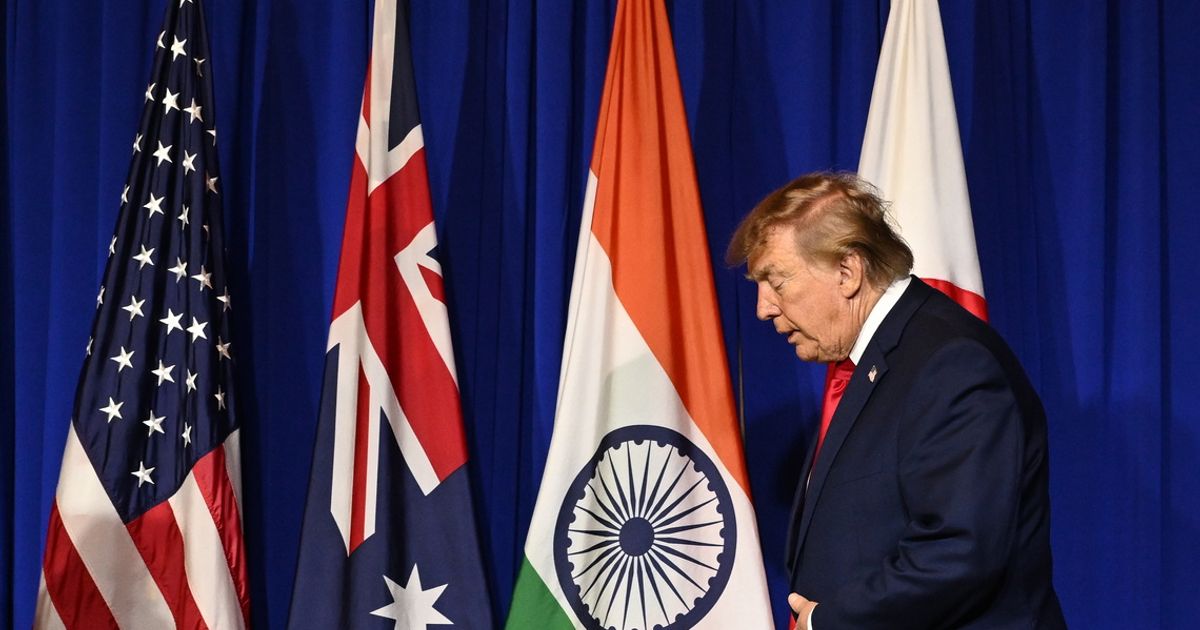
NEW DELHI – It was a sight awaited for more than two years – the leaders of the United States, India, Japan and Australia standing side by side on the same platform, reaffirming their commitment to a free and open Indo-Pacific region.Their meeting finally came on Nov 17 as the leaders of the Quad, or the four-nation grouping widely perceived as a counterweight to China’s growing assertiveness in the Indo-Pacific, got together in Manila, somewhat assuaging concerns about the group’s fading momentum.Not only was this the first Quad Leaders’ Summit in more than two years, but it was also Trump’s first attendance at such a meeting. While foreign ministers of these countries have met regularly, including five times since January 2025, the last Leaders’ Summit, to give the Quad’s activities both a top-level push and policy direction, was hosted in September 2024 in Wilmington, Delaware, by then-US President Joe Biden.It was India’s turn to host the leaders from the four-way grouping in 2025, but that meeting did not materialise, interrupting a streak of annual summits that had begun under Biden in 2021.Critics attributed the break to geopolitical churn, including trade tensions between the US and India amid a more transactional US foreign policy that has also seen Washington try to build a “constructive relationship of strategic stability” with Beijing.Quad leaders have sought to turn over a new leaf, injecting renewed vigour into their partnership by accentuating shared, abiding concerns and promising new initiatives.According to a joint press release, which did not mention China, the leaders expressed “grave concerns over economic coercion”, while also underlining their commitment to securing critical supply chains.Besides committing to work together to ensure “open, safe, and resilient maritime transit corridors in the Indo-Pacific”, they announced an inaugural Quad Business Leaders’ Forum to be held in Mumbai in early 2027 to foster greater business ties across their four private sector economies.They also welcomed the Indo-Pacific Maritime Surveillance Collaboration, a new initiative announced in May 2026 to enhance information sharing and maritime domain awareness. The first exercise under this initiative will be conducted in 2027 in Guam, an unincorporated US territory.While the summit was welcomed as a step forward, Karthik Nachiappan, a non-resident senior fellow at the Institute of South Asian Studies at the National University of Singapore, said: “The Quad isn’t out of the woods”.The real test, he told ST, will be whether the summit’s outcomes are carried out. “That’s especially true of critical minerals and AI where the commitments still lack specifics and timelines. Given China’s dominance in this area, announcements alone won’t do it.”One of the mentions in the Manila statement was a simple affirmation of the importance of the AI Accelerator, a Quad initiative announced in October 2026 to coordinate and fund efforts to support trusted AI access, deployment, and technical assistance across the Indo-Pacific.Also missing was clarity on the next Quad Leaders’ Summit, with lingering concerns around how Trump’s transactional and unpredictable approach may affect collaboration among the group’s members.“An agreed date for a standalone summit, not one squeezed onto the sidelines of another meeting as Manila was, would have given us much more confidence in the Quad’s health,” added Nachiappan. “The next 12 months will show whether this meeting produces real progress.”Many have sought to read into Trump’s decision to revive the Leaders’ Summit now, with some suggesting it as an attempt to bolster his position and give him greater leverage over Beijing during his ongoing visit to China for the 33rd Asia-Pacific Economic Cooperation Economic Leaders’ Meeting in Shenzhen.Pramit Pal Chaudhuri, practice head for South Asia at the Eurasia Group, a political risk analysis and consulting firm, said another possible reason may have been that Trump now “feels he’s gotten what he wants” from the Quad members bilaterally, nudging him to agree to a summit with the three leaders.“It’s not about the Quad; it’s about other things – a trade deal, energy purchases, FDI (foreign direct investment) – he’s very transactional,” Chaudhuri added, listing Japan’s greater investment in the US and India’s much higher liquefied petroleum gas purchases from the US in recent months as some of the positive bilateral outcomes with Quad member countries for Trump.In fact, it is this transactional approach and his desire to strike a good bilateral trade deal with China that may have also led the Quad to somewhat play down China-related concerns. Unlike in its past statements, this time there was no mention of maritime security challenges in the East and South China Seas.“He (Trump) arguably values his personal rapport with Xi more than his ties with his Quad counterparts,” noted Nachiappan. “If anything, the stronger signal went to Australia, India and Japan that there is still room to coordinate with Washington on chips, critical minerals and maritime security, even as Washington pursues its own track with China.”It is this engagement with the US on these longstanding strategic concerns – and the renewed highest-level endorsement – that represents a win for the other three Quad members.Chaudhuri said that the Quad was never meant to be an “Asian NATO” military alliance aimed at China, but a grouping meant to foster greater cooperation on strategic areas, including critical technologies, “aimed at reducing our dependency on China, or if anything… maintain an edge over China.”Indian prime minister Narendra Modi said at the summit that if Australia’s mining experience, Japan’s recycling technology, America’s expertise and India’s manufacturing base were to come together, they could provide new strength to supply chains.But a grand vision like this will run into several challenges, including Trump’s economic nationalism, which prioritises protecting and reshoring US manufacturing.“That’s one of the reasons the Americans are so difficult to work with now… That’s where you start to see the (Quad) system struggling a bit, and that will continue,” Chaudhuri told ST.Moreover, while China remains a top strategic challenge for each Quad country, they continue to depend on Beijing as a key trading partner, requiring them to engage in trade-offs that have affected the Quad’s activities and will continue to do so.The encouraging development, noted Nachiappan, is that Japan, Australia and India have deepened their ties with one another on both economic and security issues since January 2025.“If that continues, with Washington chipping in when it matters, all four will be better placed to reduce their dependence on China, and the Quad will be less hostage to the ups and downs of US–India relations,” he added.
“The Quad isn’t out of the woods”: Challenges loom for the grouping as its leaders reunite in Manila
Full Article
Original Source
Read the full article at Straitstimes →KhanList aggregates and links to publicly available news content. We do not host full articles from third-party sources. Always verify important information with original sources.