
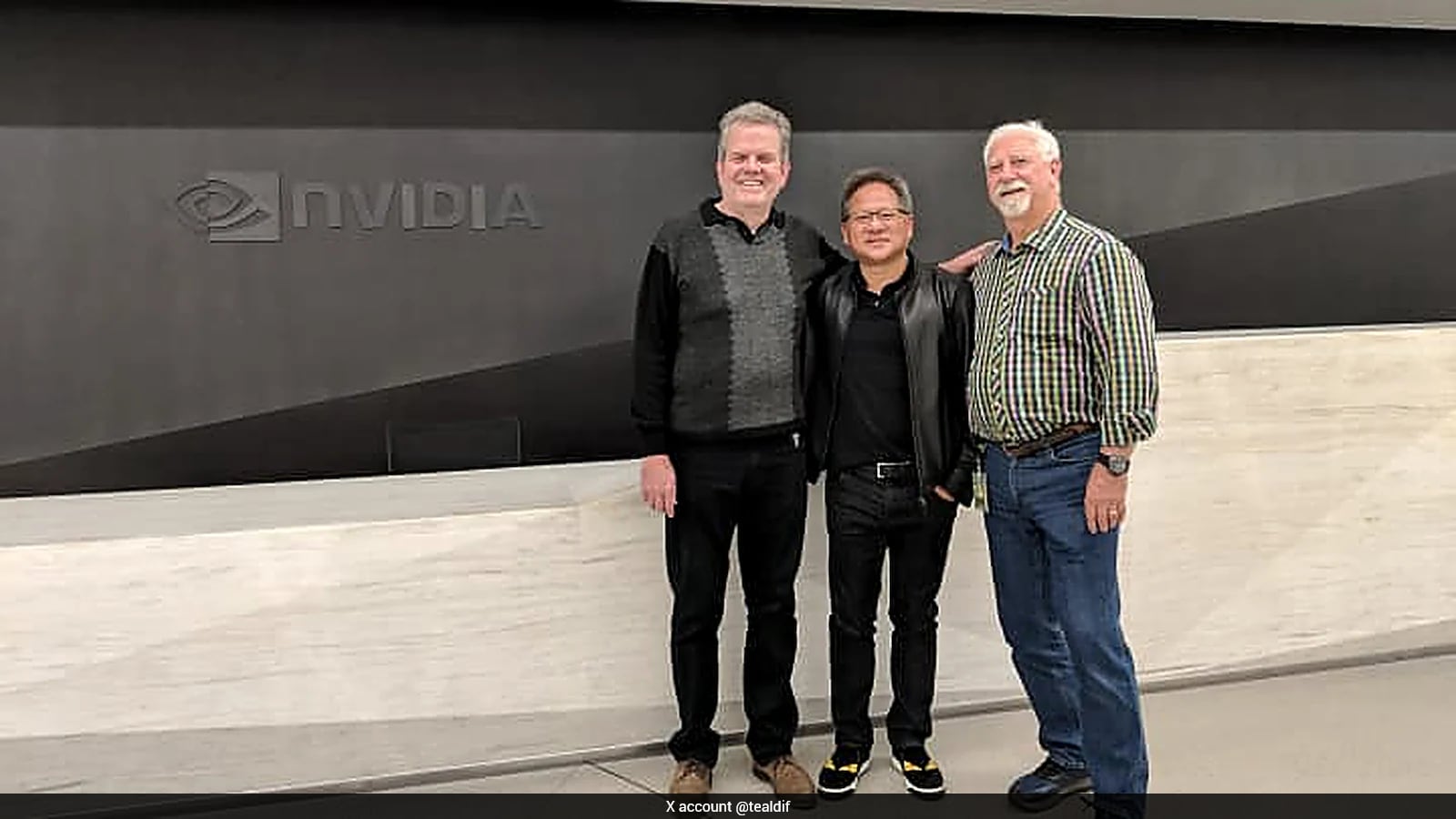
Long before Nvidia became one of the world's most valuable companies, its future founders were spending hours at a Denny's restaurant in Silicon Valley, drinking coffee and discussing computer chips.Today, Nvidia's chips power some of the world's most advanced AI systems but the company, which is now worth $3.98 trillion, began with meetings at a roadside diner 33 years ago.Three Engineers, One Diner And 10 Cups Of CoffeeThe story began in 1992 and 1993, when Jensen Huang, Chris Malachowsky and Curtis Priem started meeting at a Denny's in Silicon Valley.The three already knew each other. Priem and Malachowsky worked at Sun Microsystems, while Huang was employed at LSI Logic. They wanted to start a company together but needed a place where they could discuss their plans without attracting attention at work, so Denny's became their meeting point.The sessions often lasted hours. Malachowsky later told The Wall Street Journal that they were hardly ideal customers."We were not good customers," Nvidia co-founder Chris Malachowsky said. "We were going to show up for four hours and drink 10 cups of coffee."Their long meetings eventually got them moved out of their booth and into a room at the back of the restaurant.The room had an unusual mix of people. While the three engineers worked on their plans, San Jose police officers sat nearby, filling out reports."All the cops are writing their reports," Malachowsky said. "We're sitting there with our laptops, trying to figure out whatever we're doing."The diner was also where they discussed what kind of company they wanted to build.Huang Wanted A $50 Million BusinessEach of the three founders had a different role. Malachowsky looked after hardware design, Priem handled software architecture, while Huang took charge of business decisions.Even during breakfast, Huang was thinking about the money the company could make. He studied the competition, the cost of silicon and the possible profit margins.Priem recalled that Huang had set a tough condition before agreeing to join the startup."Jensen refused to join the startup unless it could make $50 million in sales in a year," Priem said.Their plan was to develop chips that could improve the quality of computer graphics, particularly the 3-D graphics used in video games.However, the founders did not spend all their time at Denny's. After noticing bullet holes in the restaurant's front window, they decided it was time to find a safer place to work."Maybe this isn't the safest place to hang out for hours and hours," Malachowsky said.The three eventually shifted their meetings to Priem's townhouse.How The Company Got Its Unusual NameBefore Nvidia became a company, the founders needed a name.Priem liked the letters 'NV', which were commonly used for graphics cards at the time. He also liked the sound of the word 'envy'.Their first choice was Nvision and Priem even recorded a greeting for the company's answering machine, announcing Nvision's global headquarters.However, since several other companies already had similar names, they scrapped the idea.Priem then turned to a Latin dictionary where he found the word 'Invidia', which means envy, dropped the first letter and came up with Nvidia.Not everyone was convinced that the idea would work. Huang's mother was among those who questioned his decision to leave his job and start a chip company with his friends.When he told her about the plan, she said, "Why don't you go get a job?"A Gamble That Changed The Tech IndustryThe founders could not have known what Nvidia would eventually become.Their original focus was computer graphics and gaming. They had no way of knowing that their chips would one day become essential to the development of artificial intelligence.Today, Nvidia's graphics processing units, or GPUs, are used to train and run powerful AI systems. The demand for these chips has made the company one of the biggest beneficiaries of the global AI boom.In many ways, the company's early decision to build specialised chips was a gamble. So was its later decision to invest heavily in AI computing, long before the arrival of popular chatbots such as ChatGPT.
How Three Engineers Turned A Denny's Breakfast Table Into An Nvidia Empire
Full Article
Original Source
Read the full article at Ndtv →KhanList aggregates and links to publicly available news content. We do not host full articles from third-party sources. Always verify important information with original sources.