
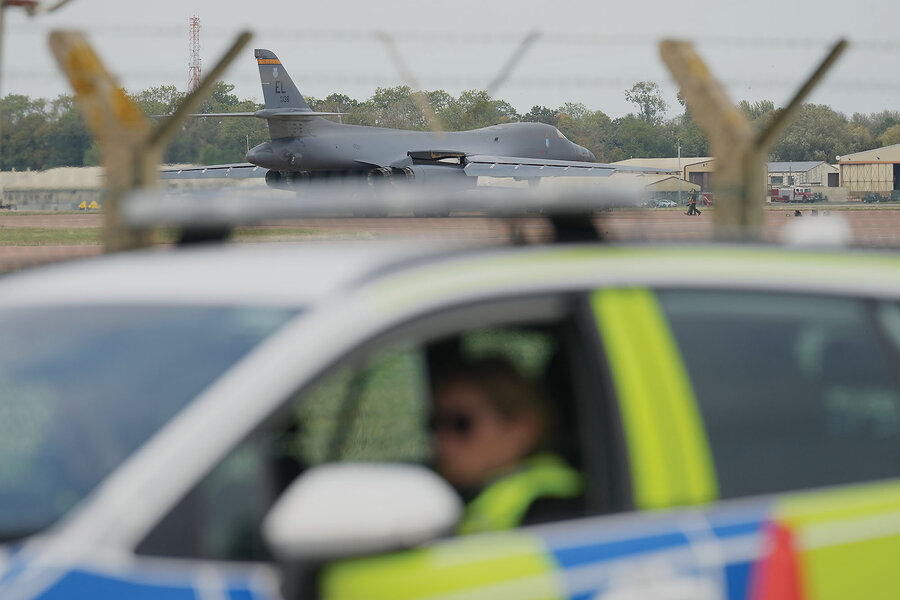
Fairford, England | Nov. 27, 2026, 5:00 a.m. ET | 5 min read The Iran war and the bucolic English countryside converged some 3,500 miles northwest of the direct conflict zone, down a single-lane road lined by a hazelnut hedge that was losing its leaves before winter.In what British and U.S. officials say was a foiled Iran-backed explosives plot, three white vans carrying barrels of fuel stopped here in the early hours of Sept. 27. They parked some 250 yards from the fence of the Royal Air Force air base, from where American aircraft mounted bombing runs against Iran beginning in March.Police arrested five masked men who fled the scene, sent in bomb disposal robots, and briefly evacuated 85 homes. But the incident was just the first of three blows to this close-knit community. Just days after the plot was suspected, U.S. bomber aircraft departed the base abruptly in early October – so abruptly, reportedly in response to drone and bomb threats, that even the refueling tankers required for their return to the United States had not been alerted in advance. Then came another announcement in November. The Royal International Air Tattoo – one of the largest military air shows in the world, which has been held at RAF Fairford for more than 40 years – would be moved permanently to another air base.The Iran war has been felt around the world at the gas pump, as disruptions to shipping through the Strait of Hormuz have constrained oil supplies from the Middle East. But the fallout here shows how a distant war can also unsettle local economies and cherished traditions.“We guessed right from the beginning that if there was going to be an [Iranian] target, it would be Fairford,” says former mayor and local council member Christine Roberts. Scott Peterson/Getty Images/The Christian Science MonitorChristine Roberts, a former mayor of Fairford, England, stands beside the town’s war memorial, decked with red poppy wreaths in honor of Remembrance Day. The town, adjacent to a Royal Air Force base, has felt the impact of the U.S.-Israeli war against Iran. “It doesn’t seem like the sort of place that would bring on international disputes; it’s a sleepy little hollow that has been awakened by the dragon, if you like,” says Ms. Roberts. “It’s a complete change for Fairford. It’s a lot for local people to take in that we’re not going to be the same again.” Since the start of the joint U.S.-Israeli attack against Iran in February, the Islamic Republic has vowed to retaliate against all bases and nations hosting U.S. forces. For months, Iranian missiles and drones struck American bases and targeted Israel and U.S. allies in the Persian Gulf.The Pentagon says Iranian retaliation in the Middle East caused $3.7 billion in “equipment losses” – including nearly 60 aircraft – through late June, and wrecked “hundreds of buildings” in eight countries.Then in July, RAF Fairford – built in 1944 in southwest England for D-Day landings and jointly used for decades by British and U.S. air forces – was named as a target by Iran’s Islamic Revolutionary Guard Corps. “Any base used to launch aggression against Iranian territory is a legitimate target of ours,” said the IRGC, noting the use of B-1 bombers from Fairford in a warning to the “British monarchy.” Jacob Turcotte/Staff Iran denies any role in the alleged plot. Yet the U.S. Department of Justice on Nov. 10 unsealed an indictment in New York, alleging that an IRGC-backed network conducted nearly 20 incidents in Europe and the U.S. since February. It stated that a key leader – in federal custody since May – gave real-time orders via FaceTime. One of those plots was at RAF Fairford. While the B-1 bombers left under suspicion of a potential drone attack, the indictment specified that the arrested operatives planned to use fuel, chemicals, and metal shrapnel to attack the base with explosives.A mid-November drive around the perimeter of the expansive air base found no detectable activity on the 10,000-foot-long runway or in multiple hangars. Large tractors and dump trucks had been placed to block gated entrances.Active American use of the base for the Iran war caused the air show to first be canceled this past July, though that was meant to be for one season only. Katsuhiko Tokunaga/Breitling/AP/FileJet display teams from across Europe fly at the Royal International Air Tattoo at RAF Fairford in England, July 14, 2014. After more than 40 years at Fairford, the annual event, one of the largest military air shows in the world, will move to another air base next year. It typically drew 170,000 people over the course of a single weekend, who shopped and dined and brought in extra cash to locals who converted farmland into temporary parking lots and campsites. When news of the initial cancellation hit last May, residents told local media they were devastated. Now, the permanent air show move will cause more losses, especially for those who built infrastructure “for future years, not thinking it would ever go,” says Ms. Roberts.A recent crop of American pilots left notes on the wall of the Lynwood & Co coffee shop, with call signs like Demon, Medic, and Tombstone. JAXXX hailed “the best café in the UK!!!” Drift wrote, “10/10 Bearclaw!”“They’ve been wonderful, so that’s a sad loss for us,” says Robert Broadbent, owner of this string of nine coffee shops. “Similarly, the barbers down the road, the Co-op [shop], the pub – all of the village has really been affected by it.” A self-described aircraft geek who dreamed of flying helicopters from the age of 6, Mr. Broadbent likens the American military presence and the annual air show to Marmite – the powerfully flavored British paste, made from spent brewer’s yeast.“You love it, or you hate it,” says Mr. Broadbent, smiling as he echoes a Marmite marketing slogan. For the air show, the financial boost was tempered by days of clogged roads and overcrowding. And residents complained about the night-and-day noise of the large American bombers during the height of the conflict against Iran. “Having them here was like a security blanket for some people, and the opposite for other people,” says Mr. Broadbent. “In terms of what harm they [alleged plotters] can do, probably this is as bad as it’s going to get, right? Someone driving through the gates with a van loaded with petrol. No ballistic missiles are going to reach here. So what are the threats? Are they real?” Deepen your worldviewwith Monitor Highlights.Politics with respectGet political stories with respectful analysis.There‘s a world of new ideas in everyBooks newsletter.There‘s more to life, enrich yours withCulture & Learning weekly.Follow humanity‘s discoveries withScience & Nature stories in your inbox.Gain a spiritual perspectivefrom the stories in your inbox.Want to understand the deeper impact of critical events? Learn the Monitor‘s insight.Already a subscriber? Log in to hide ads. The economic fallout will be “enormous,” he says. He knows of properties that usually rent for £1,000 ($1,320) per week but raked in £15,000 during the air show.“When those [American] boys were here, we needed two barbers – it was a massive, massive help, and they’re just nice,” says Jack Bushnell, a tattooed barber whose shop sits on the main street. News of the foiled attack was a surprise, he says: “Yeah, we’ve never, never seen any of that.” Bring news welcomed in any home into your home45% off$110/year → $60/yearJournalism that gets above the fray and brings perspectives you won't get anywhere else.Already a subscriber? Sign in
How the Iran war ripples unexpectedly out to rolling English farm country
Full Article
Original Source
Read the full article at Csmonitor →KhanList aggregates and links to publicly available news content. We do not host full articles from third-party sources. Always verify important information with original sources.