
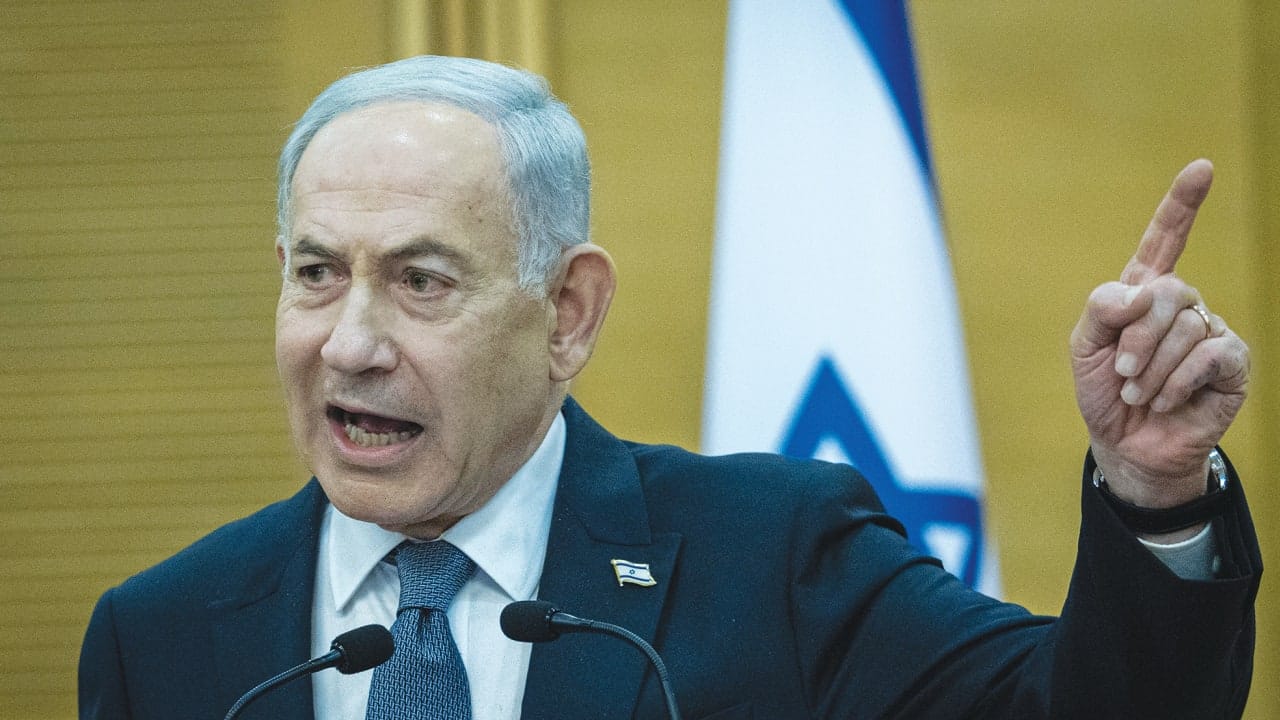
NOVEMBER 27, 2026 12:10On Wednesday, the Jerusalem District Court did not, with its bombshell statement, give Prime Minister Benjamin Netanyahu the eight additional MKs he needs for a 61-seat coalition.It may, however, have given him something almost as valuable: renewed political momentum just as Yashar leader Gadi Eisenkot is trying to form a government under his leadership, either by reaching an agreement with the Likud or by peeling the haredi parties away from Netanyahu’s bloc.The judges’ devastating assessment, that the prosecutors consider dropping the bribery, fraud, and breach of trust charges in Case 4000, the Bezeq-Walla affair; that there does not appear to have been criminal wrongdoing in Case 2000, involving Yediot Aharonot; and that an agreement should be reached in Case 1000, the gifts affair, did not change the coalition arithmetic.These were recommendations, not rulings, and the charges have not yet been withdrawn. And even though the damage to the prosecution’s case was immediate and devastating, Netanyahu’s bloc still has only 53 seats, Eisenkot’s “change bloc” remains at 48, and the Arab parties have 19.Knesset Speaker MK Matan Kahana with MK Gadi Eisenkot during a plenum session at the Knesset, the Israeli parliament in Jerusalem, November 25, 2026 (credit: CHAIM GOLDBERG/FLASH90)Coalition negotiations, however, are shaped not only by simple math but also by momentum and perception. After Wednesday, Netanyahu no longer looks like a finished prime minister with the threat of a criminal conviction hanging over his head. He looks like a politician who has been handed a remarkable reprieve.The question is what he will do with it.Netanayu calls for court cases to end immediately, claiming it has torn the country apartShortly after the courtroom drama, Netanyahu, who has proclaimed his innocence for years, told the Knesset that the trial, together with the investigations and indictment process that preceded it, had torn the country apart for a decade and should end immediately.So, too, he said, should what the never-ending saga produced: “the hatred, the incitement, the vilification, and the division.”Despite the suffering the case had caused him, his family, his inner circle, and the country, Netanyahu said, “Precisely on this day, I extend my hand in reconciliation.”In light of the “enormous and immediate dangers” facing Israel, he said, the only way forward is through unity.“We must unite to secure Israel’s future, nothing less than that, and we must do so immediately. My hand is extended in unity.”The question now is whether the courtroom developments make forming a unity government more or less likely. Paradoxically, they may make a Netanyahu-Eisenkot government easier to justify but considerably harder to negotiate.How the new developments in Netnayhu's court cases affect the major political playersHere is how they could affect the major players.First, Netanyahu, who understandably feels vindicated.“Today, something momentous happened. Today, the trial collapsed,” he declared. “Ten years ago, I said: ‘There will be nothing because there was nothing.’ But it took 10 years for that truth to be exposed for all to see.”That sense of vindication is likely to affect the prime minister’s calculations in several ways.First, it will strengthen his determination to remain prime minister and to serve first in any rotation agreement.Netanyahu will obviously not conclude from Wednesday’s events that this is the moment to step aside. On the contrary, he will see them as confirmation that the effort to drive him from office through the courts has failed, and that there is no justification for asking him to surrender through coalition negotiations what his opponents could not take from him through the legal process.Second, it removes, or at least greatly diminishes, one possible inducement for bringing him into a unity government.One scenario floated recently was that a presidential pardon might eventually become part of a broader unity arrangement: Netanyahu would make significant political concessions, perhaps even agree to leave politics or serve second in a rotation, and in return gain a path out of the trial.That possibility now appears far less relevant. Why would Netanyahu pay a substantial political price for a pardon if the cases against him are collapsing on their own?Third, Wednesday’s developments strengthen Netanyahu within the Likud. Any figures in the party who might have considered pressing him to step aside, arguing that his legal troubles were preventing the Likud from returning to power as part of a unity government, will find that argument much harder to make now.Finally, the courtroom developments make the prospect of another election more attractive to Netanyahu.Even before Wednesday, many thought the Likud would benefit from another election because the favorable conditions that helped the change bloc in October – small parties draining votes from the Right, massive Arab turnout, planeloads of voters flying in to cast their ballots – would not necessarily return in the spring. Netanyahu may now calculate that he would receive an additional boost because of the perception – which he and the Likud would promote – that he was unfairly, even criminally, hounded for a decade.The more confident Netanyahu becomes that another campaign could benefit him, the less pressure he will feel to compromise in the coalition talks.Yashar MK Gadi Eisenkot seen during a plenary session at the Knesset, Israel's parliament, in Jerusalem, November 25, 2026 (credit: CHAIM GOLDBERG/FLASH90)What is Netanyahu willing to compromise for unity?There is, however, a flip side to all this.Netanyahu used his Knesset speech not merely to claim vindication but to call for reconciliation and unity. That creates expectations. If he is genuinely extending his hand to the other side, what is he prepared to give up to make this unity happen?Wednesday strengthened Netanyahu’s bargaining position. Now the question is whether he will use that strengthened position to make a unity government possible, or demand terms – such as serving first in a rotation agreement or as the prime minister for the entire term – that may make such a government impossible.As far as Eisenkot is concerned, the developments in the court cut in opposite directions.They will make negotiations with Netanyahu over a rotation more difficult. At the same time, they will also make it easier for Eisenkot to justify sitting with Netanyahu in a government.Eisenkot has tried to distinguish between negotiating with the Likud and legitimizing Netanyahu’s continued premiership, with the criminal cases cited as a major reason Netanyahu should not continue as prime minister.That distinction, willing to sit with the Likud without Netanyahu but not with the party under Netanyahu’s leadership – becomes much more difficult to maintain after Wednesday. Not only for Eisenkot but for all parties.If the judges themselves believe that two of the three cases against Netanyahu should be dropped and that the third – the case involving gifts – should be concluded through an agreement, what is Eisenkot’s remaining justification for excluding him? The legal developments, therefore, neutralize one of the strongest arguments against sitting under Netanyahu.At the same time, they also provide Eisenkot with the cover he may need to enter a unity government. He could now tell his voters that he is not throwing a political life raft to a prime minister facing bribery charges, but responding to a dramatically changed legal reality in order to prevent another election.That changed reality also gives Eisenkot an additional reason to avoid an election, since Netanyahu could emerge stronger if the country returns to the polls.But the desire to prevent another election does not necessarily have to push Eisenkot toward unity with Netanyahu. It could do the opposite, inducing him to move more quickly to bring a minority government to the Knesset for a vote.How Bennett's B'Yachad and Liberman's Yisrael Beytenu responded to developments in Netanyahu's trialsAnother key political actor affected by Wednesday’s developments is B’Yachad head Naftali Bennett.Bennett has been pushing for a broad unity government with the Likud, but without the Arab or haredi parties, and with Eisenkot serving first as prime minister in a rotation agreement. In other words, a broad Zionist government made up largely of parties whose constituents – and whose leaders’ children – serve in the military.The courtroom developments strengthen the first half of Bennett’s argument: excluding the Likud and Netanyahu becomes harder to justify when the judges themselves are dismantling much of the legal case against him.But they weaken the second half: why would a vindicated Netanyahu now agree that Eisenkot should go first?Bennett’s formula may therefore become more attractive nationally, but less acceptable to Netanyahu personally.And then there is Yisrael Beytenu’s Avigdor Liberman.Soon after the election, Liberman significantly softened the uncompromising position on haredi conscription that he had championed for much of the last decade and sought to bring the haredi parties into the government.On Wednesday, he also appeared to leave himself some room for maneuver regarding the Arab parties, saying that Eisenkot could form a government with a “clear Jewish majority.” It was unclear whether this signaled a willingness to accept some form of Arab-party participation – something he adamantly opposed before the election – or whether Liberman still believes a Jewish majority could be assembled without it.With the cases against Netanyahu unraveling, Liberman’s refusal to sit with him looks less like a position rooted in concerns about criminality and governance, and more like an obsessive personal vendetta.Prime Minister Benjamin Netanyahu seen with MK Yakov Asher, UTJ chairman, at the Knesset, the Israeli parliament in Jerusalem, November 25, 2026 (credit: CHAIM GOLDBERG/FLASH90)And finally, there is United Torah Judaism, which Eisenkot and Liberman are furiously courting.Before Wednesday, UTJ could reasonably wonder whether Netanyahu’s political era was ending and whether it should secure its interests by joining an Eisenkot-led government.But now, the courtroom developments may reverse that calculation. Netanyahu can tell UTJ: I am not going anywhere; the cases are collapsing. Do not abandon the bloc just as my legal woes are coming to an end, because I will return.The Jerusalem District Court did not solve Netanyahu’s arithmetic problem. He still only has 53 seats, needs eight more for a majority, and faces political rivals determined to prevent his return to power.But it changed the atmosphere surrounding those numbers by weakening the argument for excluding him, strengthening his hold over the Likud, and making it harder for Eisenkot to peel away the haredim. It also gave Netanyahu more reason to believe that another election may work in his favor.At the same time, it may have made him less willing to pay the price necessary for unity – namely, relinquishing the first turn in a rotation agreement. The stronger Netanyahu feels, the less inclined he may be to compromise; yet without compromise, there may be no unity government.Paradoxically, then, what the Jerusalem District Court may have done this week is bring a Netanyahu-Eisenkot government closer in principle while pushing it further away in practice.Follow us on Google
Netanyahu feels vindicated by trial fallout - but could it derail Eisenkot's bid to lead Israel?
Full Article
Original Source
Read the full article at Jpost →KhanList aggregates and links to publicly available news content. We do not host full articles from third-party sources. Always verify important information with original sources.