
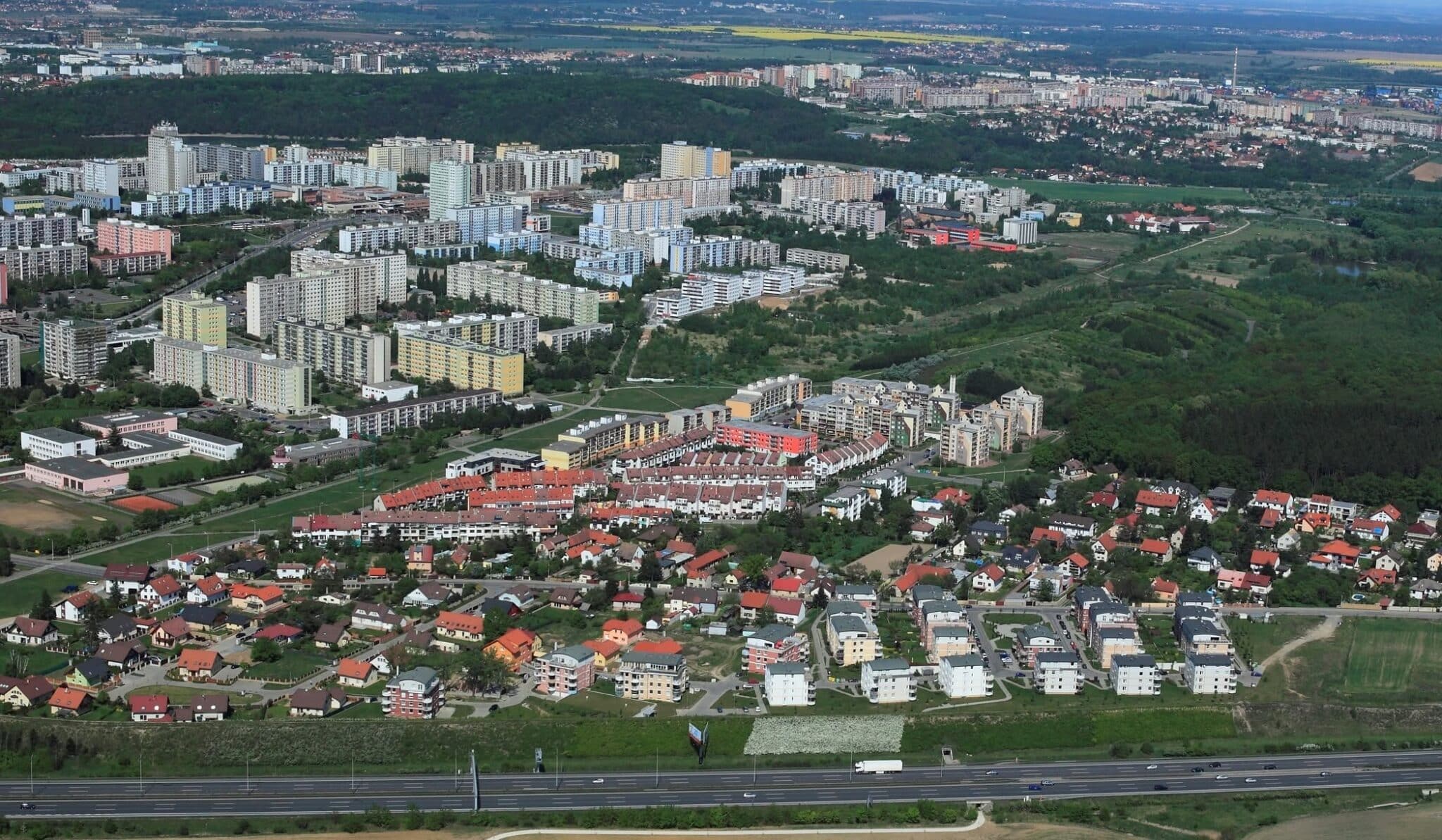
On December 22, 2019, the day Jan Kurel was due to move his young family from their Prague flat into a new suburban home, he arrived to find police cars lining his street. Intruders had smashed through his garden’s sliding door and stolen building equipment. Kurel estimated the damage at between 1-1.2 million crowns (41,000-49,000 euros). His move-in date was pushed back a further six months. The break-in was another episode in a series of delays and defects that had plagued construction from the start. Interior walls did not meet at 90-degree angles. A staircase ended in a step twice as high as the others. Faulty woodwork, Kurel tells BIRN, added 14 tonnes to the roof, causing unsupported hand-cut tiles to crack and rain down on his car. He had discovered the district of Ujezd u Pruhonic in 2017 while cycling the city’s southern edges, as his pregnant wife rested, looking for a place to raise a family. The scenic satellite community seemed to offer an idyll of forests, fields and streams with good public transport to the centre. He also liked the math. At the time, Kurel says, a small suburban house cost roughly the same as a two-bedroom apartment in central Prague. “I went home and told my wife, ‘We should look there’,” he recalls. The Kurels bought a plot in Park Ujezd, a development of family houses that promised wide-open green spaces, a central square, and a school nearby. The house would be built na klíc – turnkey and chosen from a catalogue – by developer Tempus Investment. “I thought, okay, it’s a huge company, so it’s going to be easy,” Kurel says. Yet the family did not move in until nearly three years after the signing date. He says the developer repeatedly rejected his complaints, forcing him to seek legal counsel and commission reports from court-certified experts, which found the work had fallen short of Czech and EU building standards. After Tempus Investment ran into what Kurel describes as financial difficulties, he was left to rebuild parts of the house himself, including separating the roof he shared with his neighbours to stop further cracking. Today, Kurel is one of 15 people standing for Ujezdske Forum Obcanu, or UFO, a civic group founded in February 2024 that is fielding a slate of candidates in the October 9-10 local elections. Greater transparency around future development is among the group’s top campaign priorities. Kurel’s journey from frustrated homeowner to candidate is a small-scale version of a bigger story playing out across Czechia. As rising housing costs push Prague residents toward outlying districts, municipalities increasingly rely on developers not just to build enough homes, but to help fund everything from schools to sewers. Local governments, in turn, must ensure that private-sector involvement serves the public interest. What sets Ujezd apart is that some of its newest residents are now entering local politics to strengthen the community’s stake in decisions shaping its schools, homes and public spaces amid a development boom that shows no signs of abating. Sign at entrance to Park Ujezd, Ujezd u Pruhonic, Czech Republic. Photo: BIRN The promise of Park Ujezd Katerina Radmilovic, a mother of three, bought her home in the residential Park Ujezd in 2014, just around the corner from where Kurel would eventually build his. She and her husband were drawn to the thoughtfully planned development which promised generous plots with plenty of space between houses. Both golfers, they also liked the idea of living in what was pegged to become the heart of a golf course. “Since I come from this part of Prague, it felt like a perfect match for us,” Radmilovic tells BIRN. But by spring of 2020, Radmilovic and her neighbours discovered that those plans were set to change. They checked the developer’s website and found that the golf club was no longer part of the project, while plots were smaller and streets appeared narrower with limited parking. A new proposal called for dozens of terraced houses to be built behind their homes. Radmilovic and her neighbours formed a petition committee, and began pressing the municipality and developer Tempus for answers about what was happening right in their backyards. They were also frustrated that the municipality still had not taken over much of the development’s infrastructure. “There were times when the street lights were not working,” Radmilovic says. “It was quite inconvenient and made us feel a little uncomfortable.” Mayor Vaclav Drahorad organised a meeting at the town hall where they could put their questions directly to Milos Cervenka, chairman of the board of Tempus and a fellow Park Ujezd resident. Kurel, who also attended, says Drahorad had been sympathetic to his own problems with the builders. Cervenka was no stranger to scrutiny. In 2006, he was arrested in connection with an allegation of paying lobbyist Frantisek Vybiral 500,000 crowns (about 20,000 euros) for documents he believed showed what police knew about his land dealings. At that time, Cervenka controlled hundreds of hectares around Prague, including roughly 150 hectares acquired from the state land fund. He denied wrongdoing and was later acquitted. The well-known land magnate did not sufficiently address his neighbours’ concerns. “Some of our questions were answered and some of our requests were taken into consideration, but I definitely didn’t feel like a partner in the process,” Radmilovic says. The municipal council initially raised concerns about wastewater and school capacity, and rejected the proposal for 28 two-storey row houses in September 2020. But the project later moved forward. In November 2021, Mayor Drahorad signed a cooperation agreement with Tempus covering 46 homes in Park Ujezd 4 and 5 – two further phases of the development. In exchange for a 5.31-million-crown contribution, the agreement required the municipality to withdraw its earlier objections and support the developer’s permit applications, which it did after a council vote. For Radmilovic and Kurel, disappointment with the outcome of that meeting helped steer them onto the path of local politics. “It’s easy to point out what’s wrong, but I wanted to actually do something about the things I’m not happy with in our neighbourhood,” Radmilovic says. She is now running for Katerinky Sobe, one of the civic groups fielding candidates in October’s municipal elections. “Listening to residents is clearly lacking in the leadership of our municipality. I became convinced of that during the school case,” she says, foreshadowing the next chapter in the dispute between local parents and the municipality. Current Ujezd Mayor Vaclav Drahorad with Prague Mayor Bohuslav Svoboda, both of the ODS party. Municipality’s Facebook page Plagiarism subplot Buyers like Radmilovic had seen the newly built local school, called ZS Formanska, as part of Park Ujezd’s particular appeal. Alongside the fire hall, the school’s activities would become an important social hub for bringing together lifelong residents and newcomers. But by late 2023 and early 2024, that relationship had started to fray when the municipality, under Mayor Drahorad, appointed Helena Patakova, also an ODS councillor, as director of ZS Formanska. Patakova replaced Tomas Kunst, who had led the school since its opening in 2018. The municipality published the six-year concepts submitted by both candidates in January 2024, with Patakova ranked first. Kurel and other parents who examined Patakova’s proposals alleged that parts of it had been copied from other sources without attribution. Parents from Ujezd and the neighbouring settlement Katerinky, which shares the school’s catchment area, objected. A petition seeking Patakova’s removal gathered nearly 400 signatures. Patakova disputed the allegations, while Drahorád said he had obtained an expert opinion and believed the appointment had followed the law. A subsequent review by Prague’s magistrate found problems with the competition paperwork, but said they were not serious enough to invalidate the competition. It nevertheless found that the municipality had violated the Schools Act and ordered it to remedy the appointments. The municipality declined to do so. Patakova took over in March 2024 and remains school director today. Nine of 13 teachers resigned, and some parents, including Radmilovic, withdrew their kids mid-year and enrolled them in new schools. Kurel’s wife started homeschooling their daughter. Amid this charged atmosphere, UFO was formally established. Its activities included educational camps and sporting events involving several former ZS Formanska teachers and staff. The group distributed a print newsletter, held a goulash cook-off, and continued to meet regularly at the local pizzeria to discuss issues they felt the municipality was failing to address. Then one of UFO’s founding members, Petr Smekal, a businessman with an accounting background who lived down the road from the Radmilovic family, began attending finance committee meetings and public budget hearings, and examining the municipality’s contracts and financial records. That revealed more cause for concern. A local event of Ujezdske Forum Obcanu (UFO) featuring one of the group’s founding members, Petr Smekal (R), in Ujezd u Pruhonice, Czech Republic. Photo: UFO Facebook. Finances under scrutiny Smekal found that Tempus, and its sister developer Navetina, owed the municipality 2.43 million crowns under a cooperation agreement for Park Ujezd 6, yet another planned phase of area development. The original agreement called for the developer to pay the municipality 4.421 million crowns. Tempus initially paid 442,100 crowns. A subsequent amendment reduced the scope of the projects and the total payment to 2.87 million crowns, leaving 2.43 million crowns outstanding. A July 2024 addendum set July 31, 2024 as the deadline for payment. The debt was not settled until June 17, 2026, when the municipality resolved it by offsetting the amount against funds connected to another development project. For Smekal, the issue was not simply that the payment was late. It was that he had discovered the overdue claim only after it had already become a problem. “What struck me above all was that such a significant overdue receivable had not been discussed beforehand by the financial committee,” he says. “I participated in meetings of the financial committee and public budget hearings, yet I learned about the municipality’s overdue claim against the developer only at a council meeting.” Smekal calculated that statutory late-payment interest could have amounted to roughly 582,000 crowns between August 2024 and June 2026 – enough, he says, to cover roughly a year’s worth of support for youth activities at SK Ujezd, the town football club. (He stresses that this was his estimate, not an amount formally claimed by the municipality.) But Smekal’s bigger concern was whether the transaction was legally secure, given what he described as uncertainties surrounding the original agreement and subsequent amendments. He proposed finding another legal solution to resolve these uncertainties, but said Mayor Drahorad was unwilling to discuss the issue with UFO, maintaining that everything was in order. “The whole case, in my view, points to a broader problem in the way contractual relationships with developers are set up,” Smekal says. Mayor Drahorad and Tempus owner Cervenka did not respond to detailed requests for comment on the issues raised in this article. A campaign poster for Ujezdske Forum Obcanu (UFO), in Ujezd u Pruhonic, Czech Republic. Photo: BIRN Who gets to decide? Across Central Europe, local governments face similar questions about transparency, oversight and relationships with developers. Marek Chromy of Transparency International Czechia stresses that close, long-term relationships between municipalities and developers are “normal and often necessary”. The risk, he says, lies not in the relationship itself but in the rules governing it. “Development brings new residents, and new residents need schools, roads and sewers that small municipal budgets usually can’t fund,” he says. Czech law now formalises such arrangements through planning contracts. Transparency International Slovakia has found improvements in municipal transparency in recent years, while a study across Visegrad countries found substantial gaps in the transparency of municipal companies. Elsewhere in Europe, Transparency International UK has highlighted similar risks around local planning. But issues can arise even where there is no allegation of corruption. “Problems with contract management are among the most common municipal governance issues, and they don’t need to involve bribery to harm the public,” says Chromy. He points to the enforcement of contractual rights, an issue at the heart of UFO’s concerns about Tempus, as one example. Such decisions do not necessarily involve corrupt intentions, Chromy says. They can also result from a lack of knowledge and experience, but that, too, can be problematic. “When a municipality doesn’t enforce a contractual right, such as penalty interest on a late payment, it is effectively forgoing public money,” he says. “The question then becomes who decided that, on what basis, and whether it was recorded and approved by the proper body.” Terraced houses stand empty in Park Ujezd, Ujezd u Pruhonic, Czech Republic. Photo: BIRN Welcome to ‘Červenkov’ Behind Radmilovic’s and Kurel’s homes, the future of Park Ujezd is slowly coming into focus. Rows of newly built houses stand empty, waiting for residents. Bulldozers and cranes loom on the horizon, while a deserted container showroom advertises Park Ujezd and its developer Tempus. Beyond the houses, toward the primary school, the landscape changes abruptly. Vast fields of potatoes and alfalfa, regularly visited by hungry rabbits and deer, stretch toward the protected Milicov forest and pond, criss-crossed by high-voltage electricity lines. This large tract of open land between the existing homes and the forest is currently being pursued by Tempus for its next phase of development in the area, Trojuhelnik (Triangle). The municipality has backed proposed changes to the area’s zoning, including 1.9 hectares that would allow a more compact form of development with both family homes and apartment buildings. That plan predates Prague’s new Metropolitan Plan, drawn up by the Institute for Planning and Development (IPR) to curb urban sprawl, which took effect on September 1 this year. Kurel, however, believes the new planning framework could pave the way for denser housing in Ujezd as Prague looks to accommodate demand for new homes. Asked about the impact of the plan, Anna Klimova, spokesperson for IPR , says one of the plan’s key principles is to “make more intensive use of the existing city” by focusing development on vacant land already surrounded by the urban fabric. The aim, she says, is to “complete the settlement in a logical way and create a compact, coherent whole”. Ujezd illustrates the paradox that’s emerging as Prague-adjacent districts absorb demand for housing: land occupied by single-family houses and open fields on the capital’s edge can become increasingly attractive for denser development. Kurel has his own name for what he sees happening, referring to the latest development as “Cervenkov,” after Tempus owener Cervenka. Kurel and his group of parents-turned-politicians also liken the plans to a second Jizni Mesto, the vast panelak estate on Prague’s southern edge that some of them left behind. They see the October elections as a chance to have greater input in infrastructure decisions that could shape further development, including the future of high-voltage lines and ecological corridors that hem in the area’s developable land. “We need a decision methodology which you need to follow whenever you want to build something,” Kurel says. “For example, first you need to build a kindergarten, then you can build the houses.” UFO co-founder Renata Svarcova at a community event. Jan Kurel is in the background. Photo: UFO Facebook. A community in transition Mayor Drahorad has been a central figure in Ujezd’s local government for roughly two decades, a period in which the municipality has grown into a Prague suburb. For some newcomers, his long tenure has become part of their frustration with the municipality; for some long-time residents, the newcomers themselves are part of what has changed Ujezd. On local Facebook groups, heated debates over the school, development and the municipality’s leadership play out regularly. Critics of UFO have questioned the motives of some of its candidates, including whether homeowners are primarily trying to protect the value of the properties they bought. The arguments reveal a community wrestling with two different versions of its recent history. To some longtime residents, UFO is part of the rapid transformation they are now criticising. UFO members, meanwhile, see their role as helping build a more inclusive and democratic future for Ujezd. That vision was on display at a September street festival in Katerinky that drew around 500 people, according to Kurel. Three competing groups, Ujezdske Forum, Katerinky sobe and Normalni, organised the event. What made Kurel proudest wasn’t simply the turnout, he says, but that groups which had previously operated separately managed to work together. There is no public polling for Ujezd, but ODS has won six of the 11 council seats in both the 2018 and 2022 elections, taking 57 per cent and 56 per cent of the vote respectively. With five other lists competing in this year’s more fragmented race, it’s possible the mayor’s party could lose its six-seat majority to a coalition of challengers. Whatever the outcome of the election, Kurel is glad he got involved. Despite the construction headaches, school upheaval and the battles over development, he has little regret about the decision he made from the seat of a bicycle almost a decade ago. “I love the community. We created a huge group of people who would never know each other if Ujezd didn’t exist. We actually positively influenced the town hall – we taught them how to do it properly, and we initiated that change,” he says.
How the Czech Capital’s Building Boom Is Turning Parents into Politicians
Full Article
Original Source
Read the full article at Balkaninsight →KhanList aggregates and links to publicly available news content. We do not host full articles from third-party sources. Always verify important information with original sources.