
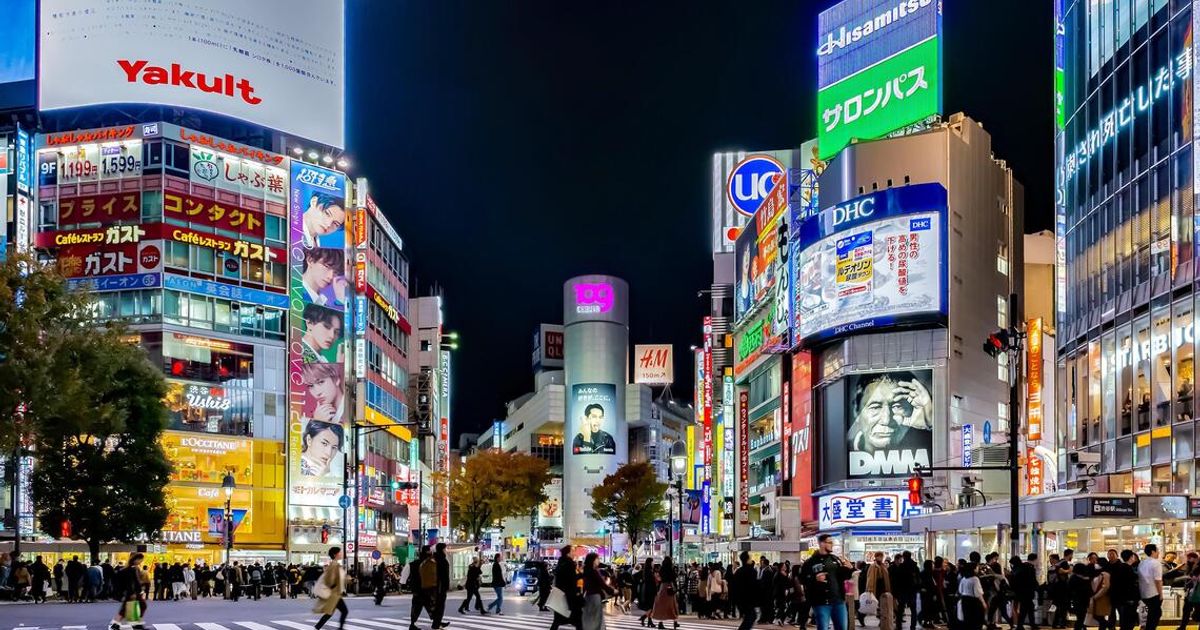
TOKYO – The spectacle at the world’s busiest scramble crossing never gets old: traffic halts in all directions, then a synchronised tide of hundreds stepping off the kerbs from different directions at once.This picture of coordinated chaos at the bustling Shibuya Scramble Crossing, where pedestrians have only roughly 50 seconds to cross on each green light, has made the intersection a top attraction.Now, Singapore is taking a leaf from Shibuya’s book. On Nov 16, the Land Transport Authority began a three-month trial scramble crossing at the junction of Joo Chiat Road and East Coast Road, turning all traffic lights red simultaneously so pedestrians can cross from all directions, including diagonally.Over in Tokyo, the Shibuya Scramble Crossing is said to be used by up to 500,000 people on weekends. The nearby Shibuya Station, serviced by nine rail and subway lines run by four train companies, feeds throngs of commuters who cross the junction.It has also become an unofficial civic square where crowds gather to cheer World Cup victories in Samurai Blue jerseys, as well as to celebrate Halloween and ring in the New Year.Shibuya’s global celebrity, however, belies the fact that it is not Japan’s first scramble crossing.‘Traffic war’That distinction belongs to the south-western city of Kumamoto, which introduced the country’s first multi-directional crosswalk at the Kokai junction around 1968 to protect students and shoppers from the nearby shopping street, university and high school.It came in an era since dubbed the “Traffic War”, when road deaths exceeded 10,000 a year. A monument erected at the junction in 2024 commemorates its pioneering role. Police records also praised the design as “effective against accidents, traffic congestion, and to protect pedestrians”. Soon after, scramble intersections began to spread across Japan. Today, National Police Agency data shows there are about 1,000 scramble crossings nationwide.Tokyo introduced its first scramble crossings in 1971, including one outside the Iriarai No. 1 Elementary School in Ota Ward. Shibuya followed in 1973, when the district was booming into a youth magnet.The opening of developments such as the Tokyu Department Main Store (1967), Seibu Shibuya (1968), Shibuya Parco (1973) and NHK Hall (1973), a concert venue located within the headquarters of Japan’s national broadcaster NHK, drew massive crowds into a bowl-shaped valley with slopes extending in multiple directions.This funnelled cars and shoppers into a dangerous bottleneck. To defuse the hazard, the Tokyo Metropolitan Police stopped vehicular traffic on a two-minute cycle to allow pedestrians to cross in all directions.What began as a utilitarian safety fix evolved into a pop-culture powerhouse, starring in films like Lost In Translation (2003) and Netflix drama Alice In Borderland (2020-2025). The latter showed a deserted Shibuya crossing to deliver an apocalyptic atmosphere, though it was filmed on a full-scale replica set in Tochigi prefecture.Tourist hot spotToday, 60.3% of foreign tourists to Tokyo stop in Shibuya, making it the city’s most visited destination for the fourth consecutive year, according to a Tokyo Metropolitan Government survey in 2026.That popularity has bred friction as tourists stop mid-track on the crossing to take photographs and videos while the signals flash green, sometimes obstructing pedestrian flow.In February, viral footage of a woman deliberately shoving a Taiwanese girl who was posing for a photo taken by her mother drew widespread condemnation of butsukari (bumping) assailants, alongside criticism of visitors blocking a busy junction that was never intended to be a tourist attraction to begin with.Beyond the zebra stripes, Shibuya itself is undergoing what Mayor Ken Hasebe calls a “once-in-a-century” transformation that is expected to last until at least 2034. Led by train companies Tokyu Corp, JR East and Tokyo Metro, the ongoing two trillion yen (S$16.2 billion) overhaul has already added new skyscrapers like Shibuya Hikarie (2012), Shibuya Scramble Square (2019) and Shibuya Sakura Stage (2024). Soon, there will be elevated walkways to disperse ground-level crowds, and a redeveloped Hachiko Plaza that will continue to feature the bronze statue of Hachiko – Japan’s most loyal dog.Amid the redevelopment works, legacy retailers are vanishing after failed lease negotiations. On Sept 30, Seibu Shibuya closed after 58 years, while craft emporium Hands Shibuya drew the curtains on 48 years of operations on Nov 15. The Hands site, which was acquired by property group Hulic in 2013, is set to be developed into a luxury hotel under The Gate Hotel brand, with shops on the lower floors. Hundreds braved the rain to witness the closure, with one writing on X: “I teared up when I heard someone shouting, ‘Thank you, Hands!’ It really feels like the end of an era.”While developers promise a safer district, some netizens fear the changes will dilute the eclectic street culture that has made Shibuya famous and jump-started the careers of global fashion designers like Comme des Garcons, Issey Miyake and Yohji Yamamoto.Still, even as old Shibuya icons shutter and Singapore tests out the formula anew, Shibuya’s famed Scramble Crossing will remain untouched – proof that over 50 years after it opened, a simple traffic solution remains the beating heart of the district.
How Shibuya Scramble Crossing went from safety fix to global icon
Full Article
Original Source
Read the full article at Straitstimes →KhanList aggregates and links to publicly available news content. We do not host full articles from third-party sources. Always verify important information with original sources.