
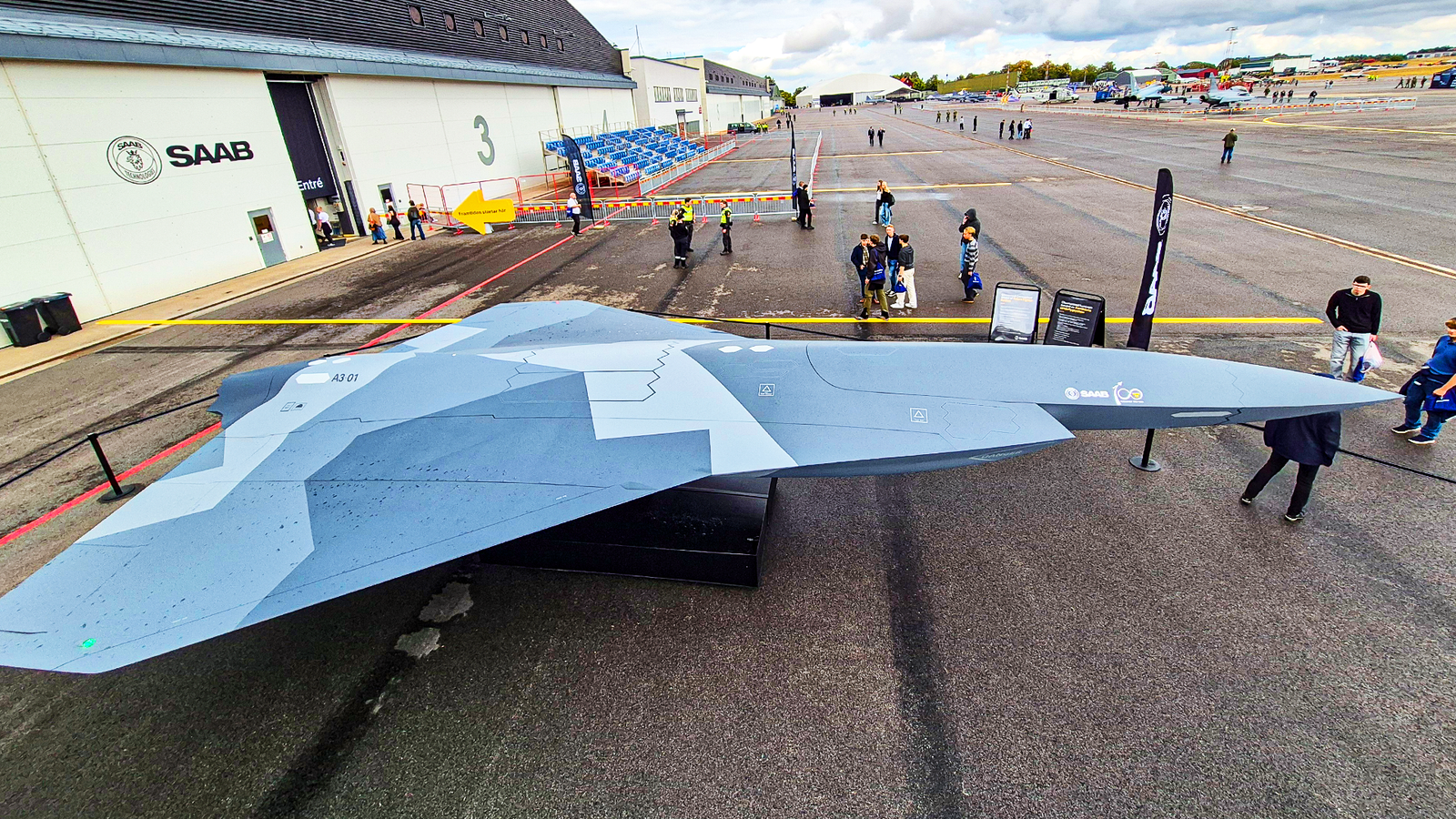
Last weekend, Simple Flying had a chance to visit the Jubilee Air Show for the 100th anniversary of the Swedish Air Force in Linköping, where Saab put a brand-new full-scale uncrewed combat aircraft mock-up on display, but the most important part of the A3-001 may have little to do with its stealthy shape. Many of Europe's major powers continue to pursue enormous next-generation combat-air programs, but the Swedish company is taking a narrower route: develop an autonomous aircraft that can work with today's Saab JAS 39 Gripen E , enter flight testing quickly, and cost considerably less than a conventional fighter. That creates an intriguing contrast with Europe's broader FCAS and GCAP ambitions. Saab is not claiming that the A3-001 replaces a sixth-generation fighter, but its approach could give European air forces what they need much sooner: additional combat mass that can be sent into dangerous airspace without risking another pilot, while working with current 4th-generation European fighter jets. The question is whether a relatively compact team of around 650 engineers in Linköping can turn that concept into an operational weapon before Europe's much larger programs deliver their own autonomous combat aircraft. Saab's A3-001 Is Designed To Put Pilots Further From Danger Credit: Victoria Agronsky | Simple Flying The first answer came at Malmen Air Base in Linköping, Sweden, where Saab displayed a full-scale model of the A3-001 during the Swedish Armed Forces Air Show on August 21-23. Saab describes the aircraft as a future uncrewed combat-air component intended to operate alongside crewed aircraft, including the Gripen, rather than as a standalone fighter jets replacement. The company's stated missions include electronic warfare, suppression of enemy air defenses (SEAD), and precision strike in highly contested environments. That mission set explains why Saab is emphasizing low observability and autonomy. The A3-001 is envisioned as a supersonic aircraft capable of moving into areas where a crewed fighter and its pilot would face greater danger, potentially collecting information, conducting electronic warfare or helping attack defended targets before passing information back to the manned aircraft. Saab's Head of Advanced Programs, Peter Nilsson, told The Aviationist that the unmanned aircraft could operate ahead of the Gripen E, with integrated sensors sending data back to the fighter. Saab's own description places the A3 inside a wider system-of-systems approach in which crewed and uncrewed platforms cooperate. But before Sweden can deploy such a system, Saab must first prove it can develop the aircraft quickly enough to make its cost and operational advantages meaningful. The A1-A3 Roadmap Is Saab's Shortcut To A Production Aircraft Credit: Antonio Di Trapani | Simple Flying This is where Saab's development strategy becomes particularly important. The company is not attempting to fly the A3-001 directly from the concept displayed at Malmen; instead, it is developing a sequence of demonstrators designated A1 and A2, with the A3 representing the longer-term operational concept. Saab says it intends to fly uncrewed demonstrators with fighter-like characteristics before 2030, while the A3 represents what could follow in the mid-2030s if Sweden decides to continue with the technology. The first major milestone is the A1. Saab is working with Sweden's Defense Materiel Administration and targeting a first flight in about a year and a half, pointing toward late 2027 or early 2028. Basically, the A1 will shape the subsequent A2 and A3 designs, meaning Saab can use real flight-test results to modify the aircraft instead of attempting to lock down every requirement before the first prototype ever leaves the ground. The propulsion arrangement illustrates the difference between the demonstrators and the future aircraft. The A1 is planned around the General Electric F414 family used by the Gripen E, with the engine producing approximately 22,000 pounds (98 kN) of thrust, according to The War Zone. The A3, however, does not yet have a selected engine, and Saab's current concept should therefore not be treated as a finalized production specification. Saab concept Role Current status Target A1 Initial technology demonstrator Development underway First flight in ~15-18 months A2 Follow-on technology demonstrator Development phase Validate additional technologies A3-001 Future operational concept Full-scale concept displayed Potential IOC around 2035 The value of this roadmap is that each aircraft can answer questions for the next one. But that raises the more important issue: how does Saab intend to make a sophisticated, supersonic, and low-observable combat aircraft substantially cheaper than a Gripen? Saab's Cost Argument Depends On Combat Mass Credit: Victoria Agronsky | Simple Flying The answer lies in what or who the A3 doesn't need to carry. A conventional fighter has to protect a human pilot, provide a cockpit and life-support systems, meet the requirements of a crewed aircraft, and remain survivable enough to bring its pilot home. An autonomous aircraft can instead be optimized around the mission, allowing Saab to accept greater risk and potentially simplify elements that are essential to a crewed fighter. Saab has explicitly described the future aircraft as being "considerably cheaper than the Gripen," according to The Aviationist. That does not mean the A3 will be a cheap drone in the conventional sense. Saab is proposing a high-end aircraft with low observability, supersonic performance, sophisticated sensors, and autonomous operation. The War Zone reports that Saab has discussed a force structure in which multiple autonomous combat aircraft could complement each Gripen, making the economic argument less about making one drone inexpensive and more about generating considerably more combat capacity for a given defense budget. The intended tactical arrangement is especially revealing. A Gripen E could remain farther from the threat while an autonomous aircraft moves forward to sense, jam, locate, or attack targets, with the manned fighter receiving the resulting information and potentially employing its own weapons. The aircraft could enter tougher environments without exposing the Gripen and its pilot to the same level of risk. This is where Saab's proposition starts to look less like a drone project and more like an alternative way to build an air force. But Europe already has a much larger next-generation combat-air project, making the question unavoidable: why does Saab believe its project can go further? Saab Is Choosing Agility Where Others Chose Scale FCAS was intended to be a much broader combat-air system involving a future fighter, unmanned remote carriers, and a combat cloud, with France, Germany, and Spain participating. However, the program was suspended earlier this year, leaving only one active 6th-generation fighter program in Europe, jointly developed by the UK and Italy, and also by Japan: the GCAP/Tempest, which is still at least a year from first flight. Meanwhile, Saab's A3 proposition is dramatically narrower and faster to build, and that is precisely its potential advantage: it can concentrate on a single autonomous aircraft and integrate it with an existing fighter rather than waiting for an entire next-generation architecture to be created. The Swedish company has already spent years exploring this direction. In 2025, Saab and Airbus held exploratory discussions about a joint drone-wingman program for Eurofighter and Gripen aircraft, showing that Saab's interest in collaborative combat aircraft extends beyond the A3 itself. Army Recognition reported that the discussions centered on an unmanned combat aircraft capable of supporting both platforms. Consequently, the industrial model differs significantly. Saab reportedly has about 650 engineers in Linköping working on future combat-air concepts, and can draw on existing knowledge from Gripen and GlobalEye projects. Its A1/A2 development is therefore tied to technologies and operational experience already within Saab's organization, rather than starting with an entirely new industrial ecosystem. That does not mean Saab has actually outflanked FCAS or GCAP in technological terms. The A3 remains a concept too, and Sweden has yet to commit to an operational A3 fleet. What Saab has potentially outflanked is the assumption that Europe needs to wait for its largest next-generation fighter programs before it can acquire meaningful autonomous combat-air capability. The Biggest Risk Is Making A High-End Drone Cheap Enough Credit: Antonio Di Trapani | Simple Flying Saab's proposition has an obvious problem: every additional capability pushes the price up. Supersonic performance requires substantial propulsion and aerodynamic engineering, while low observability demands specialized shaping, materials, and manufacturing. Add advanced sensors, electronic warfare systems, secure communications, autonomy, and internal weapons carriage, and the aircraft starts to resemble a compact fighter rather than a disposable drone, as The War Zone explained. That makes the A1 and A2 flight tests particularly important. Saab needs to demonstrate not only that an unmanned aircraft can achieve fighter-like performance, but also that autonomous systems can operate reliably alongside a crewed Gripen as a loyal wingman in a contested environment. The company has indicated that the A1 and A2 will progressively mature the technologies required for the eventual A3, while the A3 concept itself is intended to represent a future operational configuration, according to Saab. There is also growing international competition. Saab's aircraft enters a global market in which the United States is pursuing its own Collaborative Combat Aircraft program, while General Atomics, Anduril, and Boeing are developing competing autonomous combat-air concepts. Army Recognition noted that Saab is positioning the A3 as a European counterpart to the US CCA effort, but a Swedish aircraft does not need to defeat those American platforms outright; it needs to offer European customers sovereign technology, fighter integration and an affordable path to combat mass. The timeline to watch begins with the A1's first flight, which Saab expects to occur in late 2027 or early 2028. Fighter-like uncrewed demonstrators are expected to fly before 2030, while Saab's longer-term roadmap points to an A3 aircraft in the early 2030s and potential Initial Operational Capability in the middle of that decade, subject to Sweden's decision to proceed. The Aviationist placed the A1's first flight about 15–18 months away, giving the program a much closer milestone than its ultimate operational target. Saab's A3 Gamble Could Give Europe Combat Mass Before GCAP Arrives Credit: Antonio Di Trapani | Simple Flying For Saab, the real test now moves from the drawing board to flight testing. The A3-001 remains a future operational concept, but the A1 and A2 demonstrators give Sweden a practical way to test whether its vision of affordable, autonomous combat aircraft can work before committing to a production fleet. If Saab can translate the full-scale concept unveiled at Malmen into a flying system, it could give European air forces an alternative to waiting for much larger next-generation combat-air programs to mature. The timeline will be crucial. Saab expects the A1 to fly in late 2027 or early 2028, followed by more sophisticated technology demonstrations before 2030, while the A3 could potentially reach Initial Operational Capability in the mid-2030s. Saab's roadmap means the next few years will determine whether the company can turn its rapid-development philosophy into a genuine operational advantage, particularly as European governments look for more combat capability without simply buying additional crewed fighters. Cost will ultimately decide whether that advantage becomes meaningful. A supersonic, low-observable aircraft equipped for electronic warfare, SEAD, and precision strike will inevitably be more expensive than a conventional expendable drone, so Saab must prove that removing the pilot and integrating the aircraft with the crewed fighter jets can deliver substantially lower costs without sacrificing survivability. If the company achieves that balance, Sweden could potentially buy autonomous aircraft in meaningful numbers and use them to multiply the effectiveness of its existing fighters rather than replacing them outright. That is what makes the A3-001 more significant than another European combat-air concept. GCAP and other sixth-generation programs will continue to pursue increasingly sophisticated crewed and uncrewed systems, but Saab is testing whether Europe can achieve part of that capability through a smaller, faster, and potentially cheaper platform. The decisive moment will come when the A1 leaves the runway: if Saab's 650-engineer team can turn today's full-scale model into a credible combat aircraft on schedule, it may demonstrate that Europe's future airpower does not have to wait for its biggest programs to takeoff.
How Saab's 650-Engineer Team Just Outflanked Europe's FCAS Consortium With A Cheaper Combat Drone
Full Article
Original Source
Read the full article at Simpleflying →KhanList aggregates and links to publicly available news content. We do not host full articles from third-party sources. Always verify important information with original sources.