
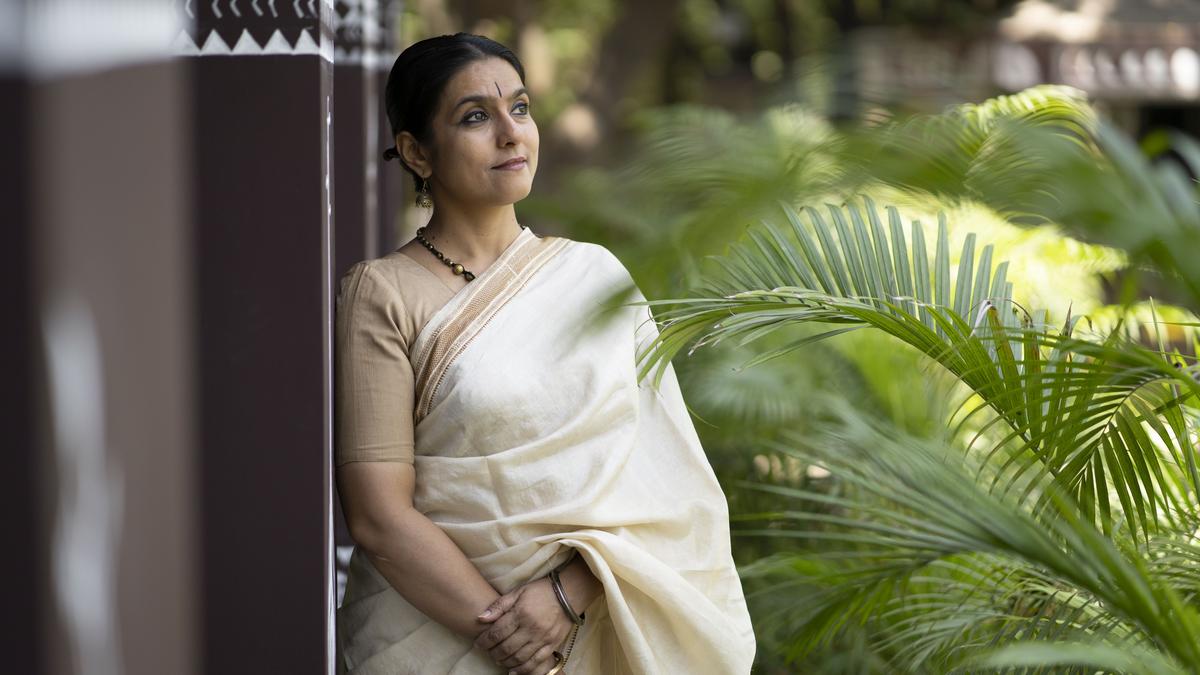
You are woken by the sharp, piercing chirps of birds outside your window. Not an early bird yourself, you turn over, hoping to catch some shut‑eye. But the chirps grow louder, now interspersed with faint jingles of ghungroos that gradually grow from simple taps to more complex patterns.This is how Mahagami Gurukul in Chhatrapati Sambhajinagar stirs to life every morning. The brainchild of Kathak and Odissi dancer Parwati Dutta, Mahagami, a space devoted to dance, music, theatre and the performing arts and a part of the Mahatma Gandhi Mission (MGM), is gearing up to celebrate its 30th anniversary with a specially curated festival, ‘Satata Trimsat’.The idyllic gurukul, dotted with red‑brick pathways, leads to cottages tucked within the lush landscape, their walls transformed into canvases of Warli art. White stick figures of dancers and musicians animate the earthy grey surfaces. A banyan tree, at the heart of the pathway, occupies the central space. Planted 30 years ago by Pt. Birju Maharaj, its branches act as a canopy under the sky, while its aerial roots almost touch the ground. Beneath it stands a statue of goddess Saraswati in a samabhanga pose, lending the space the sanctity of a temple and a dance school. It also becomes the site of prayer and invocation to commence ‘Satata Trimsat’. The banyan tree planted by Pt. Birju Maharaj in Mahagami. | Photo Credit: Courtesy: Mahagami But Mahagami’s story is not just about imparting training in dance; it is about bringing the classical arts to Aurangabad three decades ago, a city not traditionally regarded as a major cultural centre. Parwati arrived here in 1996, when she felt cultural institutions were thriving mainly in metropolitan cities. She chose to begin here. She wanted to start an art centre on unfamiliar turf, and that is when she says she was invited by MGM to Aurangabad to establish Mahagami. “When I landed here, it was just one large barren land with no amenities or comforts. A single cottage‑like structure stood in the middle of an open field.”The journey, she reveals, is not just about building the physical structure of the gurukul, but also about nurturing the next generation of dedicated dancers. “At first it was just a handful of children; then through lecture‑demonstrations, conversations and workshops, people were introduced to classical arts,” she says. An engineering student with a love for mathematics, Parwati took to Kathak, training under Pt. Birju Maharaj, and later began learning Odissi from guru Kelucharan Mohapatra. It is this love for the two dance forms — and mathematics — that one sees in her dance and choreographies. She even gave up her scholarship to study abroad to pursue dance and credits her parents “for never questioning my decisions and always encouraging me to follow my heart.” Pt. Birju Maharaj with Parwati Dutta at Mahagami. | Photo Credit: Courtesy: Mahagami But building an institution demanded more than just artistic commitment. Students needed platforms, and audiences needed opportunities to encounter and understand the classical arts. “We initiated a programme named ‘Surrender’, an intimate concert series that brought established musicians and performers together with Mahagami’s students. Young learners could share what they had learnt alongside experienced artistes, while audiences encountered a range of traditions.”The challenges were practical as well as artistic. “There was no stage or even stage lights. For our very first show, we borrowed lighting equipment from Dr Babasaheb Ambedkar Marathwada University and eventually trained our dancers in lighting, too. Costumes were first sourced from outside, but today we have dedicated tailors who stitch them for us right here. The lack of facilities compelled us the institution to rely on its own resources and talents to become self‑sufficient,” shares Parwati.She gradually introduced an annual residential programme, ‘Sadhana’, which “brings dance into conversation with yoga, Sanskrit, music, visual arts and traditional instruments,” while ‘Anushtha’ allows audiences to experience a range of art forms — from tabla and Rudra Veena to Kathak and Odissi. The idol of Goddess Saraswati in samabhanga transforms the courtyard into a sacred outdoor space. | Photo Credit: Courtesy: Mahagami “I believe knowledge is not separate from practice. Students are encouraged to develop a theoretical foundation and explore how ideas from texts can find expression in movement. Hence, research, music, history and the region’s cultural inheritance — all contribute to the institution’s work. Mahagami has thus grown not only as a training space, but also as a place for experimentation and inquiry,” states Parwati, who has conceived and choreographed more than 800 original works within the classical dance structure.The region’s heritage, including Ajanta and Ellora, has also informed her work. “During the initial days, the struggle reached a point when I wanted to shut shop and head back home. With boxes packed, I decided to visit Ajanta and Ellora. I just sat there, soaking in the ambience and the sculptures, and realised they were not carved overnight — they took years, following the guru‑sishya parampara, where a sculptor handed down his training and knowledge to the next and the next. That sense of continuity and patience became a turning point in my life. I started dancing right there. Came back, unpacked, and began building the gurukul with a new resolve to continue.”At ‘Satata Trimsat’, Parwati and everyone involved in Mahagami looked back on that journey with a range of dance performances, artists capturing the ambience live on canvas and the release of the second edition of Vayam, a book documenting the institution’s journey.An overwhelmed Parwati told her students: “We won’t count years, we will count breaths… How many breaths have you given to dance?” In its own way, Mahagami’s journey has followed a similar progression — from a modest beginning to a larger institution, from individual practice to a shared artistic experience, and from a small space in an open field to a place that now draws students and audiences from across the world.By the time I leave, the campus feels less like a retreat and more like a living performance. The sounds of birds and the jingle of ghungroos seem to fade as traffic snarls and blaring horns grow louder. ‘Sutratman - the luminious theads of Gandhi’ presented by the students of Mahagami at the 30th anniversary festival. | Photo Credit: Special Arrangement Kaleidoscopic‘Satata Trimsat’ brought the students and families together, with parents stepping in as volunteers — one, a dentist, compered the shows across two evenings. Mahagami’s goal, as Parwati Dutta explained, “is not to see art as a compartment but as a way of life,” a philosophy reflected in the institution’s very name — Mahagami, the inward sojourner.The dance presentations were staged at Rukmini Sabhagriha, located next to Mahagami. The inaugural evening opened with Sutratman — the luminous threads of Gandhi — presenting Gandhian principles through Odissi and Kathak, using a spinning wheel and threads to depict weaving — which metaphorically extended to society itself: just as threads unite to form fabric, people must come together to build a stronger collective.Parwati’s love for Dhrupad came through in her choreographies, notably Varnaja — calligraphic images through Kathak and the concluding Nrityarpana, a Kathak and Odissi performance featuring 75 dancers. She focused more on nritta in Odissi and laya in Kathak, forming a seamless merging of the two forms.Her love for Mathematics too surfaced in the intricate sequences and kaleidoscopic stage patterns. Arresting choreography within the classical structure challenged the notion that tradition stifles creativity.The highlight was that all dancers were Gen Z and Gen Alpha; breaking the myth of an “unserious generation”. An Odissi recital by senior dancers as part of Nrityarpana at ‘Satata Trimsat’ | Photo Credit: Special Arrangement
How Parwati Dutta’s Mahagami turned Aurangabad into a cultural centre
Full Article
Original Source
Read the full article at Thehindu →KhanList aggregates and links to publicly available news content. We do not host full articles from third-party sources. Always verify important information with original sources.