
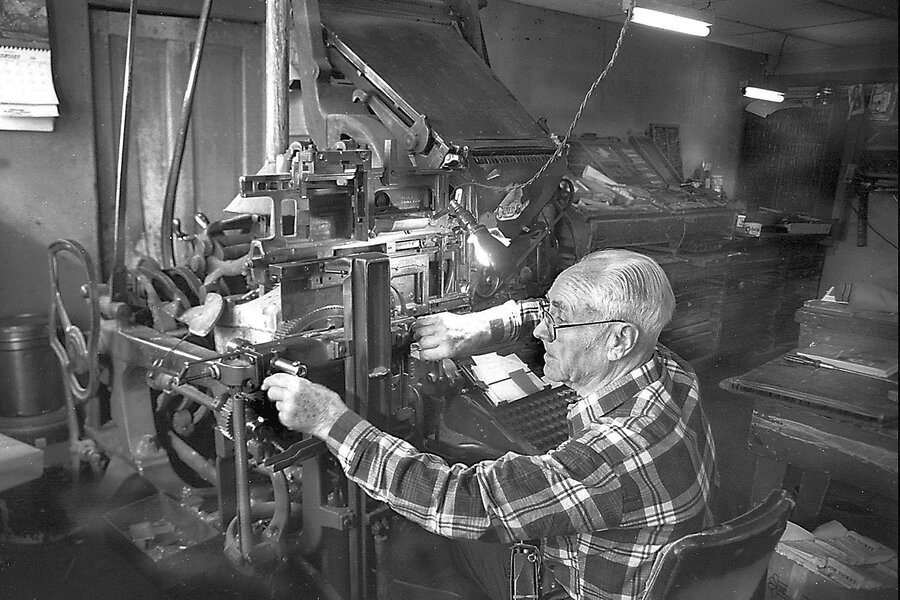
No country is more deeply anchored by the free press than the United States, whose founders made the media the only industry specifically protected in the Constitution. The press was so important, Thomas Jefferson wrote in 1787, that “were it left to me to decide whether we should be a government without newspapers or newspapers without a government, I should not hesitate for a moment to prefer the latter.” And yet, as Jeff Jarvis notes in his fascinating new book “Hot Type: The Magnificent Machine That Gave Birth to Mass Media and Drove Mark Twain Mad,” very few Americans read the newspaper at the time of the nation’s founding.The issue wasn’t primarily educational, Mr. Jarvis notes, but technological. Printing a newspaper required workers to painstakingly place individual letters on a metal plate and manually pull a crank to print individual copies of each and every page. Once printed, type had to be cleaned with lye and, reportedly, sometimes, urine. Newspapers could only be distributed as far as a horse could carry them. The result was that at the turn of the 18th century, the average U.S. newspaper’s circulation topped out at about 4,000 copies.That logjam persisted for more than a century. By the Civil War, reader interest in news was voracious. Railroads and steam engines allowed newspapers to travel great distances, solving one part of the distribution puzzle. But printing itself remained a challenge and circulation was limited. “It is discreditable to the inventive genius of this country that the one great mechanical want of our time is still unsupplied,” Mr. Jarvis quotes from a 1869 article in New York’s World newspaper. “We want the means of supplying the demand for reading matter. The inventive talent of the country produced the steamboat, the cotton-gin, and the electric telegraph.”The answer, Mr. Jarvis notes, came near the end of the 19th century, with the invention of the Linotype, a printing press designed by German-American clockmaker Ottmar Mergenthaler. It revolutionized printing by casting an entire line of text as a single solid metal slug. The machine allowed a relatively small number of operators to set enough type for a multipage, daily newspaper. Gone were compositor rooms where as many as a 100 workers laid out letters and pulled cranks.“The machine is constantly making chewing movements as if it were hungry for the brass delicacies,” a German newspaper observed.The Linotype gave birth to the mass media and, Mr. Jarvis argues, changed the way we communicate. “Printed mass media is an exception in the oral history of humankind,” he tells the Monitor in an interview. Wide distribution of newspapers “starts basically at the beginning of the last century,” he says, before being overtaken by radio, television, the internet – and now, artificial intelligence.The Linotype might seem like an esoteric subject for a book published in 2026. But by examining the flow of information over 250 years of American history, “Hot Type” provides a valuable service by putting artificial intelligence in context. Mr. Jarvis is an apt guide. A professor emeritus of journalism innovation at City University of New York, he co-hosts three regular podcasts – “AI Inside,” “Intelligent Machines,” and “Breaking the News” – and is widely seen as a leading thinker on AI and the news business.The comparisons between today’s AI’s innovation and the Linotype are rarely addressed directly in “Hot Type,” but they nevertheless echo eerily in the reader’s mind. Like AI, the Linotype was not human but machine, yet many commenters insisted on describing it with human characteristics.“Though observers often ascribed thought to it, his Linotype could not think,” Mr. Jarvis writes, so Mergenthaler, its inventor, “had to think ahead for it, anticipating and controlling every possible sequence of actions, in what amounted to an algorithm in steel.”As Mr. Jarvis researched his book, many newspapers folded. He tells the Monitor he realized economic stability in the media has long been elusive. “What really struck me is that at the beginning of scale in media, nobody could figure out what the business model was,” he says. The Linotype allowed for increased production and circulation, but advertisers were unwilling to pay for it.Even Mr. Jarvis’ hero, Mark Twain, the most successful writer of his day, struggled to find his economic footing. Like many a Silicon Valley founder, he rode a roller coaster between fantastic wealth and economic collapse. He invested heavily in a rival typesetting machine called the Paige Compositor, which found early success.“I came up to my room and began to undress, and then, suddenly and without warning the realization burst upon me and overwhelmed me: I and mine, who were paupers an hour ago, are rich now and our troubles are over!” Twain wrote to an associate in 1893.Just a year later, he was forced to declare bankruptcy when the Paige Compositor was overtaken by the Linotype. “Mark Twain Loses All,” New York’s World newspaper announced on April 18, 1894. It’s a business story as wild as that of any Silicon Valley founder.To recover from the financial disaster, Twain was compelled to hit the lecture circuit, traveling the world and eventually earning enough to pay back all his debts. The New York Times called Twain’s publishing firm “financially embarrassed.” For the rest of his life, Twain “lived perilously close to the indefinable line between sanity and madness,” Mr. Jarvis quotes Bernard DeVoto, the Pulitzer Prize-winning curator and editor of Twain’s papers. For the rest of his life, Mr. Jarvis writes, Twain’s writings were “characterized by constant beginnings with no ends, like a chain of failed startups.”But if a poor decision on a printing technology propelled Mark Twain to financial ruin and diverted his literary mastery, it also ushered in a new era of journalism that featured thick newspapers full of reportage from all over the world. It was only with the Linotype that America was finally able to realize Thomas Jefferson’s dream of sharing important, factual information “thro’ the channel of the public papers, and to contrive that those papers should penetrate the whole mass of the people.”The Christian Science Monitor owned and operated eight Linotype machines at inception. By the early 1930s, 29 hot-type machines pressed reports sent by correspondents around the world. The Monitor printed on Lintotype for over 60 years, informing readers through the Great Depression, World War II, the early decades of the Cold War, and the assassinations of President John F. Kennedy and the Rev. Martin Luther King Jr. before being phased out in the early 1970s.A Linotype set its last line at the Los Angeles Times in 1974, at The New York Times in 1978, and at The Washington Post in 1980, making way for computerized typesetting, digital page composition systems, and eventually the internet and AI. Each of these changes disrupted business, changed the flow of information, and required societies to adjust.“It’s unsurprising to me that our business model today is unclear,” Mr. Jarvis tells the Monitor. Current disputes – such as media companies’ efforts to get AI firms to pay to license content use for their chatbots – show that earlier innovations, including copyright, “may not be valid in this current era as we figure out what the heck AI is.” Deepen your worldviewwith Monitor Highlights.Politics with respectGet political stories with respectful analysis.There‘s a world of new ideas in everyBooks newsletter.There‘s more to life, enrich yours withCulture & Learning weekly.Follow humanity‘s discoveries withScience & Nature stories in your inbox.Gain a spiritual perspectivefrom the stories in your inbox.Want to understand the deeper impact of critical events? Learn the Monitor‘s insight.Already a subscriber? Log in to hide ads. The rapid pace of change associated with artificial intelligence has been polarizing as tech barons alternately warn AI could lead to human extinction or, in the words of Elon Musk, unlock “unprecedented global abundance.” In his encyclical, “Magnifica Humanitas,” Pope Leo XIV warned that “humanity, created by God in all its grandeur, is today facing a pivotal choice: either to construct a new Tower of Babel or to build the city in which God and humanity dwell together.”And yet, to read Mr. Jarvis’ book “Hot Type” is to remember that change is constant, that the past is not exactly as we imagine it was, and that we have muddled our way through other innovations that seemed revolutionary at the time, but now appear quaint. ALREADY A SUBSCRIBER? LoginReal news can be honest, hopeful, credible, constructive.The Christian Science Monitor was founded in 1908 to lift the standard of journalism and uplift humanity. We aim to “speak the truth in love.” Our goal is not to tell you what to think, but to give you the essential knowledge and understanding to come to your own intelligent conclusions. Join us in this mission by subscribing.
How one innovative machine spawned mass media
Full Article
Original Source
Read the full article at Csmonitor →KhanList aggregates and links to publicly available news content. We do not host full articles from third-party sources. Always verify important information with original sources.