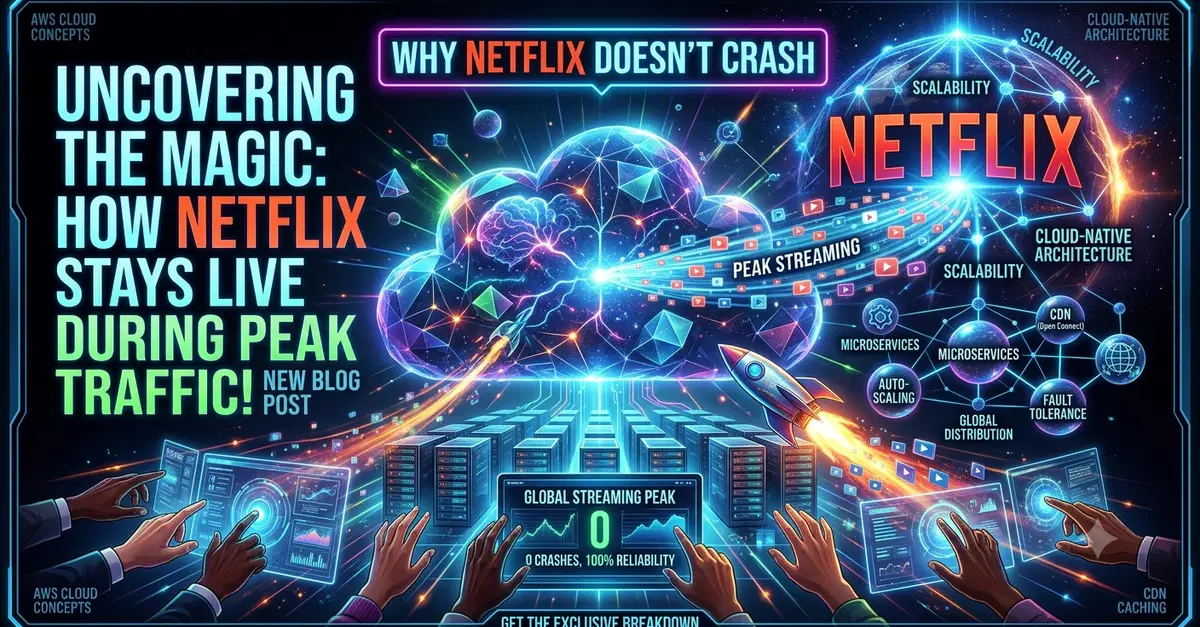
Millions of people open Netflix at the same time—during weekends, evenings, or when a new season drops. Despite this massive traffic, users usually experience smooth streaming with minimal downtime. The reason isn't one powerful server. It's a cloud architecture designed for scalability, redundancy, and intelligent traffic management. Let's look at the key cloud concepts that make this possible. The Challenge Imagine a new series is released. Within minutes: Millions of users log in Thousands start streaming simultaneously Search requests increase Recommendation engines become active Video delivery traffic spikes If all these requests reached a single server, it would fail almost instantly. Cloud architecture prevents this. 1. Load Balancing A load balancer acts as a traffic controller. Instead of sending every request to one server, it distributes traffic across multiple servers. Benefits Prevents server overload Improves response time Increases availability Handles traffic spikes efficiently Without load balancing, one busy server could bring down the entire application. 2. Auto Scaling Traffic isn't constant throughout the day. Cloud platforms automatically adjust the number of running servers based on demand. During Peak Hours More servers are launched automatically Incoming traffic is distributed across them During Low Traffic Extra servers are removed Infrastructure costs decrease This ensures applications remain responsive without running unnecessary resources. 3. Content Delivery Network (CDN) Streaming every video from one central server would introduce delays, especially for users far from the data center. A CDN stores copies of content in multiple geographic locations. When a user presses Play, the content is served from the nearest available location. Advantages Faster streaming Lower latency Reduced load on the origin servers Better experience for global users 4. Caching Not every request needs to reach the database. Frequently accessed data is temporarily stored in cache. Examples include: User profiles Movie posters Trending lists Homepage recommendations Benefits Faster responses Lower database load Reduced server processing Caching significantly improves performance during traffic spikes. 5. Distributed Infrastructure Instead of depending on one data center, cloud applications run across multiple regions and availability zones. If one location experiences an issue: Traffic is redirected Other regions continue serving users Service remains available This improves both reliability and fault tolerance. 6. Database Replication Millions of users continuously: Log in Save watch history Update profiles Add shows to watchlists Handling all these requests with a single database would create a bottleneck. Cloud systems use multiple database replicas. Benefits Higher read performance Better availability Reduced database overload 7. Monitoring and Alerts Cloud infrastructure is monitored continuously. Engineers track metrics such as: CPU utilization Memory usage Network traffic Error rates Response time Failed requests If abnormal behavior is detected, alerts are triggered so issues can be addressed quickly. Monitoring helps identify problems before users notice them. 8. Fault Tolerance Cloud systems assume that failures will happen. Instead of trying to prevent every failure, they are designed to recover automatically. Examples include: Restarting unhealthy servers Redirecting traffic Replacing failed instances Recovering from hardware failures The goal is to keep the service running even when individual components fail. 9. Microservices Rather than running everything as one large application, different features are separated into independent services. Examples include: Authentication Search Recommendations User profiles Video streaming Payments If one service experiences an issue, the rest of the platform can continue functioning. This makes scaling and maintenance much easier. Putting It All Together A typical request follows this flow: User │ ▼ CDN │ ▼ Load Balancer │ ▼ Application Servers │ ▼ Cache │ ▼ Database │ ▼ Response Enter fullscreen mode Exit fullscreen mode Each layer handles a specific responsibility, allowing the system to remain fast and reliable even under heavy traffic. Key Cloud Concepts Used Load Balancing Auto Scaling CDN Caching Distributed Infrastructure Database Replication Monitoring Fault Tolerance Microservices These concepts work together to improve scalability, performance, and reliability. Lessons for Developers Even small projects can benefit from cloud design principles. Instead of focusing only on writing code, think about: How will the application scale? What happens if one server fails? Can frequently used data be cached? Can traffic be distributed across multiple servers? How will performance be monitored? Building with these questions in mind leads to more resilient applications. Final Thoughts Netflix's reliability isn't the result of a single technology—it's the outcome of combining multiple cloud concepts into a well-designed architecture. Load balancing distributes traffic, auto scaling adjusts resources, CDNs reduce latency, caching minimizes repeated work, and monitoring keeps the system healthy. The biggest takeaway isn't to copy Netflix's infrastructure, but to adopt the same mindset: build applications that can scale, recover from failures, and deliver a consistent user experience as demand grows.
How Netflix Doesn't Crash During Peak Hours (Cloud Concepts) ! 😱
Full Article
Original Source
Read the full article at Dev →KhanList aggregates and links to publicly available news content. We do not host full articles from third-party sources. Always verify important information with original sources.