
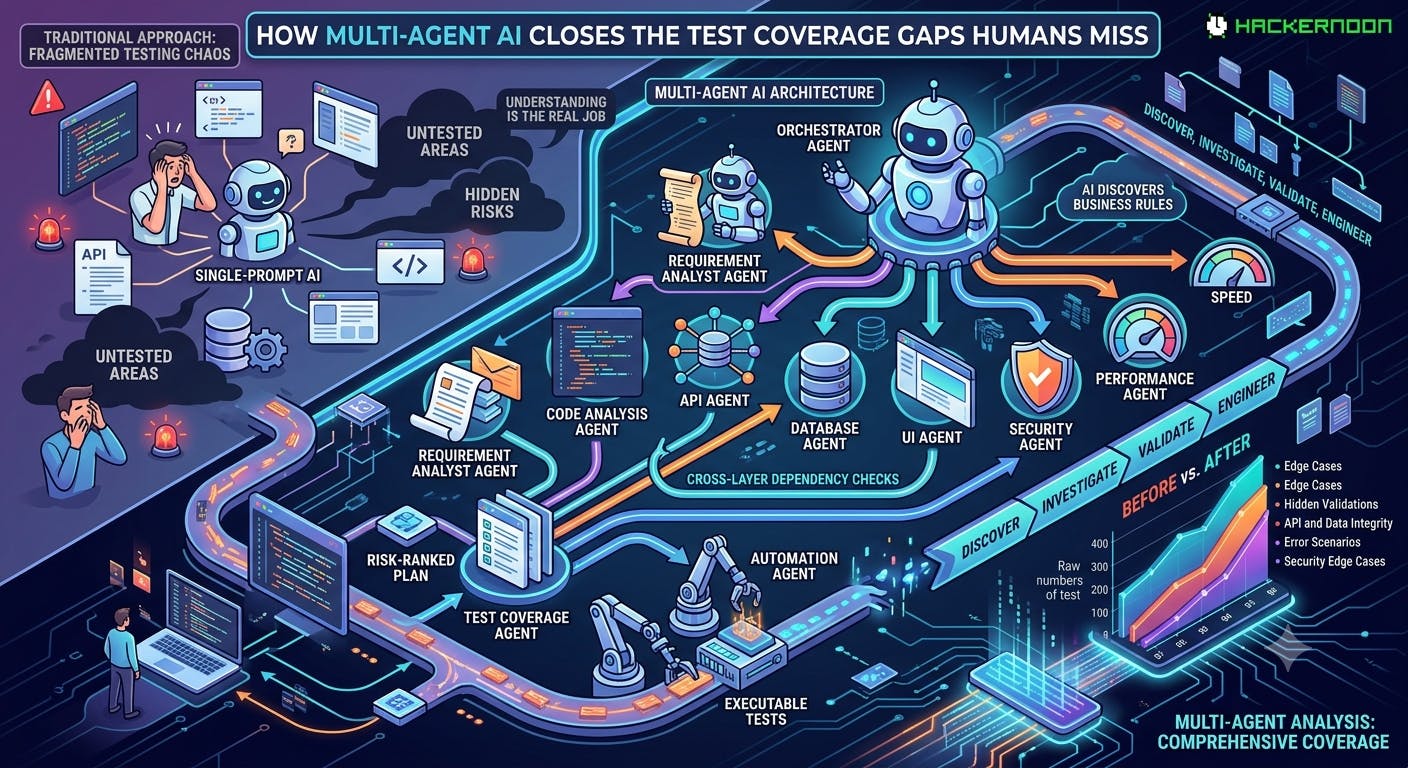
How Multi-Agent AI Closes the Test Coverage Gaps Humans Miss Enterprise applications rarely have their business rules in one place. They're scattered across source code, API contracts, database schemas, configuration files, UI components, and — often — nowhere written down at all, just implied by a validation check someone added three years ago. Traditional test design, whether done by a human or a single AI prompt, only ever surfaces the rules someone remembered to look for. Everything else becomes a coverage gap that shows up in production instead of in CI. The fix isn't "generate more test cases." It's changing what the AI is actually doing before it writes a single test: understanding the application first, the way a senior test architect would, then letting test design fall out of that understanding. This piece lays out an architecture for doing that — a set of specialized AI agents, each responsible for one layer of the application, coordinated by an orchestrator, so that coverage tracks what the system actually does rather than what someone guessed it does. Understanding the application is the real job It's tempting to frame this as "AI generates test cases," but that undersells what's actually valuable and sets the wrong expectation. Test generation is the last step, not the point. The point is: AI understands the application. AI discovers business rules that were never documented. AI identifies dependencies between a UI flow, the API it calls, and the database constraint that quietly rejects half the inputs the UI thinks are valid. AI finds hidden risks — an exception path with no test, a validation rule that only triggers on a specific combination of fields. AI recommends where coverage is weakest, ranked by risk, not by file count. Test cases are the output of that understanding, not a substitute for it. A pipeline that skips straight to "write tests" without doing this analysis first will generate plausible-looking tests that miss exactly the things a real test architect would have caught the undocumented business rule, the cross-layer dependency, the edge case nobody wrote down anywhere. Thinking like a test architect A test architect doesn't start at the code. They start at intent and work down through every layer the system touches: The analysis pipeline: each layer narrows the gap between intent and implementation before a single test is written. Each layer answers a different question. Requirements and business rules establish intent — what is this system supposed to do, and what constraints govern it. Source code, API contracts, and database schema establish reality — what does the system actually do, and where does implementation quietly diverge from intent? UI flows and logs establish behavior in the wild — what do real usage patterns look like, and what's actually failing? Existing automation tells you what's already covered, so you're not duplicating effort. Risk analysis synthesizes all of it into a ranked list of what's most likely to break and most costly if it does. Only then does a test coverage report and the tests behind it get produced. Single-prompt approaches tend to collapse this whole pipeline into one step, which is exactly why they miss things a layered analysis wouldn't. The architecture: specialized agents, one orchestrator This is the actual differentiator over any single-agent approach: instead of one model trying to hold requirements, code, APIs, databases, UI, security, and performance in its head at once, each layer gets its own agent, and an Orchestrator Agent combines their findings into one coherent risk and coverage picture. Requirement Analyst Agent reads specs, tickets, and user stories, and extracts the business rules and acceptance criteria that should exist, whether or not they're written down anywhere formally. Code Analysis Agent reads the diff since the last known-good state, lint output, and typecheck errors, and flags what changed and what the toolchain is already telling you is wrong. This is the grounding layer: it anchors the whole pipeline in real signal instead of guesses. API Agent analyzes contracts (OpenAPI specs, GraphQL schemas, or inferred request/response shapes) for breaking changes, undocumented parameters, and inconsistent error handling across endpoints. Database Agent inspects schema, constraints, and migrations for integrity rules that the application layer doesn't redundantly enforce the classic gap where the UI "validates" something the database was actually the one enforcing. UI Agent walks the actual UI flows using a built-in browser, capturing screenshots and behavioral markers rather than relying on brittle, hand-maintained selectors. Security Agent checks auth boundaries, input handling, and injection-prone paths surfaced by the other agents' findings. Performance Agent flags changes likely to affect latency or load behavior, based on what the Code and Database agents found. Test Coverage Agent takes every upstream agent's findings and synthesizes them into a single, risk-ranked coverage plan: what's covered, what's missing, what's duplicated. Automation Agent turns the coverage plan into executable tests, runs them (browser or API capture), attaches evidence (screenshots, logs, request/response pairs, behavioral markers — not just a pass/fail boolean), and hands off failures to whatever coding agent the engineer already uses, whether that's Claude Code, Cursor, or Codex. Orchestrator Agent sequences all of the above, resolves conflicting findings (e.g., the API Agent and Database Agent disagreeing about where a validation rule actually lives), and prevents any single agent's blind spot from silently becoming the final answer. This decomposition matters for a concrete reason: a single agent doing all of this has no clean checkpoint. A wrong assumption in step one — misreading what a function does, missing a business rule—silently corrupts everything downstream with nothing to catch it. Specialized agents with narrow, verifiable outputs give the Orchestrator something concrete to cross-check. What the prompts actually look like Vague instructions produce vague analysis. The difference between "analyze this code" and a properly scoped prompt is the difference between a generic smoke test and a test that catches a real bug. A few examples, one per agent type: Requirement Analyst Agent: "Extract every business rule implied by this specification, including constraints that are only stated as examples rather than explicit rules. Flag any acceptance criteria that are ambiguous enough to be implemented two different ways." Code Analysis Agent: "Identify every business rule implemented in this service. Highlight validation logic, hidden assumptions, exception paths, and potential negative test scenarios." Database Agent: "List every constraint enforced at the database layer that has no corresponding validation in the application layer. Flag any that would fail silently if bypassed." Security Agent: "For each endpoint touched by this diff, identify input paths that reach a database query or shell command without explicit sanitization, and rank them by exploitability." The pattern in each of these: scope to something specific and checkable, and explicitly ask for what's hidden or assumed, not just what's obviously visible. Before vs. after These numbers are illustrative, not a benchmark from a specific production run — but they reflect the kind of shift teams report when moving from manually authored suites to a layered, multi-agent analysis: Test cases ~120 ~180 Coverage 78% Materially higher, weighted toward risk rather than file count Edge cases Frequently missed Surfaced explicitly by the Risk Analysis stage Hidden validations Ignored (nobody knew they existed) Discovered via cross-layer analysis (API ↔ Database ↔ UI) API dependency checks Rarely covered Explicit contract validation Data integrity checks Ad hoc Directly derived from schema and constraints Error handling scenarios Sparse Derived from exception paths found in code analysis Security edge cases Usually a separate audit, if done at all Integrated into the same pipeline The more interesting shift isn't the raw test count — it's the mix. More of the added coverage comes from business-rule and cross-layer dependency findings than from mechanically increasing the number of assertions per function. Where AI still needs a human This is the part worth being honest about, because it's what makes the rest of this credible rather than a sales pitch. AI can miss domain knowledge that was never written down anywhere, the agents could reach a rule that exists only in a senior engineer's head. It can hallucinate business rules that sound plausible but aren't real, especially when requirements are ambiguous or contradictory. It can misinterpret legacy code, particularly when naming is misleading, or the code was written to work around a constraint that no longer exists. It needs human validation before any of this ships. The Orchestrator Agent reduces the rate of bad findings; it doesn't eliminate the need for a reviewer. And the whole pipeline depends on prompt quality — vague or overly broad prompts at any layer degrade that layer's findings, and degraded findings propagate downstream. Treat this as a quality engineering assistant that dramatically cuts the time to find real risk — not a replacement for someone who understands the domain signing off before it merges. Illustrative metrics worth tracking If you're evaluating whether this kind of pipeline is working for your team, track: time spent understanding the application before any test is written, test design effort reduced (hours saved per sprint), duplicate tests removed once the Test Coverage Agent has visibility into what already exists, additional scenarios discovered that weren't in the original suite, requirement coverage improved (percentage of documented acceptance criteria actually under test), and risk coverage increased (percentage of high-risk findings from the Orchestrator that now have a corresponding test). Even rough, self-reported numbers on these six give you a much better signal than raw test count. The DIVE framework A memorable way to apply all of this, independent of any specific tooling: D — Discover the application: requirements, code, APIs, database, UI, all treated as one connected system rather than separate testing efforts. I — Investigate dependencies and business rules: the cross-layer connections that a single-file or single-endpoint view never surfaces. V — Validate risks, edge cases, and current coverage: rank findings, and check what's already tested before generating more. E — Engineer comprehensive test scenarios and automation assets: only now does test generation happen, grounded in everything the previous three stages found. DIVE maps directly onto the agent architecture above — Discover and Investigate correspond to the Requirement, Code, API, Database, and UI agents; Validate corresponds to the Security, Performance, and Test Coverage agents plus the Orchestrator; Engineer corresponds to the Automation Agent. The framework is the part worth remembering even if the specific agent names change. Practical takeaways Start with requirement analysis before generating a single test — coverage built on top of a skipped discovery phase inherits all of that phase's blind spots. Use specialized agents instead of one broad prompt; narrow, checkable responsibilities are what let you catch a bad finding before it propagates. Validate AI output with human domain expertise — treat every AI-surfaced "business rule" as a hypothesis until a human confirms it. Treat AI as a quality engineering assistant, not a replacement for judgment about what should ship. And continuously refine prompts and feedback loops — the quality of every layer's output is bounded by how precisely that layer was asked. Where this is heading The broader testing industry is converging on this same shape in 2026 — specialized agents per layer rather than one model doing everything, tighter integration with what CI already knows, and analysis that starts from application understanding rather than jumping straight to test generation. The specific agent breakdown above is one way to build it; the underlying principle is the durable part: test coverage should be a function of what your system actually does and actually risks — not a snapshot of what someone guessed it might do.
How Multi-Agent AI Closes the Test Coverage Gaps Humans Miss
Full Article
Original Source
Read the full article at Hackernoon →KhanList aggregates and links to publicly available news content. We do not host full articles from third-party sources. Always verify important information with original sources.