
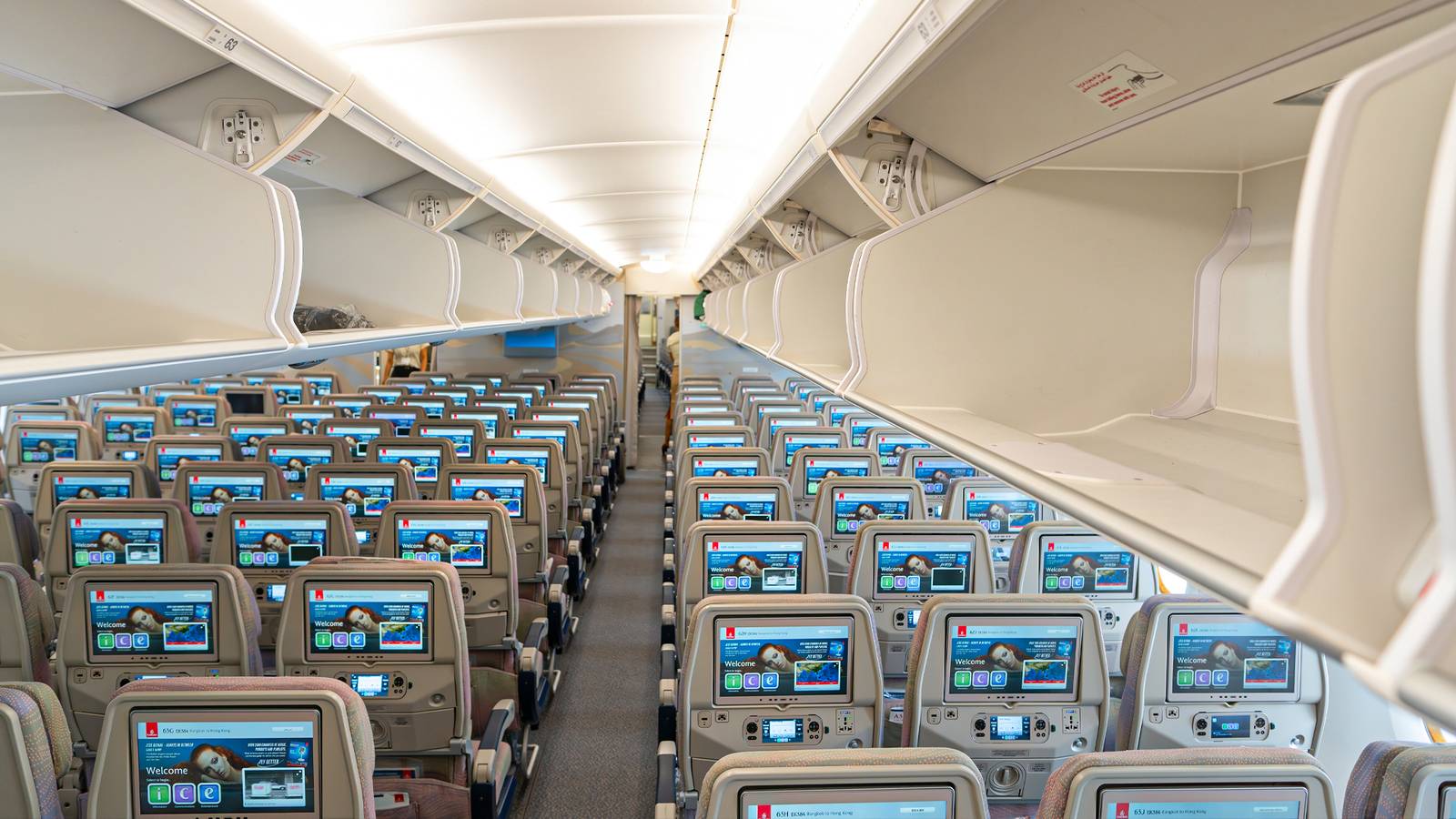
Published Nov 22, 2026, 6:01 PM EST Aaron is an aviation enthusiast and world traveler with a deep interest in aerospace history and technology. He has traveled around the world numerous times, often incorporating visits to aviation museums and historic aircraft collections into his journeys. A native of New Zealand, he is an expert in aviation and maintains a broad interest in a variety of other subjects. The discussion of how narrow economy-class seats are when fitted 10-abreast vs. nine-abreast is largely restricted to the Boeing 777 and Airbus A350. These two aircraft cabins are sized so that they are variously configured nine-abreast or 10-abreast. The massive A380 was wide enough so that it was only fitted with 10-abreast economy seating. Nine-abreast was unnecessary for the Superjumbo, even for premium-heavy mainline carriers, while regulations preclude any consideration of 11-abreast configuration. The A330 (including A330neo) and Boeing 787 airliners are typically nine-abreast aircraft, although some earlier mainline Boeing 787s were configured eight-abreast in economy. Today, Japan Airlines remains the only airline to configure its flagship Dreamliners eight-abreast. The A330 and 787 are not realistically wide enough for a 10-abreast configuration. Both 777 & A350 Designed For Nine-Abreast Seating Credit: igedeekapp | Shutterstock Both the Boeing 777 and the Airbus A350 were originally designed for nine-abreast seating. The Boeing 777 was developed as a luxury long-haul aircraft that would offer relatively generous seat width with a 3-3-3 layout. This made it one of the more comfortable high-capacity widebodies. The original 777s came with an internal cabin width of around 19 feet, 3 inches (5.87 meters). They were all configured nine-abreast. Later, Boeing 777-200LRs and -300ERs widened this to 19 feet, 3 inches (5.86 meters). The A350 followed almost two decades after the 777 originally entered service and followed a similar philosophy. But while it was called the 'Xtra Wide Body' (XWB), Airbus trimmed its width relative to the Triple Seven. Its width was considered spacious enough for a comfortable nine-seat economy configuration. These Airbus A350s were built with an internal cabin width of 18 feet, 5 inches (5.60 meters). The old-production standard A350s were wider than the early Boeing 777s, but they also came at a later time when pressures for denser seating had increased. All these aircraft were physically and legally capable of fitting ten abreast (3-4-3), but airlines chose not to. Low-Cost Carriers Operating Bespoke A350s Credit: mxttrooke l Shutterstock As a rule of thumb, low-cost airlines concentrate on regional travel with the Boeing 737 and Airbus A320 families. Long-haul international routes have been the domain of mainline carriers. Low-cost carriers work in a market segment that pushes for denser seating to reduce the cost per seat. Meanwhile, mainline carriers put more emphasis on premium seating and their premium brands. However, some low-cost carriers have moved into the long-haul leisure route market segment. The two sister low-cost, long-haul, leisure airlines, Air Caraïbes and French Bee, have both purchased fleets of A350s. These are original production A350s, and both use the 3-4-3 (10-abreast) economy seating layout. This allows Frenchbee to achieve the A350-1000's maximum certified seat count of 480 (40 premium and 440 economy). Air Caraïbes also has the same configuration on some of its A350-1000s. Aircraft Internal Cabin Width Seat Width 9-abreast 777-200LR/-300ER 19 feet, 3 inches (5.86 meters) 18.5 inches (47 cm) 10-abreast 777-200LR/-300ER 19 feet, 3 inches (5.86 meters) 17 inches (43 cm) 9-abreast 777-9 (777X) 19 feet, 7 inches (5.97 meters) Not standardized (approx. 18+ inches) 10-abreast 777-9 (777X) 19 feet, 7 inches (5.97 meters) 17.6–18 inches (44-46 cm) 9-abreast original A350 18 feet, 5 inches (5.60 meters) 18 inches (46 cm) 10-abreast original A350 18 feet, 5 inches (5.60 meters) 16–16.7 inches (40.6-42 cm) 9-abreast A350 NPS 18 feet, 9 inches (5.72 meters) 18.7 inches (47.5 cm) 10-abreast A350 NPS 18 feet, 9 inches (5.72 meters) 17 inches (43 cm) The result is rather squishy. The published seat width for these economy seats is around 16 inches (41 cm). For reference, the industry average across the airline industry for economy class seats is 17 to 18 inches (about 43–46 cm). These two low-cost airlines are the only ones to have configured their old production A350s in this way. They can because their marketing is not so much concerned with onboard comfort; it's about getting passengers to far-flung leisure destinations as cheaply as possible. Just endure the flight. Boeing 777-200LR & 777-300ER Trend To 10-Abreast Credit: AV8 Photos I Shutterstock Historically, airlines configured their Boeing 777-200LRs and 777-300ERs nine-abreast (3-3-3), giving economy class passengers 18–18.5 inches (46–47 cm) in seat width. At the same time, market forces increasingly favored a high-density economy-class cabin. This generation of 777 was around four inches (nine cm) wider than the older aircraft. Today, most of the world's 777-300ERs have been fitted or retrofitted to seat 10-abreast, cutting the seat width to approximately 17 inches (43 cm). Some carriers have resisted the trend, notably Japan Airlines, ANA, Korean Air, and Singapore Airlines. But most, including premium-branded airlines like Qatar and Emirates, are now 10-abreast. But even with the nine-abreast hold-outs, it has sometimes not been for the want of trying. In September 2025, Korea's JoongAng reported, "Korean Air is reconsidering its plan to change the seating layout in economy class from a “3-3-3” to a tighter “3-4-3” arrangement after a mounting backlash from consumers." Korean Air has not yet published a final seat map or official cabin configuration for its ordered Boeing 777-9 aircraft, but it would be surprising if it retains the nine-abreast configuration. The Wider Boeing 777-9 (777X) Credit: Ian Dewar Photography l Shutterstock At 19 feet, 7 inches (5.97 meters), the 777-300ER was already wide enough for most mainline carriers to configure economy class 10-abreast. The incoming Boeing 777-9 and 777-8 (777X) come with thinner walls, allowing them to have a cabin width of 19 feet, 7 inches (5.97 meters). Boeing actively trolls Airbus and its A350, saying on its 777X product page, "Up to 40 cm (16 inches) wider than the A350." The extra width will give the remaining holdout airlines more freedom to opt for the denser layout. In November 2026, Singapore Airlines announced its new 777-9 cabin with 17.6 inches (44.7 cm) for economy seats in a 3-4-3 configuration. The 777-9's cabin is wider and longer than the 777-300ER, but this will not necessarily increase the aircraft's density, as the vast majority of 777-300ERs are already 10-abreast. Ironically, the opposite is almost true because other market forces are pushing for more premium seating. The Boeing 777-300ER is certified to carry up to 550 passengers in an ultra-high density layout. The 777-9 has more cabin space to fit even more seats, but Boeing is limiting its maximum exit-limit seat count by 75 seats (to 475) or by 110 seats (to 440), depending on the door configuration. Put another way, the 777-9 is envisioned to have more business and premium economy seats, while the already standard 10-abreast economy will benefit from a few more inches of lateral space. The economy class cabin is expected to shrink. New Production A350s Offer More Wiggle Room Credit: MJX Studio l Shutterstock As stated, the old production A350s have an internal cabin width of approximately 18 feet, 5 inches (5.60 meters). Without introducing a new variant or generation, Airbus introduced a new production standard that increases the usable cabin length and thins the aircraft walls. This allows the new-production standard cabin width to be 18 feet, 9 inches (5.72 meters). The first new-production standard A350s were delivered in 2022. For airlines retaining the nine-abreast seating, it allows the typical economy seat width to grow from approximately 18 inches (46 cm) up to 18.7 inches (47.5 cm). That will be welcome to passengers. However, it also made 10-abreast seating more feasible. These new aircraft with 10-abreast seating can accommodate 17-inch (43 cm) seats, bringing it closer to the conventional industry standard for economy seating. To date, Philippine Airlines appears to be the only mainline carrier to opt for 10-abreast economy on new production standard A350s. It is able to offer up to an inch more in seat width than French bee, but also has to trim more than an inch relative to airlines operating the A350 in nine-abreast. With the airline industry being a game measured in a couple of marginal inches and pressure for dense economy seating, it's possible more carriers will follow suit. Wider Seats On NPS A350 Than 777X In Practice Credit: Falcons Spotters l Shutterstock The Boeing 777 was originally designed as a nine-abreast airliner, but it has since grown by eight inches (17 cm) in cabin width over its life. This has allowed it to transition to a 10-abreast airliner without having to sacrifice much of its original spaciousness. The original economy class seats were around 18–18.5 inches (46–47 cm), and the next generation is expected to be around 18 inches (46 cm). This may not be an improvement for economy class passengers, but it is not catastrophic either. The A350 echoes the 777's path, while also being much more constrained. The A350 can be and is configured 10-abreast, but this reduces the seat width to 16–17 inches (41-43 cm). But there is also some degree of an apples-to-oranges comparison here. For economy passengers, the 777-9 doesn't normally have the advantage. They will be configured 10-abreast, while the A350 is almost always nine-abreast. The new-production-standard nine-abreast A350 has a meaningful advantage of approximately 1.1 inches (2.8 cm), or 6.25% more seat width per economy passenger compared with a 10-abreast 777-9. This A350's nine-abreast vs. the 777X's 10-abreast comparison is important as it's a better representation of the actual industry standard. It's also worth noting that the A350 is more versatile than the 777X in terms of its missions and airlines. Only a relatively limited number of mainline carriers are purchasing the 777X, while a larger range of airlines, including low-cost airlines, are purchasing (often smaller) A350 fleets.
How Much Narrower Economy Seats Get When Airlines Fly 10-Abreast Cabins
Full Article
Original Source
Read the full article at Simpleflying →KhanList aggregates and links to publicly available news content. We do not host full articles from third-party sources. Always verify important information with original sources.