
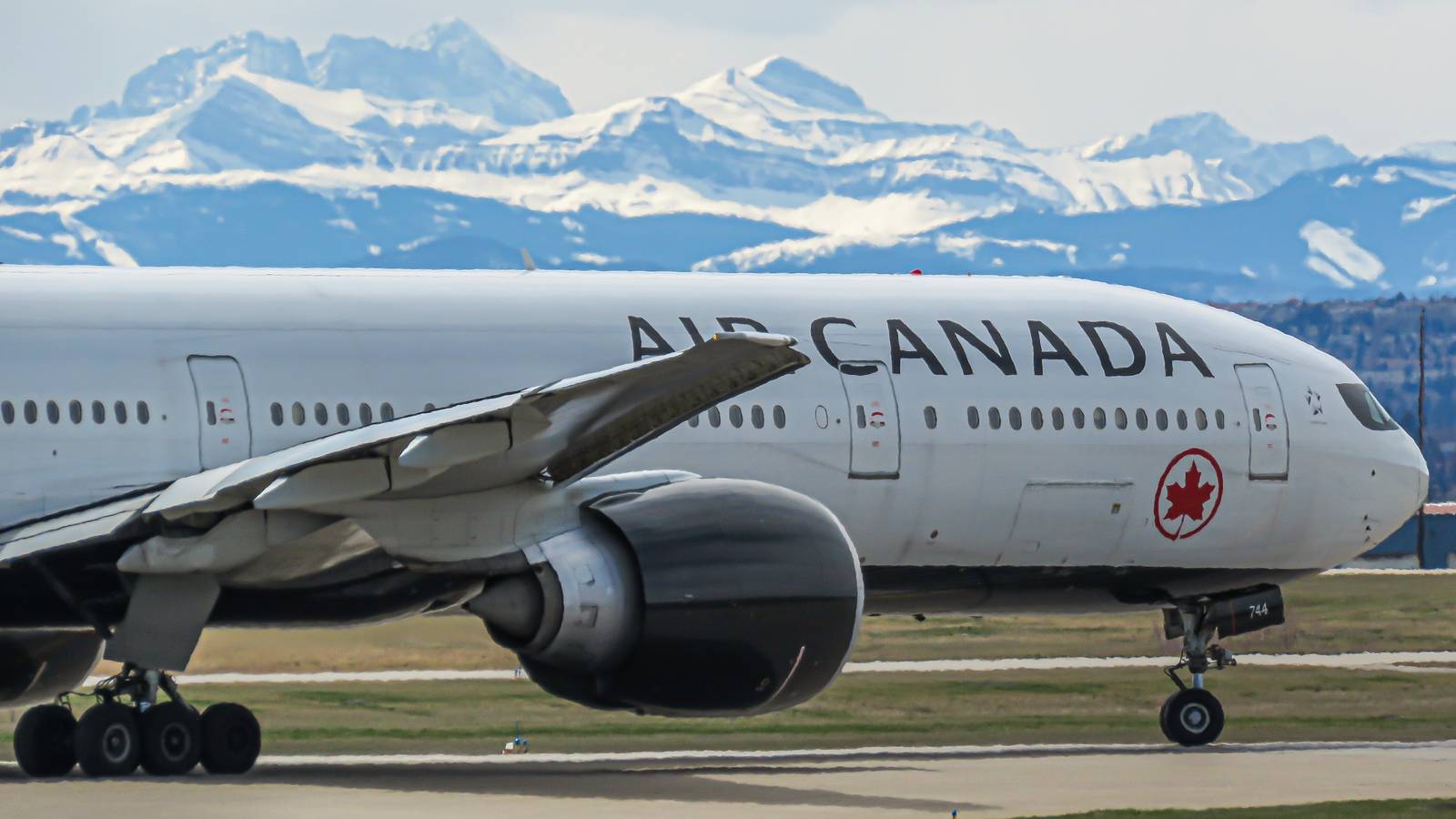
Credit: Jenari | Shutterstock, Simple Flying Published Nov 22, 2026, 5:00 PM EST Jack comes to Simple Flying with a lifelong interest in all things aviation. He holds a degree in Aerospace Engineering from Georgia Tech, and is a certified private and remote pilot. Beyond these experiences, Jack previously worked for a corporate flight department where he gained first-hand experience in the world of business aviation. Currently, Jack works in the professional services industry and continues to build his flight hours outside of work. Sign in to your Simple Flying account Air Canada closed the third quarter of 2026 with record operating revenue of $6.984 billion, up 21% from the same period last year. The figure invites an easy narrative that the airline’s new Basic fares in business class and premium economy, introduced in late July, fueled the gain, but the evidence published so far does not support that conclusion. A more useful question for travelers is what a Basic business ticket actually removes, and whether Air Canada’s version requires fewer sacrifices than those of Delta Air Lines and JetBlue, both of which have built similar premium tiers. Answering it requires looking first at what the quarterly results do and do not say, then at the fare rules themselves, and finally at how competing airlines have drawn the line between the seat and everything around it. A Record Top Line With A Thinner Bottom Line Credit: Markus Mainka | Shutterstock Passenger revenue reached roughly $6.3 billion, driven by yield up 11%, passenger load factor rising 2.6 percentage points to 89.1%, and cargo revenue growing 33%. Unit revenue climbed 14% on both a total and a passenger basis, a gain that arrived on top of capacity growth of 5.7%. Those figures describe an airline filling more seats at higher prices, a pattern consistent with a record quarter. All figures were reported by the airline. Profitability told a different story, as fuel expense rose by $906 million while the price per liter climbed from 88.3 cents to 148.3 cents, and operating income slipped to $261 million from $284 million, compressing the operating margin to 3.7% from 4.9%. Adjusted EBITDA of $936 million landed slightly below last year’s $961 million, with the margin falling to 13.4% from 16.6%, while net income attributable to shareholders dropped to $139 million from $264 million and free cash flow turned negative by $440 million. Metric Updated Full-Year 2026 Guidance Prior Full-Year 2026 Guidance (Provided on August 11, 2026) Adjusted EBITDA $2.4 billion to $2.7 billion $2.9 billion to $3.2 billion ASM capacity Approx. 2.75% increase from 2025 2.25% to 3.25% increase from 2025 Adjusted CASM 5.5-6% increase from 2025 5-6% increase from 2025 Free cash flow Break-even ± $150 million $200 million to $500 million Management responded by lowering its full-year adjusted EBITDA guidance to $2.4 billion to $2.7 billion, down from $2.9 billion to $3.2 billion, and attributed the change chiefly to higher expected fuel prices. The chief financial officer credited decisive pricing, capacity, and cost actions with softening the fuel impact, a phrase that describes recovering cost pressure rather than capturing premium leisure demand. Balance sheet actions continued alongside the operating results, as Air Canada used Aeroplan transaction proceeds to repay $1.7 billion of debt and completed an $800 million issuer bid that reduced shares outstanding by about 10%. What The Premium Cabins Actually Contributed Executives reported that premium cabin revenue rose 19% and corporate revenue 22%, with North American markets posting the strongest unit revenue gains because shorter booking windows let the airline pass higher fuel costs into fares more quickly. Premium travel was already central to the airline’s economics, accounting for about 30% of passenger revenue in its 2025 results despite occupying far fewer seats than economy. The trend also predates the Basic launch, since premium revenue grew 11% in the second quarter, when no premium Basic fares existed. Chief Commercial Officer Mark Galardo pointed to a behavioral shift, saying that premium customers, whether traveling for leisure or business, have been flying more in spring and autumn than during the summer peak. He described the quarter as a story of premium rather than budget passengers, and he predicted record September and October revenue. Galardo added that the shift began two or three years ago, has accelerated, and is now appearing slightly in November. On the new fares, Galardo said in mid-August that it was far too early to judge reception because they had been on sale for barely more than a week, and he described United Airlines' early results with its own premium Basic fares as interesting. Because Air Canada’s Basic fares were on sale for only about the last nine weeks of a 13-week quarter, and because fuel-driven fare increases and shifting travel patterns were operating simultaneously, the sources reviewed provide no basis for crediting unbundling with the revenue gain. What Air Canada’s Basic Business Fare Takes Away Credit: Air Canada | Simple Flying Business Class Basic is sold on flights within Canada, to the United States, and to and from Central and South America, and it is not offered on long-haul itineraries such as Montreal to New Delhi. Tickets are non-refundable and carry no future travel credit, while changes up to two hours before departure cost $200 within Canada or to the US and $700 on international flights, in Canadian dollars. Same-day airport changes and standby are not permitted, advance seat selection carries a fee, and the checked allowance falls from two bags to one on Canada and US routes. Carry-on allowances remain at one personal article and one standard article across Basic, Standard, and Latitude. Despite the cuts, the fare remains more than critics might expect, since passengers retain Maple Leaf Lounge access, priority check-in and baggage handling, and the same earning rate of one Aeroplan point and four Status Qualifying Credits per dollar. Premium Economy Basic is stricter because it drops lounge access, keeps the same flexibility limits, and, according to AwardWallet, excludes eUpgrade certificates. The business class table lists no eUpgrade row, which makes sense because no cabin sits above it, so the restriction mainly affects travelers who would otherwise apply certificates to a Premium Economy ticket. The savings are modest; on Toronto to Mexico City, AwardWallet found Basic at $1,022, Standard at $1,093, and Latitude at $1,256, leaving only a $71 gap between Basic and Standard, a spread that AwardWallet interprets as a nudge toward the pricier option. How Delta’s Basic Business Compares Credit: Delta Air Lines Delta began selling Basic Business on July 8 for travel starting in September, and the fare preserves the lie-flat seat, Zone 1 boarding, and the standard Delta One meal while removing most of the ground experience. Seats are assigned after check-in, the checked allowance shrinks by one bag, and the ticket earns 2 SkyMiles per dollar instead of 5, although it still counts toward Medallion status. Delta also bars upgrades of every kind, paid ones included, and rules out same-day confirmed changes and standby. Delta First Basic has been flying since July in select domestic and Latin American markets, while Premium Select Basic follows alongside Basic Business in September. Lounges mark the sharpest contrast, since Basic Business passengers keep Delta One check-in and the Delta One Lounge only through January 18, 2027, after which the privileges lapse unless obtained through a Sky Club membership or an eligible American Express card. Fees also differ, as AwardWallet reports that Delta raised the change and cancellation charge for Basic Business to $500 from $99 on travel originating in the United States and Canada, with cancellations yielding an eCredit toward a future ticket. Measured against those terms, Air Canada’s version asks for less on several frontsbecause it retains lounge access, preserves full Aeroplan earnings, and charges $200 for changes within Canada or to the US, versus Delta’s $500. Its $700 international change fee, roughly US$496, is comparable to Delta’s, and its lack of any refund or credit is harsher than Delta’s eCredit. Air Canada also confines Basic to shorter routes, whereas Delta extends its premium Basic fares to select long-haul international markets. JetBlue Takes A Narrower Route Credit: Wirestock Creators | Shutterstock JetBlue Airways sorts travelers first by onboard experience, choosing among Main, EvenMore, BlueFirst, and Mint, and then by up to three fare options named Base, Standard, and Flex that differ in seat selection and refundability. Base fares omit seat selection and return travel credit on cancellation, less any fee, and they are branded for Main, EvenMore, and BlueFirst. President Marty St. George framed the structure as two clicks: the onboard experience first and the fare second, according to the release. The release states that Base fares are not available in Mint, so the lie-flat product keeps only its Standard and Flex tiers, and a Mint Base fare does not appear in JetBlue’s own description. BlueFirst, the domestic first-class product that begins rolling out later this year, is listed with a Base option, although JetBlue says fuller fare details will follow. United, which introduced unbundled premium fares in April 2026, and Lufthansa already sell comparable products, and Air Canada’s tiers resemble those of its partners. The Fourth Quarter Will Be The First Real Test Credit: Peter Bueno | Shutterstock The fourth-quarter report in early 2027 will be the first to cover a full quarter with Basic fares on sale, which should give analysts a cleaner view than the partial exposure in the third quarter. The reading will be clouded because Air Canada has said it is not yet providing 2027 guidance and has trimmed planned first-quarter 2027 capacity by two points; fuel prices remain the key variable in its outlook, and a new chief executive, Anko van der Werff, is due to arrive by the end of January 2027. Within that noise, the most informative signal may be how many buyers choose Standard when the gap is as small as $71, a figure airlines rarely disclose that would show whether Basic is expanding the premium audience or repricing existing buyers. Delta’s lounge cutoff on January 19, will supply a parallel test of how travelers react to losing ground perks, and Air Canada, having kept its lounge access, can treat that contrast as either a selling point or a cushion for tightening its terms later. Because the incoming chief executive will inherit both the fare structure and the missing 2027 outlook, his first budget cycle may decide whether Basic remains a modest entry point or grows into the fare most travelers see first in search results.
Air Canada Posted A Record $6.984 Billion Quarter While Its Basic Business Class Strips Out Flexibility & eUpgrades
Full Article
Original Source
Read the full article at Simpleflying →KhanList aggregates and links to publicly available news content. We do not host full articles from third-party sources. Always verify important information with original sources.