
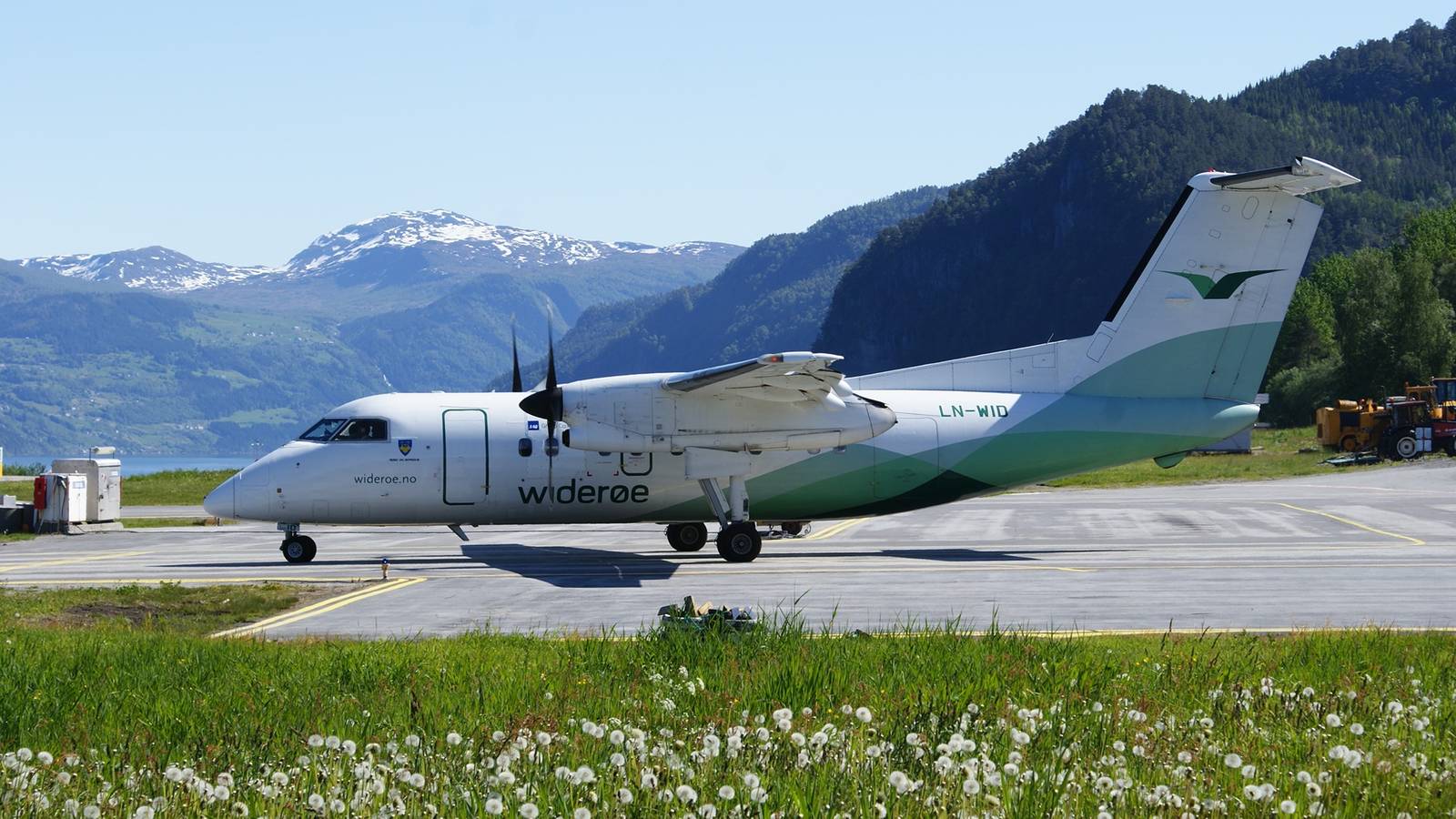
Published Nov 2, 2026, 5:00 PM EST Brandon's passion for aviation started at a young age. He became involved in the flight simulator and VATSIM communities, which sparked his interest in aviation and eventually led him to earn his private pilot license. Outside of work, he continues to build flight hours, explore new airports, and stay involved in the aviation community. On Wednesday, October 21, a Widerøe Bombardier Dash 8-100 registered LN-WIE flew 17 sectors between eight airports in Arctic Norway. It left Tromsø (TOS) at 04:12 UTC and finished at Lakselv (LKL) at 21:28, spending 8 hours and 34 minutes airborne across an elapsed day of 17 hours and 16 minutes. The shortest flight, Båtsfjord (BJF) to Vadsø (VDS), lasted seven minutes. Five sectors ran under 20 minutes. The aircraft returned to Hammerfest (HFT) five separate times. None of it exists on commercial merit. These are public service obligation routes, tendered by the Norwegian government and operated under subsidy because no airline would fly them otherwise. Widerøe won all 13 PSO routes in the 2017 tender round, and the Dash 8-100 is the aircraft that makes the arrangement work at 39 seats on short Finnmark runways. Keeping those airframes flying has required De Havilland Canada to certify the type to 160,000 flight cycles, double its original design life and the highest of any commercial aircraft. Seventeen Sectors In Seventeen Hours Credit: Simple Flying On Wednesday, October 21, a Widerøe Dash 8-100 registered LN-WIE operated 17 flights across eight airports in Arctic Norway. The aircraft departed Tromsø Airport (TOS) at 04:12 UTC and arrived at Lakselv Airport (LKL) at 21:28, a span of 17 hours and 16 minutes. We followed the rotation on Simple Flying's Live Flight Tracker, the same approach we took when tracking a Ryanair Boeing 737 through a full day of European short-haul flying. The two days look nothing alike. LN-WIE spent 8 hours and 34 minutes airborne across its 17 flights, averaging just over 30 minutes per sector. The longest was Tromsø to Kirkenes (KKN) at 1 hour 7 minutes, the only flight of the day to exceed an hour. The shortest was Båtsfjord (BJF) to Vadsø (VDS) at seven minutes. Eleven of the 17 flights lasted 35 minutes or less, and the aircraft completed its first four sectors before 07:30 UTC. The route pattern is equally unusual. The aircraft arrived at Hammerfest (HFT) five separate times and at Tromsø four, working between those two points and a cluster of smaller airports across Finnmark, Norway's northernmost county. It also reached Alta (ALF), Vardø (VAW), Vadsø, Båtsfjord, Kirkenes and finally Lakselv, where it finished the day rather than returning to where it started. Four of the eight airports were visited more than once. This is not point-to-point flying in any conventional sense. It is one aircraft circling back repeatedly through the same handful of fields, which is a pattern dictated by something other than commercial route planning. The Seven-Minute Flight The third sector of the day was Båtsfjord to Vadsø. The aircraft departed at 06:09 UTC and arrived at 06:17. Seven minutes airborne, which is shorter than the taxi time at most major airports. It is the kind of sector that exists nowhere in a conventional airline network, and on this day it was not even unusual. Four other flights ran under 20 minutes. Vadsø to Båtsfjord in the opposite direction took 10 minutes that evening. Vardø to Vadsø took 11. Kirkenes to Vardø took 15. Hammerfest to Alta took 16. Five of the 17 sectors, nearly a third of the day's flying, lasted under 20 minutes, and together they accounted for 59 minutes of airborne time out of 514. Several were shorter than the turnaround that preceded them, inverting the usual relationship between time airborne and time on the ground. These sectors are the reason the network exists in this form. The Bombardier Dash 8-100 is the backbone of Widerøe's public service obligation operation in Norway, particularly in the north. The routes connecting Vardø, Vadsø, Båtsfjord and the other Finnmark fields are subsidized by the Norwegian Ministry of Transport and Communications precisely because the distances involved and the populations served do not support commercial air service. The evening sequence makes the logic plain: Kirkenes to Vardø to Vadsø to Båtsfjord, three consecutive sectors totaling 36 minutes airborne, strung together to connect four communities in a single rotation. A seven-minute flight is not an inefficiency in the schedule. It is what the government contracted for. The Aircraft Spent More Time Parked Than Flying Credit: Widerøe Across the full rotation, LN-WIE accumulated 8 hours and 34 minutes airborne against an elapsed day of 17 hours and 16 minutes. That leaves 8 hours and 42 minutes between sectors, marginally more time on the ground than in the air. For an aircraft operating 17 flights in a day, the arithmetic is counterintuitive until sector length is taken into account. When half the flights last under 35 minutes, turnaround time becomes the dominant constraint on how many sectors fit into a day. The turnarounds were quick. The shortest was 18 minutes at Hammerfest, between arriving from Vadsø at 07:26 and departing for Tromsø at 07:44. Several others ran close: 20 minutes at Hammerfest later that morning, 20 minutes at Båtsfjord in the evening, and 22 minutes at Hammerfest, Alta and Vardø. Across the 16 turnarounds, nine were 30 minutes or less, and the median sat at roughly 23 minutes. The two long stops were both at Tromsø. The aircraft sat for 78 minutes between arriving from Alta at 11:19 and departing for Hammerfest at 12:37, then 62 minutes in the early afternoon before operating to Kirkenes. Those two pauses account for more than two and a half hours of the day's ground time on their own, meaning the remaining 14 turnarounds averaged under half an hour between them. Everywhere else, the pattern held: land, turn, depart. Hammerfest saw the aircraft five times and Tromsø four, with the rotation repeatedly returning to both rather than progressing along a line. The final turnaround of the day, 34 minutes at Tromsø, preceded the 40-minute positioning sector to Lakselv. Why Norway Pays For These Routes Credit: fivetonine | Shutterstock None of these flights exist on commercial merit. They operate under public service obligation contracts, under which the Norwegian Ministry of Transport and Communications subsidizes air service on routes that would not otherwise be flown. Widerøe has held those contracts across the regional network, winning all 13 PSO routes in the 2017 tender round after the government determined it wanted a single operator across all subsidized regional routes in the country. The Dash 8-100 is the aircraft that makes the arrangement work. Dom Sipinski described the type as the backbone of Widerøe's public service obligation operation, noting that Widerøe is not only the largest operator of the Dash 8-100 but the only one running the aircraft to the end of its service life. At 39 seats, the type matches what these communities generate in demand. Widerøe itself is the largest regional airline in Scandinavia, carrying approximately 2.8 million passengers annually across more than 40 domestic and international destinations, operating from a base at Bodø and now part of Norwegian Group. Widerøe's fleet structure shows how central the smallest type remains. AvioRadar lists 26 Dash 8-100 and -200 aircraft at 39 seats, three Dash 8-300s at 50 seats, 16 Dash 8-400s at 78 seats, and three Embraer E190-E2s at 110 seats. ch-aviation counts 19 Dash 8-100s specifically within a total fleet of 51. Either way, the smallest aircraft in the fleet carries the network that justifies the subsidy. AvioRadar noted that extending the structural life of the Dash 8-100 allows the airline to preserve a network tailored to Norway's geography without prematurely moving to larger aircraft that would undermine the economics of lower-demand routes. Oslo has since opened a new tender covering southern Norway's PSO routes. How A 39-Seat Turboprop Reaches 160,000 Cycles Credit: fivetonine | Shutterstock A flight cycle is one takeoff and one landing. On a day like the one LN-WIE flew, the aircraft accumulated 17 of them before midnight, which is where the Dash 8-100's structural problem begins. De Havilland Canada designed the type for 80,000 cycles. Several of Widerøe's aircraft are already well past that figure, because no other operator in the world works the type this hard. The Extended Service Program raised the certified limit to 120,000 cycles. Widerøe went past that too. In 2022, the airline became the launch customer for Extended Service Program PLUS, which lifts the limit to 160,000 flight cycles. De Havilland Canada states that this gives the Dash 8-100 the highest certified flight-cycle life of any commercial aircraft. Widerøe initially enrolled ten aircraft with options for ten more, and expanded the agreement in 2026 by adding four, bringing the total under ESP+ to 14 with options for six further airframes. It remains the only customer. Dom Sipinski observed that the gap to the second-most-intensive operator of the type is large enough that Widerøe will quite likely remain the only one. The airline also participates in De Havilland Component Solutions, the manufacturer's component support programme, and extended the intervals between A and C checks across its Dash 8-100, -200 and -300 fleets in 2021. Werner Skaue, Widerøe's Director of Aircraft Trading, framed the decision in operational terms: "The Dash 8-100 remains an important part of our regional network, and ESP+ provides us with a practical and cost-effective way to extend the life of these aircraft while maintaining the safety, reliability and performance on which our operations depend." The alternative is not a newer small turboprop, because none is in production at this size. Extending the airframes Widerøe already owns is the only route to keeping Finnmark's airports connected.
How Many Flights In One Day? We Tracked A Wideroe Dash 8 For 24 Hours
Full Article
Original Source
Read the full article at Simpleflying →KhanList aggregates and links to publicly available news content. We do not host full articles from third-party sources. Always verify important information with original sources.