
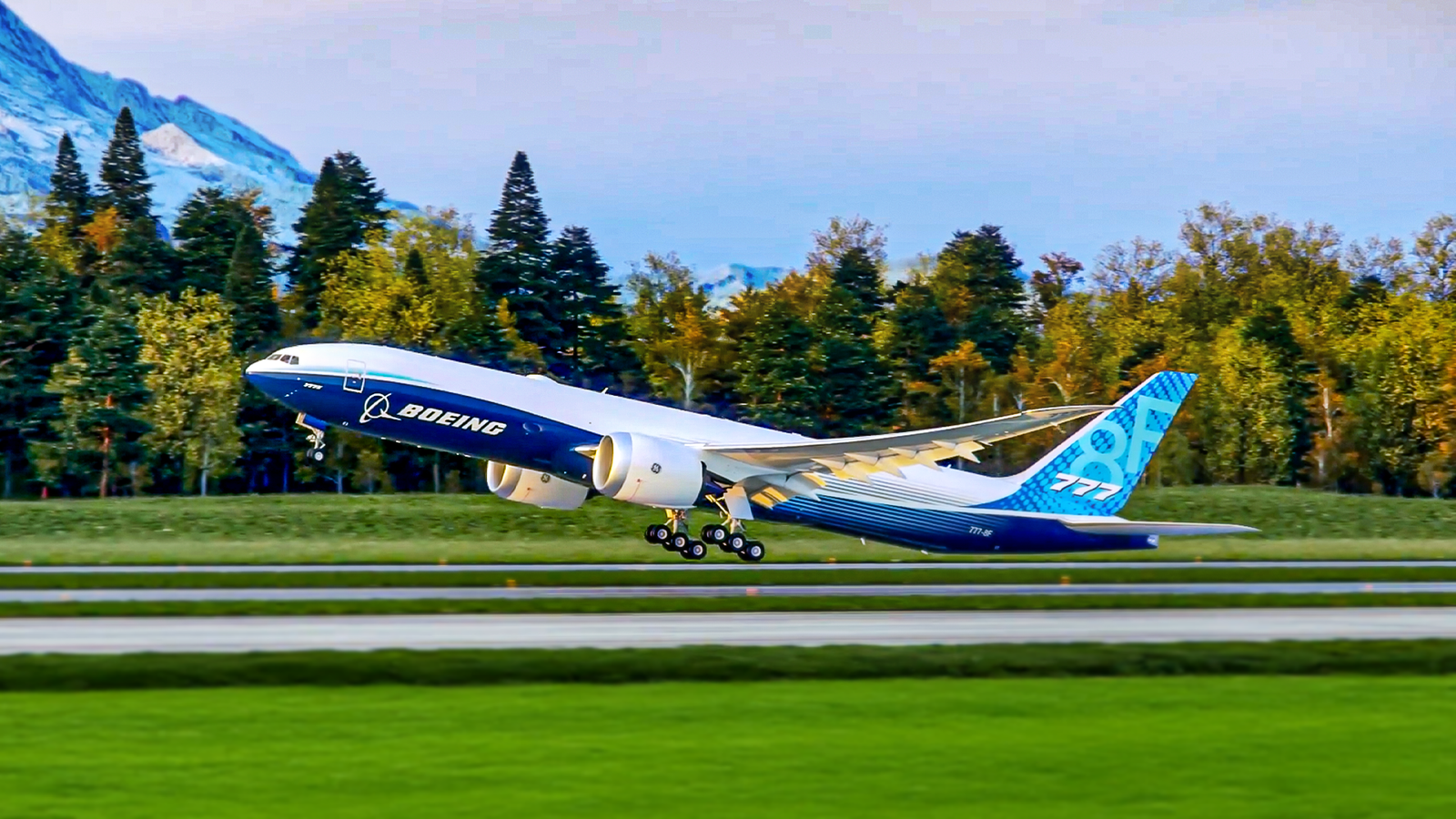
Published Nov 2, 2026, 6:00 PM EST Chris earned a Master’s degree in Defense and Strategic Studies (Highest Honors) from the University of Texas at El Paso. His graduate work concentrated on Global and National Security, Low-Intensity Conflict, Modern Warfare, and US grand strategy. He also undertook extensive regional studies, analyzing how key regions integrate into the broader US security architecture. This rigorous program provided him with a comprehensive understanding of U.S. military operations, global strategy, and weapons systems. Additionally, he gained a strong appreciation for great power competition.—an increasingly central force shaping international relations and conflict for the foreseeable future. While living in Ho Chi Minh City, Vietnam, the author had the great pleasure of having an eighth-floor apartment with an excellent view of the Tan Son Nhat International Airport (SGN), the country's largest and busiest airport. It was always amazing to watch the aircraft taxi, routinely queue up, and take off for their destinations. Aside from the ubiquitous passenger jets operating at Tan Son Nhat, cargo planes were also a regular sight. Two operators that the author would frequently see, were Cargolux Airlines International and Asiana Cargo (a subsidiary of Asiana Airlines). An interesting facet of watching these cargo carriers was that they operated Boeing 747s. Watching these massive, lumbering giants taxi and dwarf the other aircraft and ground vehicles was always amusing. While these enormous aircraft have been a mainstay of global logistics and commercial passenger travel for decades, their remarkable production run has come to a close. The final delivery of the 747 was made in 2023, ending roughly 50 years of production. These storied aircraft have increasingly been displaced by the twin-engine Boeing 777 Freighter, which offers greater fuel efficiency and range. The future looks bright for the latter, as Boeing predicts a massive surge in the global freighter fleet. The 747, A Longtime Staple of Global Air Freight, Will Fade Away Credit: Cargolux The 747 was initially intended to serve as a short-term bridge between conventional jet travel and the expected arrival of supersonic commercial flight. Pan American World Airways (Pan Am) operated the aircraft's first scheduled commercial passenger flight. Regarding this historic service, the Pan Am Museum notes that it took place on " . . .January 22, 1970, when it carried 335 passengers and 20 crew members from New York’s JFK Airport to London Heathrow (LHR)." Following its introduction into commercial service, Boeing states that more than 100 customers have purchased 1,574 aircraft, which have logged more than 118 million flight hours and nearly 23 million flight cycles. In the nearly six decades since production began, the 747 has seen numerous iterations. While best known as a passenger airliner, its design also incorporated features intended to accommodate oversized cargo. Speaking to this history, the Northwest Airlines History Center explains that a ". . .high fuselage and long body was the heart of Boeing’s heavy-lift- proposal to the U.S. Air Force in the 1960s - but Lockheed would win the competition with their C-5 Galaxy." To adapt the aircraft for commercial use, the " . . .rear ramp and high wing were traded for a conventional layout, but the option for nose loading was retained - pushing the cockpit above the main deck and creating the distinctive “hump” and upper-deck cabin." Given that Boeing incorporated cargo-handling considerations into the aircraft's design from the outset, it should come as little surprise that the first dedicated cargo variant, the 747-200F, was delivered to Lufthansa on March 9, 1972, marking the beginning of a new era in air cargo transportation. Air Cargo Week notes that the 200F could carry nearly three times the amount of cargo on a single flight as its predecessor, the Boeing 707 Freighter. The latter could accommodate roughly 74,957 lb (34,000 kg) of freight, compared with the 231,485 lb (104,999 kg) carried by the former. As a result, the 200F became considerably more profitable for cargo carriers over the long term, despite the higher fuel and capital costs associated with its operation. The final purpose-built freighter variant of the 747 family was the 747-8F. The 8F entered the market at a time when the jumbo jet was increasingly being phased out in favor of more economical twin-engine freighters, such as the 777F. Illustrating this industry shift, Air Cargo Week reported in March 2026 that Boeing had sold a total of 362, 777Fs following its entry into the market in 2009. This was more than triple the total sales of the 747-8F during its 16 years on the market (2005-2021), during which time 109 8Fs were sold. Less Is More, Twin-Engine Aircraft Are Defining The Future Of Airfreight At first glance, moving from an aircraft that can carry an enormous amount of freight to one with a comparatively lower payload might seem illogical. Yet, as seen above, this transition has been underway for more than 15 years. To highlight the difference in cargo-carrying capacity, Atlas Air lists the 747-400F's maximum revenue payload at 249,100 lb (112,900 kg), while Boeing lists the 777F's maximum payload at 235,895 lb (107,000 kg). Why leave the Jumbo Jet behind? The answer lies in range and fuel efficiency. Although the 747-400F offered greater cargo-carrying capacity, its published range was shorter. Atlas Air lists the aircraft's maximum design range at 4,455 nautical miles (8,250 km), roughly the distance from New York City to Istanbul, Türkiye. By comparison, the 777F has a range of 5,000 nautical miles (9,260 km) with a 235,895 lb (107,000 kg) payload, approximately the distance from Los Angeles to London. Added to this extended range is improved fuel efficiency. The Government Accountability Office notes that the ". . .Boeing 777 can be as much as 30 percent more fuel-efficient than older model Boeing 747s." However, this comparison concerns passenger aircraft and measures fuel efficiency on a per-seat basis, rather than comparing dedicated freighters. The 777F's growing prominence illustrates the industry's shift toward newer twin-engine freighters. Air Cargo Week—quoting Boeing—has stated that its 777F fleet carried US$4 trillion in global trade in 2025 and represents around 40% of global freighter capacity. The 777F has also overtaken the 747 as the world's most widely operated freighter type, marking a significant shift in the global air cargo industry. Demand for and production of freighters is not expected to abate either, with the global fleet projected to grow substantially in the coming decades. On October 28, 2026, Boeing projected that global air cargo traffic would double over the next 20 years, driving the freighter fleet beyond 4,000 aircraft by 2045. Boeing stated that this growth "will be fueled by time-sensitive shipments for advanced manufacturing and AI hardware, diversifying supply chains and rising e-commerce volumes as carriers adapt route networks to shifting trade lanes and manage geopolitical disruptions." A Bright Future For Freighters According to Boeing, the uptick in air cargo traffic is expected to be substantial. The company states that the worldwide freighter fleet will grow 67%. To grasp this surge, in 2025 cargo carriers operated 2,395 aircraft; by 2045 this number is expected to nearly double to an incredible 4,010 airframes. Further, Boeing states that dedicated freighters are forecast to be carrying more than half of global air cargo traffic in the long term. Regarding the growth of the global freighter fleet, Boeing states that ". . . deliveries are expected to total 2,900, with approximately 45% replacing retiring airplanes, while the remainder will grow the fleet." In terms of deliveries, about two-thirds of all new builds will be converted passenger planes; of that, nearly 60% will be in the standard body family. A large aspect of the need for additional freighters is the move to diversify supply chains. This is largely a product of the COVID-19 pandemic and the supply chain disruptions that followed. China, widely considered the factory of the world, was the export hub for virtually every product that one can think of. Today, global corporations are wary of such disruptions and many have made the decision to move or build additional manufacturing centers to other nations, such as Vietnam and India. Speaking to this trend, North Eastern University's Center for Emerging Markets has stated that ". . . sixty percent of American and European companies are now seeking to relocate suppliers and production facilities closer to home or diversify their sources of supply to reduce the impact of global supply chain disruptions." Moving manufacturing sites to various other countries will of course require more aircraft on duty to pick up the finished products and transport them to their respective markets. The Future of Boeing's Freighter Family Credit: Boeing The Boeing 747 revolutionized international air cargo transportation, establishing a new standard for payload capacity and long-distance freight operations. However, as airlines increasingly prioritize operating economics, fuel efficiency, and range, its successor, the twin-engine 777F, has assumed a leading position in the global freighter market. With international air cargo demand expected to expand considerably over the coming decades, Boeing is positioning its next-generation freighter to capitalize on this growth. Following on the heels of the highly successful 777F is the 777-8F, which will carry Boeing's freighter expertise into the future. Boeing states that this new variant will have a maximum structural payload of 260,145 lb (118,000 kg), making it the highest-capacity twin-engine freighter. Powered by the new GE9X engines, the aircraft is projected to deliver a 30% reduction in fuel consumption and CO2 emissions compared to the 747-400F. While the Queen of the Skies may have reached the end of its production run, its legacy will continue through a new generation of more efficient, capable, and technologically advanced cargo aircraft.
No More 747s: Even Boeing Admits That The "Future Of Freighters" Is Twin-Engine Jets
Full Article
Original Source
Read the full article at Simpleflying →KhanList aggregates and links to publicly available news content. We do not host full articles from third-party sources. Always verify important information with original sources.