
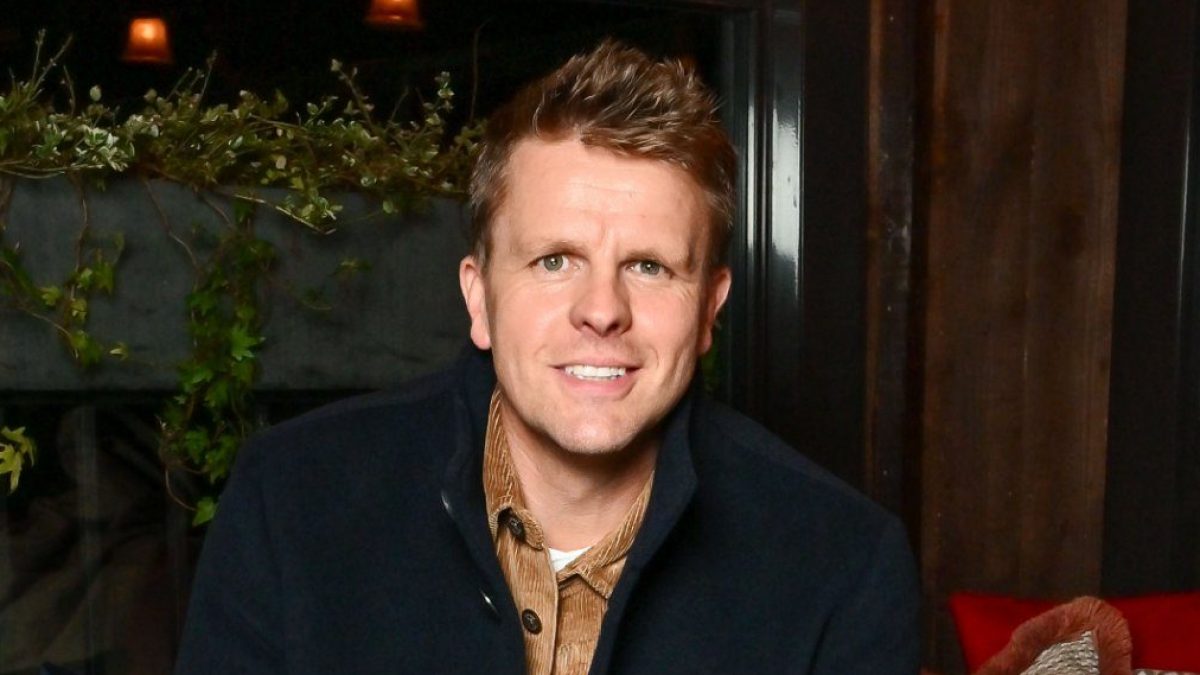
To celebrate the wedding of Prince William and Kate Middleton, back in 2011, the Royal Air Force laid on a full military flypast. Among those planes was a Lancaster bomber, whose manifest included a young BBC presenter, Jake Humphrey. Humphrey had graduated from the corporation’s children’s channel and was increasingly deployed for their sports coverage. But as the plane approached London, he lost contact with BBC HQ. He delivered his monologue three times, but nobody heard it. “The Lord giveth, the Lord taketh away,” he wrote later of the experience. For a while, Humphrey felt like one of broadcasting’s nearly men. Off the back of hosting Bamzooki on CBBC, he was booked to lead the BBC’s Formula 1 coverage in 2009, but soon enough the Beeb began haemorrhaging the rights, with Sky becoming the sport’s main channel. At the 2012 Olympics, he was marginalised out at the velodrome, and the same year announced that he would be leaving for BT Sport, a new broadcaster that was buying up Premier League and Champions League rights. This brought him to bigger audiences but felt, at times, like an awkward fit. Viewers ribbed him for his tendency towards “Accidental Partridge” exchanges (like Steve Coogan’s character, Humphrey is from Norwich), while former footballers like David Ginola and Steven Gerrard seemed less than impressed with his attempts at banter. He became a bit of a social media joke, something that he described as like how he “felt when [he] got bullied at school”. And yet, a decade on from cruising aimlessly above London in a Second World War bomber disconnected from human civilization, Humphrey has refashioned himself as one of the UK’s top podcasters. His show, High Performance, began life in 2020. It paired him with Professor Damian Hughes and sought to interview top athletes, and other industry leaders, to discover their mindset techniques. In its opening salvo of episodes, he interrogated athletes like Rio Ferdinand, Tom Daley and Robin van Persie, as well as Ant Middleton (a former soldier who recently appeared alongside Tommy Robinson at the Unite the Kingdom rally) and Steven Bartlett, a podcaster who has been accused of spreading medical misinformation. It has proved a potent combination, turning the podcast into one of the country’s most popular outlets, and leading to a spin-off book, High Performance: Lessons from the Best on Becoming Your Best. Humphrey doesn’t fit the stereotype of men who are successful in sports podcasting. They are usually former pros, people who have been hugely successful on the field. They have big and active fanbases. And, crucially, they often trade in controversial, contrarian takes, provoking fierce debate and stirring up social media anger. Humphrey brings none of these things. Humphrey started his career presenting Bamzooki on CBBC (Photo: BBC/Simon Duncan) “Jake is a really good example of the opposite of that stereotype,” says Mike Carr, CEO of Crowd Network, one of the UK’s top publishers of sports podcasts. “He spent years building trust and recognition as a broadcaster, and that gave him a huge advantage when he moved into a direct-to-audience environment.” Where podcasts and YouTube channels have tended towards shouty clickbait, whether that’s pitting Lionel Messi and Cristiano Ronaldo against one another or suggesting that Manchester United/Spurs/Chelsea/Liverpool are locked in some permacrisis, Humphrey has remained a voice of calm. It is a tone that grates with a lot of people. He is a frequent sight on the popular Reddit forum LinkedInLunatics, where he is lampooned for his corporate jargon. “We made it. You and I,” he wrote on LinkedIn, earlier this year. “You are the end of an unbroken chain of near-misses stretching back thousands of years.” In another post, he describes conducting an end-of-year review with his wife of 25 years, Harriet. Among his key questions for Mrs Humphrey were: “Where did 2024 miss the mark for you?”, “What does a great 2025 look like?”, and “What are the things that currently light you up?” For some, he is a sign of the insidious invasion of tech-bro speech into normal life. For others, it is on a spectrum with the worst content on the internet. But it is hard to pin down precisely why Humphrey grates with so many listeners. He largely eschews controversial guests and topics, preferring the easy stories of triumphing over adversity that are often present in sports narratives. “Jake recognised an opportunity early,” says Jim Salveson, director of sport at the Sport Social Podcast Network. “Through High Performance, he used his access to elite athletes and high-achieving individuals as a launchpad into a broader conversation around leadership, personal development and performance.” It has turned Humphrey’s podcast into a leading forum for conversations about modern masculinity. “I can look back 20 years to when there were practically no conversations in public about mental health,” says Iain Macintosh, a veteran football pundit and now CEO of Track Radio. “It is, societally speaking, ‘a good thing’ that we have these platforms that, when used responsibly, can do a great deal of good.” Here, however, Humphrey’s approach seems conflicted. Much of his work revolves around overcoming the obstacles of your upbringing (he is famous for posting his A-level results – a U, an N, and an E – on results day) by advocating hard work and a rigorous schedule. He sets his alarm for 5am and starts the morning with water, vitamins and then “planning a list for that day”. He calls these tips the “World Class Basics” yet they fly in the face of much of modern mental health discourse, which focuses on compassionate and bespoke responses to the world. “Try not to allow excuses to tell you it isn’t possible,” he wrote in a viral post on LinkedIn. “I have 2 kids, 4 jobs, work for 2 charities, and still manage it.” As a sentiment, it is not far from influencer Molly-Mae Hague’s notorious proclamation that “we all have the same 24 hours in a day”. Jake Humphrey presenting F1 coverage for the BBC at the Hungarian Grand Prix in 2011 (Photo: Mark Thompson/Getty) Away from the steadying influence of the BBC or BT, Humphrey has leaned into his persona as a painfully earnest lifestyle guru, unlocking a formula that is proving enormously popular – and lucrative. “The opportunity isn’t necessarily to leave traditional media behind,” says Carr. “It’s to take the audience and credibility you’ve built there and develop something of your own around it.” More and more, talent from legacy media companies is being drawn to the creative autonomy and financial rewards of digital media. “The smartest sporting talent have realised they’re no longer applying for shelf space in someone else’s supermarket,” judges Salveson. “They’re building their own shop.” Last week saw the launch of a new Disney+ show, Stick to United, co-hosted by Manchester United legend Wayne Rooney and Mark Goldbridge, a YouTuber who became famous for his red-faced, irate rants about the club. At the same time as Goldbridge was graduating to the House of Mouse, fellow football YouTuber John Nellis was announced as the latest “celebrity” to be joining the autumn series of Strictly Come Dancing. In sports media, the line between the men and women working for traditional broadcasters and “content creators” has never been more porous. It flows both ways: armchair pundits from podcasts, YouTube or TikTok becoming household names, and mainstream presenters seeking the quick returns of online platforms. That can be very seductive. “You get to do the show that you want to do, rather than the show that the producers want to do,” says Macintosh. “And if you do it well, you get the win. You get the money.” There is no doubt that Humphrey is among the legion of podcasters currently getting filthy rich by offering easy answers to unmoored young men. In America, this has festered, creating the toxic podcasts bros – Lex Fridman, Logan Paul, Joe Rogan, Andrew Schulz, and Theo Von – who rallied round Donald Trump’s bid for re-election. Humphrey is a milder sort of bro. But his obsessive self-starter “grindset” is on a continuum with writers such as Jordan Peterson who have advocated for reclaiming masculinity through structure and endeavour. In his earnest LinkedIn posts and breathless Instagram reels, Humphrey comes across like a Middle Englander attempting to peddle a cult of productivity.
How Jake Humphrey turned his Accidental Partridge routine into millions
Full Article
Original Source
Read the full article at Inews →KhanList aggregates and links to publicly available news content. We do not host full articles from third-party sources. Always verify important information with original sources.