
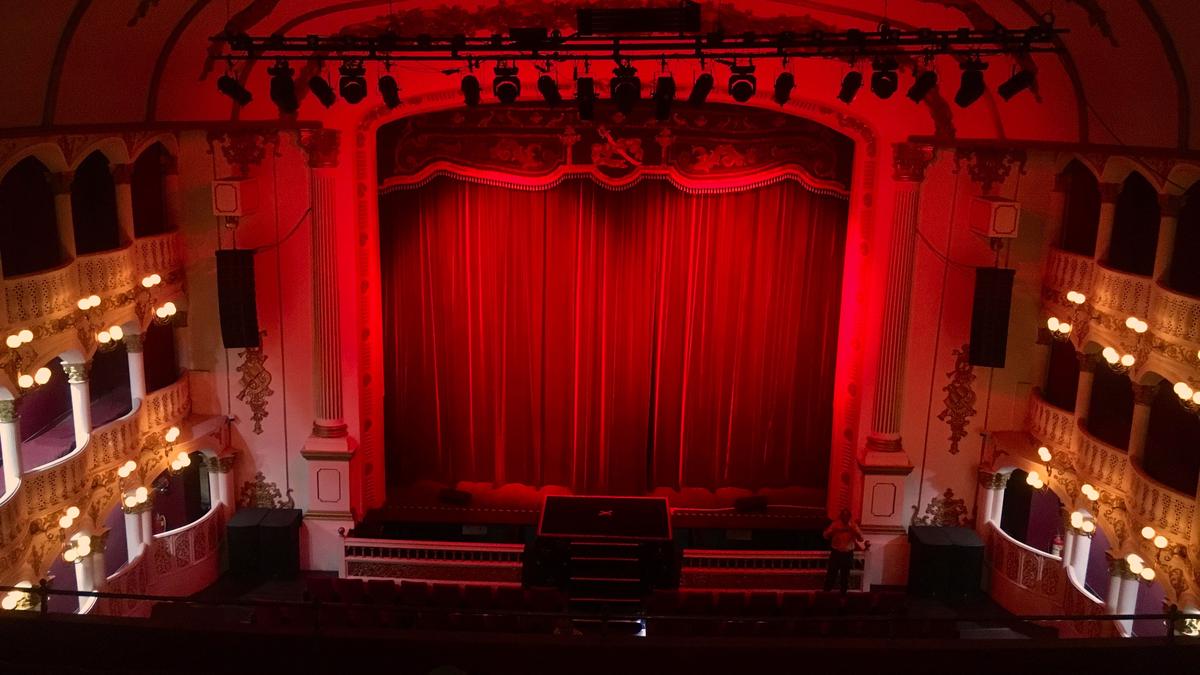
Mumbai’s Royal Opera House has had quite a dramatic life. Conceived in 1908 by Maurice Bandmann (a well-known entertainer from Kolkata) and Jehangir Framji Karaka, who headed a coal-broking firm, the grand edifice was inaugurated in 1911 by King George V and completed in 1916. Once celebrated as Mumbai’s cultural crown jewel, it gradually suffered neglect and lay in ruins. And, finally, in 1991, India’s only surviving opera house shut down. The Opera House initially catered to Mumbai’s elite, including British officials, Europeans and affluent Indians. | Photo Credit: Special Arrangement In 2010, its restoration was commissioned by Jyotendrasingji of the erstwhile royal family of Gondal in Gujarat, which has owned the Royal Opera House since the 1950s.The work was entrusted to conservation architect Abha Narain Lambah, who, over six years, gave the building a new lease of life while retaining much of its original structure and architectural grandeur, including the side balconies and exquisite ceilings. It accommodates 575 seats across three levels — Royal Stalls, Dress Circle and Grand Balcony. Constructed in Baroque style, the Opera House, which acquired the prefix ‘royal’ following King George V’s visit to Bombay, featured Italian balustrades, Corinthian columns, marble statues, ornamented gold ceilings, Minton tiled flooring and crystal chandeliers. Ornamented gold ceilings, Minton-tiled flooring and crystal chandeliers define its opulent interiors. | Photo Credit: Special Arrangement Initially conceived as a venue for opera, the Opera House catered largely to Mumbai’s elite — British officials, Europeans and a cosmopolitan section of Indians. Subsequently, it opened its doors to Indian musicians and theatre personalities such as Bal Gandharva, Krishna Master, Bapu Pendharkar, Master Dinanath, Jyotsna Bhole and Prithviraj Kapoor. In 1925, British Pathe, a producer of newsreels and documentaries, rented it for screening its films. Also, with the entry of ‘talkie’ movies in the early 1930s, the popularity of cinema increased. In 1935, Ideal Pictures acquired the theatre and renovated it. But, some decades later, the growing popularity of home video and the decline of single screen cinemas gradually took their toll. And the Opera House eventually shut down.Today, the Gondal royal family’s descendants, Himanshusinghji and Kumud Kumari, with the support of honorary director Ashish Doshi, oversee the activities of the Royal Opera House, which recently celebrated its 10th anniversary of its renovation. The event was marked by a musical programme, curated and led by Vishal Shah. The show brought together Bollywood hits and classical and contemporary music. Asad Lalljee. | Photo Credit: Special Arrangement Speaking about the restoration, Asad Lalljee, curator of the Royal Opera House and CEO of Avid Learning, said, “It has supported the creative economy, bringing prominence to not just our building, but to the neighbourhood that goes by the same name.” He added that over the past decade, the venue had hosted a diverse range of events, which included music, theatre, dance, literature, cinema, architecture, heritage, children’s programmes, cultural diplomacy and conversations on contemporary issues.In the next decade, Lalljee hoped to expand international collaborations, develop more interdisciplinary programmes and explore new possibilities at the intersection of art, technology and design. “Equally important is strengthening our engagement with younger audiences and building deeper partnerships,” he said, underscoring the Royal Opera House’s significant role in shaping the city’s cultural sensibilities.
How India’s only opera house became a hub for diverse cultural activities
Full Article
Original Source
Read the full article at Thehindu →KhanList aggregates and links to publicly available news content. We do not host full articles from third-party sources. Always verify important information with original sources.