
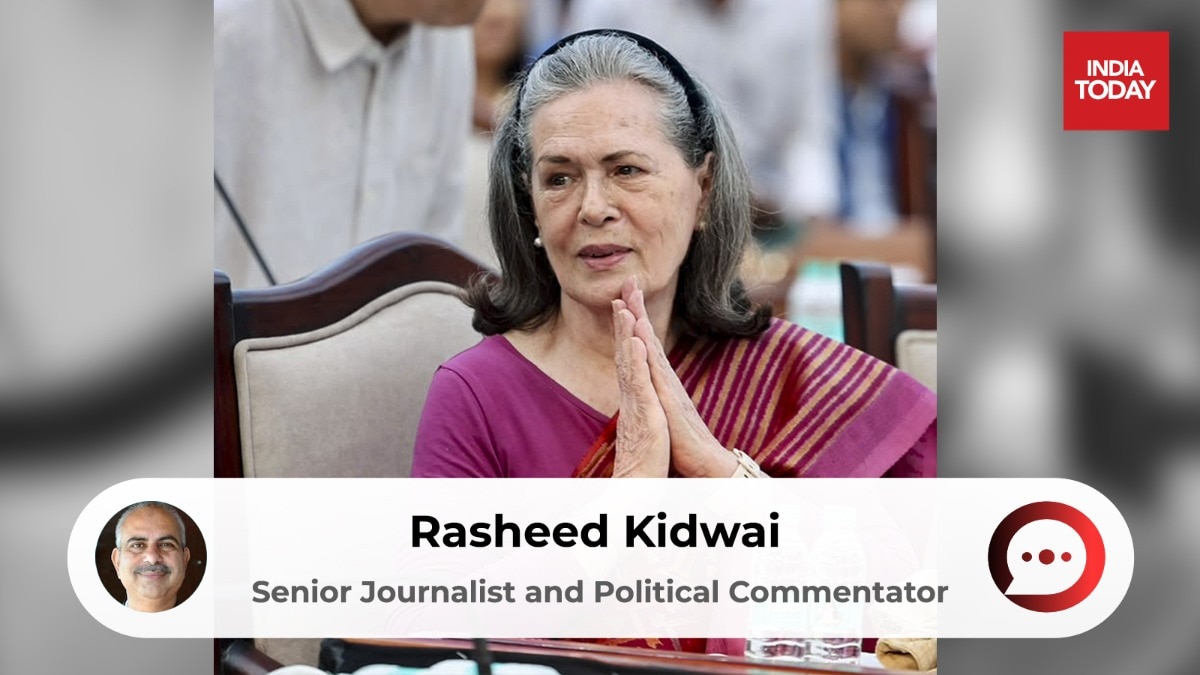
There is an old problem with political memoirs in India. Those who have nothing to lose are often willing to tell everything, while those who have something at stake must weigh every revelation against its possible consequences. Sonia Gandhi belongs firmly to the second category.Her memoir, Belonging:A Journey of Love, is, therefore, an unusual undertaking. Sonia is not a retired politician settling accounts with history. She remains chairperson of the Congress Parliamentary Party. Her son, Rahul Gandhi, is Leader of the Opposition in the Lok Sabha, while her daughter, Priyanka Gandhi Vadra, is a member of Parliament. Every observation she makes about the past is liable to become ammunition in a contemporary political battle.That is what makes Belonging, which hit the shelves on November 10, both compelling and hazardous.With Assembly elections due in Uttar Pradesh and Punjab in 2027, two states where the Congress carries a particularly complicated historical baggage, Sonia’s revelations threaten to reopen controversies that the party has neither satisfactorily explained nor entirely escaped.THE PERILS OF REMEMBERINGThe most affecting passages made public so far concern the two assassinations that transformed Sonia’s life. In an extract published by The Guardian, Sonia recalls the morning of October 31, 1984, when Indira Gandhi was shot by her own security guards. Sonia’s account of accompanying her bleeding mother-in-law to the hospital is remarkable for its immediacy. Hours later, Rajiv Gandhi tells Sonia that he has been asked to become Prime Minister. She pleads with him to refuse. His reply is devastating: “They will kill me anyway.”Seven years later, her worst fear comes true. These passages offer a glimpse of a Sonia Gandhi largely concealed behind the public image of a reserved, disciplined, and occasionally inscrutable politician. Her reluctance to enter politics, so often dismissed by critics as a carefully cultivated posture, acquires a different meaning when viewed against this history of personal loss.But a memoir cannot be judged only by its emotional candour. Sonia's private memories are inseparable from events that continue to divide the country.Take the Emergency. Sonia now describes Indira Gandhi’s decision to impose it in June 1975 as a mistake. She recalls Rajiv opposing the move even as Sanjay Gandhi urged his mother towards confrontation. In the book, she suggests that “keeping Sanjay in check could have prevented much of the damage that followed.”It's an important admission, yet the real difficulty lies elsewhere. Once a political memoir begins distinguishing between personal intentions and political consequences, it invites similar scrutiny to other episodes. If Indira’s actions must be examined independently of Sonia’s affection for her, the same principle must apply to Rajiv Gandhi, Narasimha Rao, and the Congress itself.Nowhere is that test more demanding than in Ayodhya.THE TEARS OF DECEMBER 6Sonia's admission that she wept while watching the demolition of the Babri Masjid on television on December 6, 1992, has already attracted political attention.In her interview with The Guardian, she recalls recognising that India faced “a long battle” to preserve the secular ideals associated with Mahatma Gandhi, Jawaharlal Nehru, and the freedom movement.The BJP’s response was swift. Its spokesperson, Sudhanshu Trivedi, accused the Congress of continuing to identify with Babur, turning Sonia’s expression of grief into another confrontation over the party’s attitude towards Hindu sentiment. The exchange is a foretaste of the political difficulties that her memoir could create as Uttar Pradesh approaches the Assembly elections.From a non-partisan perspective, there is little reason to question the sincerity of Sonia’s anguish. Indeed, her reaction was consistent with the position she took at the time.As chairperson of the Rajiv Gandhi Foundation, Sonia insisted on issuing a strongly worded statement condemning the demolition, overruling reservations expressed by P Chidambaram and others who felt the organisation should avoid entering into a contentious political dispute.For Sonia, December 6 was more than a national calamity. It was among her earliest public assertions of a political position after Rajiv’s assassination. But there is a distinction between the sincerity of an individual’s response and the consistency of a political party’s conduct.The Congress, for its part, has never satisfactorily resolved its contradictions over Ayodhya.Rajiv Gandhi’s government permitted the unlocking of the disputed site's gates in 1986, although the decision was formally taken by a court. In 1989, the political handling of the shilanyas, or foundation-laying ceremony, added another layer of controversy. Rajiv also invoked the ideal of Ram Rajya during that year's selection campaign.Indeed, Rajiv began his 1989 Lok Sabha election campaign in the Ayodhya-Faizabad area with the promise of Ram Rajya, seeking to appeal to Hindu religious sentiment at a time when the Ram Janmabhoomi movement was gathering momentum.Three years later, the Babri Masjid was demolished while a Congress government headed by Narasimha Rao ruled at the Centre and Kalyan Singh’s BJP government held office in Uttar Pradesh.The BJP bore direct political responsibility for the mobilisation that culminated in the demolition, and the Uttar Pradesh administration failed to protect the structure. But the question of whether Rao could have intervened earlier has continued to divide Congress leaders and historians.Sonia’s tears cannot, by themselves, resolve that argument. Nor can the party’s repeated expressions of regret substitute for a coherent account of its own decisions.NARASIMHA RAO'S DEFENCE FROM BEYOND THE GRAVEThere is a certain irony in the fact that Sonia Gandhi’s memoir has reopened an argument that another Congress leader sought to settle from beyond the grave.The controversy acquires another dimension when viewed through Rao’s posthumously published book, Ayodhya:6 December 1992.Published in 2006, more than a year after his death, Rao’s account was a pointed rejoinder to those who had held him responsible for failing to protect the 16th-century mosque. “Brave words are being said after the event and people look like sages who knew everything beforehand,” Rao wrote. He accused his critics of adopting a convenient posture, driven by “political and vote-earning considerations”.In the chapter titled “The Building Blocks of Dispute”, Rao alleged that some unnamed Congress leaders had calculated that if his consultations with the Vishwa Hindu Parishad and Rashtriya Swayamsevak Sangh succeeded in averting the crisis, they could share the credit. If they failed, they would have an excuse to turn against him. In Rao’s memorable formulation, they were playing “either for success or an alibi”.Arjun Singh, Rao’s cabinet colleague and longstanding critic, subsequently became one of the most prominent voices accusing him of failing to prevent the demolition. Rao, in turn, regarded such criticism as politically motivated.There is another uncomfortable element. Rao’s account also revisited Rajiv Gandhi’s handling of the 1989 shilanyas, arguing, on the basis of official records, that it had taken place on undisputed land. The distinction was central to the defence of Rajiv’s decisions, but it did little to settle the larger question of whether the Congress had encouraged competing religious expectations for electoral advantage.Sonia’s position on Ayodhya is clear in moral terms. The difficulty is that the Congress’s political record is much murkier.The party cannot indefinitely treat Ayodhya as a dispute between Rao’s alleged failures and the Gandhi family’s secular convictions. Its history is more complicated than that.THE DOCTRINE THAT CONGRESS NEVER WROTEAccording to Sonia’s earlier recollections, Rajiv had told her shortly before his assassination in May 1991 that he would physically stand before the Babri Masjid to prevent its destruction, even at the cost of his life. In a rare television interview in 2004, Sonia returned to December 6, recalling that the demolition had brought not merely tears but profound distress.Sonia’s intervention during the 1998 general election campaign, including her expression of regret over the demolition, failed to deliver the anticipated electoral dividends. The then Congress president, SitaramKesri, even reportedly complained that the party had lost in many constituencies where she had campaigned.Successive assembly and Parliamentary elections in Uttar Pradesh have demonstrated that expressions of anguish over Babri, no less than invocations of Ram Rajya, have failed to restore the Congress’s once-formidable coalition of Hindu and Muslim voters. Even in Muslim-dominated constituencies, the party has struggled to regain its former standing.Today, the challenge is even greater. The Supreme Court’s 2019 Ayodhya judgment, the construction of the Ram temple, and its consecration in January 2024 have fundamentally altered the political landscape.Rahul Gandhi has periodically emphasised his Hindu faith, visited temples, and invoked his Kashmiri Pandit ancestry. He has presented himself as a Shiv bhakt and publicly discussed his gotra,a sacred marker of Hindu lineage. Simultaneously, he has sought to defend constitutional secularism and minority rights.There is nothing inherently contradictory about religious belief and secular politics. The difficulty arises when voters cannot distinguish a party’s convictions from its electoral adjustments.This is the dilemma facing the Congress in Uttar Pradesh in 2027. The BJP can invoke the completion of the Ram temple as evidence of a promise fulfilled. The Samajwadi Party has consolidated much of the anti-BJP political space, including significant Muslim support. The Congress must persuade Hindu voters that its commitment to secularism is not hostility towards their faith, while convincing minorities that its defence of constitutional rights is neither conditional nor opportunistic. Sonia’s revelations risk placing the party once again between these competing expectations.Punjab presents a different, but no less formidable, historical challenge.Sonia’s criticism of the Emergency, her recollections of Indira Gandhi’s assassination, and the larger Nehru-Gandhi legacy inevitably touch upon painful memories of Operation Blue Star and the anti-Sikh violence of 1984. The Congress’s adversaries, particularly the BJP, the Aam Aadmi Party, and the Shiromani Akali Dal, have ample political incentive to revisit these episodes. In a state where the Congress has been in power more recently than in Uttar Pradesh, such historical controversies could complicate an already demanding attempt to regain office.In the broader context, the Congress needs an Ayodhya doctrine: not another exercise in competitive religiosity, nor a retreat into defensive silence, but a coherent position that respects religious faith while unequivocally defending constitutional equality and the rule of law.Privately, many Congress leaders would prefer to avoid the ghosts of Babri Masjid and Ram Janmabhoomi altogether. But this ostrich-like approach has yielded little. The party would do well to convene a special session of the All India Congress Committee, listen to its grassroots workers, and arrive at a clear political resolution on Ayodhya. It needs to explain not merely what it opposed in 1992, but what its tands for in 2026.This is the paradox of Belonging. Its greatest strength may also be its greatest political liability.Sonia is entitled to tell her story as she remembers it, with all the pain, affection, and convictions that have shaped her life. But she cannot determine how that story will be received, or how her political adversaries will use it.As the fallout from the memoir gathers momentum, the Congress must learn to distinguish between defending its legacy and defending every decision made in its name.Ultimately, Sonia Gandhi’s memoir raises a question larger than the fortunes of one family. Can a political party acknowledge its failures without surrendering its convictions? Can it reconcile the memories of those who led it with the judgments of those who lived through the consequences?Sonia has begun the difficult business of remembering. The Congress must now undertake the more demanding task of reckoning.- Ends(Views expressed in this piece are those of the author and do not necessarily reflect the views of the publication)
The past is never past in Sonia Gandhi's India
Full Article
Original Source
Read the full article at Indiatoday →KhanList aggregates and links to publicly available news content. We do not host full articles from third-party sources. Always verify important information with original sources.